
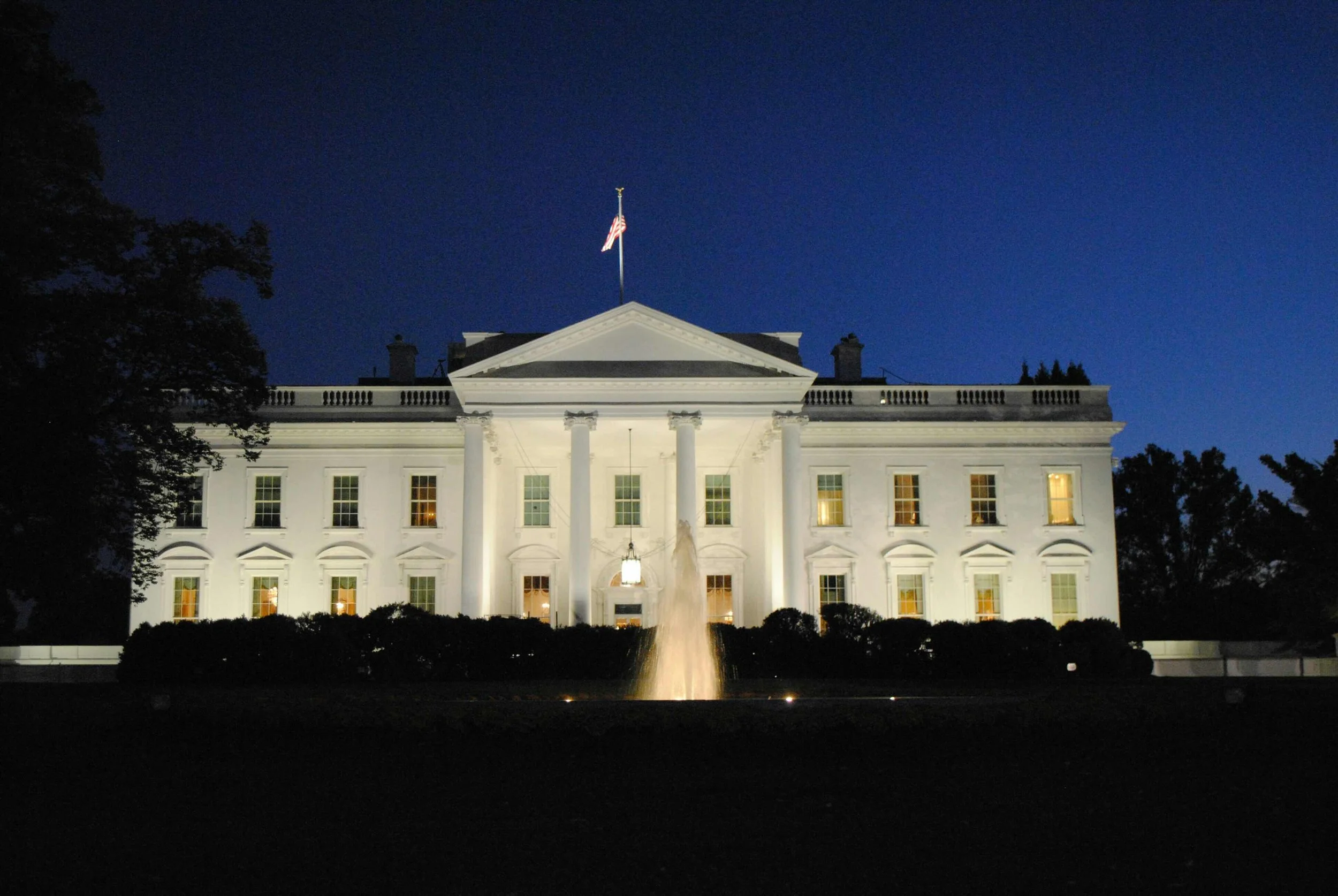
The White House has issued an executive order aimed at curbing the implementation of state AI laws. (Photo by Tabrez Syed on Unsplash.)
Dec. 11, 2025 — Earlier today the White House issued an executive order aimed at curbing the implementation of certain state AI laws. The order, Ensuring a National Policy Framework for Artificial Intelligence, has been expected for some time. It is a lighter version of the state AI law moratorium proposed but ultimately scuttled during Congressional debate in early July over the One Big Beautiful Bill spending package.
The President’s order is not a new law; it merely establishes his Administration’s policy on certain AI matters.
What does today’s executive order say?
The actions within today’s executive order include:
The establishment of an AI Litigation Task Force within the Department of Justice, charged with challenging state AI laws “inconsistent with [the White House’s AI policy].
The publication of a report by the Commerce Department evaluating existing state AI laws, and identifying “onerous laws that conflict with [White House AI policy].” This report should be published within 90 days—around early March 2026.
The potential loss of some federal funding for states under the Broadband Equity Access and Deployment (BEAD) Program, tied to a state’s AI laws.
A demand that federal departments and agencies assess their discretionary grant programs to determine whether agencies may condition those grants on state AI laws, as those laws align or conflict with White House AI policy.
An order tasking the Chairman of the Federal Communications Commission (FCC) with determining whether to adopt a federal reporting and disclosure standard for AI models that preempts existing state AI laws.
A request asking the Chairman of the Federal Trade Commission (FTC) to issue a policy statement on the application of the FTC Act’s prohibition on unfair and deceptive acts or practices. “That policy must explain the circumstances under which state laws that require alterations to the truthful outputs of AI models are preempted” by the FTC Act.
The White House’s Special Advisor for AI and Crypto and the Assistant to the President for Science and Technology shall jointly prepare a legislative recommendation establishing a uniform federal policy framework for AI that preempts state AI laws that conflict with White House policy.
Those legislative recommendations shall not propose preempting state AI laws that relate to child safety protections; AI compute and data center infrastructure; and state government procurement and use of AI.
It’s important to know what the order does, what it doesn’t do, and what still remains unclear.
The most helpful legal analysis we’ve found was published recently by Charlie Bullock of the Institute for Law & AI. We offer an edited and condensed version of Bullock’s work here.
What is an executive order? What power does it have?
An executive order is not a Congressionally enacted statute or law. While Congress has the authority to preempt some state AI laws by passing legislation, the President generally cannot unilaterally preempt state laws by presidential fiat.
An executive order announces the policy goals of the executive branch of the federal government, and can also contain directives from the President to executive branch officials and agencies.
Think of it as establishing enforcement policy, not law.
What is an ‘ai litigation task force’?
The executive order instructs the U.S. Attorney General to create an AI Litigation Task Force to bring lawsuits in federal court to challenge allegedly unlawful state AI laws.
In other words, Justice Department lawyers who would otherwise investigate and prosecute other cases will instead be tasked with challenging specific state AI laws that are already in effect or are about to take effect.
On what grounds would these state laws be challenged?
The executive order suggests that the Task Force will challenge state laws that allegedly violate the dormant commerce clause and state laws that are allegedly preempted by existing federal regulations. The Task Force is also authorized to challenge state AI laws under any other legal basis that the Department of Justice (DOJ) can identify.
It’s important to note that tech companies and individuals are free to file similar challenges to state AI laws in federal court. None have done so to date.
Would such a challenge succeed?
The Institute for Law & AI’s Charlie Bullock offers a full analysis on LawAI’s website. We’ll distill his arguments here.
‘Dormant commerce clause’ challenge
This argument, which a number of commentators have raised in recent months, suggests that certain state AI laws violate the commerce clause of the U.S. Constitution because they impose excessive burdens on interstate commerce.
LawAI’s analysis indicates that this commerce clause argument, at least with respect to the state laws specifically referred to in the executive order, is unlikely to succeed in court.
In 2023, the Supreme Court issued an important dormant commerce clause opinion in the case of National Pork Producers Council v. Ross. The thrust of the majority opinion in that case, authored by Justice Gorsuch, is that state laws generally don’t violate the dormant commerce clause unless they involve purposeful discrimination against out-of-state economic interests in order to favor in-state economic interests.
Andreessen Horowitz (A16Z), the venture capital firm that has been vigorously fighting AI bills in state legislatures, recently issued a paper laying out the dormant commerce clause challenge. “Congress should govern the national AI market and states should police harmful uses of AI within their borders,” they wrote.
Most state AI laws adopted in the past two years have been written to police harmful uses of AI within their borders, but the A16Z paper argues that the state proposals of greatest concern to tech companies, such as New York’s RAISE Act, “purport to have significant safety benefits for their residents,” but in fact “are unlikely” to provide substantial safety benefits.
LawAI’s Charlie Bullock disagrees. He writes that this is, transparently, a policy judgment. As Justice Gorsuch observes in Ross, “policy choices like these usually belong to the people and their elected representatives. They are entitled to weigh the relevant ‘political and economic’ costs and benefits for themselves, and ‘try novel social and economic experiments’ if they wish.” New York voters overwhelmingly support the RAISE Act, as did an overwhelming majority of New York’s state legislature. It’s unlikely that a federal court would override those policy judgments and substitute its own.
Federal preemption of state law
It’s possible for state laws to be preempted by federal regulations, and it’s possible that the DOJ Task Force will eventually succeed in invalidating some state laws by arguing that they are so preempted.
In the absence of significant new federal AI regulation, however, it’s doubtful whether many of the state laws the executive order is intended to target will be vulnerable to this kind of legal challenge. Moreover, any state AI law that created significant compliance costs for companies and was plausibly preempted by existing federal regulations could be challenged by the affected companies, without the need for DOJ intervention. The fact that no such lawsuit has yet been filed challenging the most notable state AI laws indicates that the new Task Force will likely be faced with slim pickings, at least until new federal regulations are enacted and/or state regulation of AI intensifies.
Alternative grounds
The executive order authorizes the DOJ Task Force to challenge state AI laws that are “otherwise unlawful” in the Attorney General’s judgment. It’s impossible to say for sure what theories DOJ lawyers might come up with to challenge state AI laws. But it would be surprising if the Task Force managed to come up with a legal argument for preemption that has been overlooked by everyone who’s considered this issue.
What federal funding would be threatened or withheld?
The executive order contains two subsections that concern efforts to withhold federal grant funding from states that attempt to regulate AI.
The U.S. Department of Commerce may attempt to withhold non-deployment Broadband Equity Access and Deployment (BEAD) funding “to the maximum extent allowed by federal law” from states with the types of AI laws the White House finds onerous.
The executive order instructs all federal agencies to assess their their discretionary grant programs and determine whether existing or future grants can be withheld from states with AI laws that are identified as undesirable by the White House.
What is ‘non-deployment bead funding’?
The Broadband Equity Access and Deployment (BEAD) program is a federal program meant to bring high-speed internet connections to Americans in rural areas. Congress created the program in late 2021 as part of the Infrastructure Investment and Jobs Act.
Each state has been allocated a portion of BEAD’s total $42 billion in available funding. Nearly all of that funding is dedicated to “deployment,” which encompasses the actual wire connecting, ditch digging, cable laying, and all that.
There is a relatively small portion of BEAD money available under the category of '“non-deployment funding.” This covers activities like cybersecurity and privacy training, signup assistance and tech support, and remote learning.
The executive order is clear: BEAD funding to deploy high-speed internet connections to rural areas are not affected by a state’s AI laws. Only funding for non-deployment programs would be threatened by the executive order.
It’s also important to note that those non-deployment programs do not yet exist. States and the Department of Commerce’s National Telecommunications and Information Administration (NTIA), which administers the BEAD program, are currently in the final stages of proposal submissions and acceptances.
other discretionary funding
The executive order instructs agencies throughout the executive branch to assess whether they can, essentially, deny certain discretionary grants to states based on a state’s non-compliance with White House policy on AI laws.
The legality of this course of action, and its likelihood of being upheld in court, is difficult to determine.
The federal government distributes about a trillion dollars a year in grants to state and local governments, and more than a quarter of that money is in the form of discretionary grants (as opposed to grants from mandatory programs such as Medicaid).
Ultimately, further research is needed to determine how much state grant funding, if any, is legitimately at risk.