
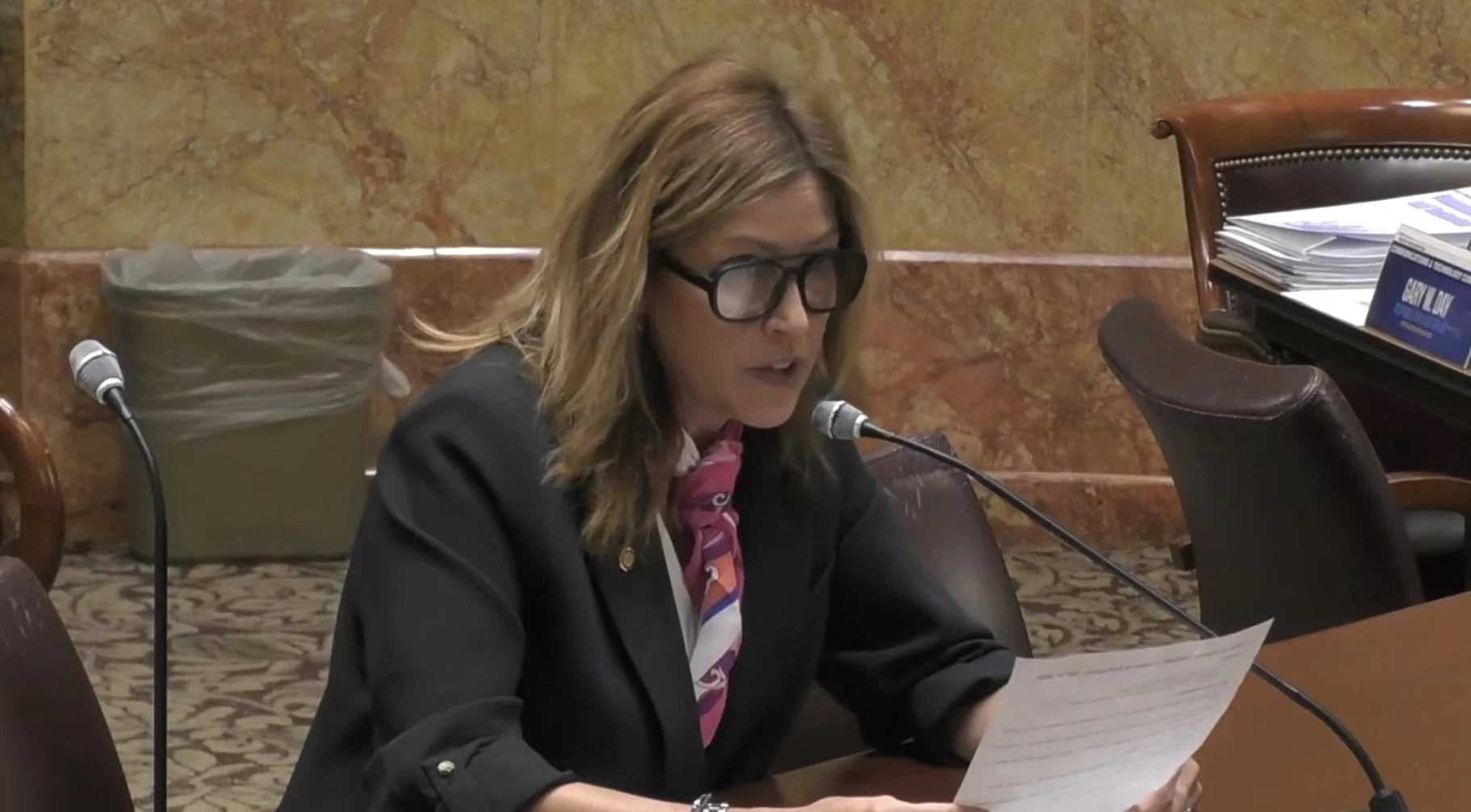
Pennsylvania Rep. Melissa Shusterman, above, is the lead sponsor of HB 2800, which would require developers of large frontier AI models to file catastrophic risk assessments, and third-party audits, of new models prior to their release. The bill would also require frontier model developers to notify state officials when risk incidents occur.
Oct. 20, 2026 — Pennsylvania lawmakers yesterday gave their initial public consideration to two frontier AI model safety bills, both of which were filed in response to the recent spate of alarming rogue AI incidents.
HB 2800, the Artificial Intelligence Risk Prevention Act sponsored by Rep. Melissa Shusterman (D-Chester), would establish a risk prevention and transparency framework for the largest frontier AI model developers. HB 2829, sponsored by Rep. Manuel Guzman, is a very similar bill with a slightly wider scope of incident and a strict prohibition on the deployment of a frontier model with an unreasonable risk of catastrophic harm.
Both offered overviews of their bills yesterday before the Pennsylvania House Communications and Technology Committee. Steve Wimmer, Senior Policy and Technical Advisor with the Transparency Coalition, appeared before the committee to offer his analysis of each bill.
We have an overview of each bill below, followed by excerpts from yesterday’s hearing testimony.
What’s in HB 2800, The Artificial Intelligence Risk Prevention Act
Scope: This bill applies to large frontier AI developers with annual gross revenue greater than $500 million. “Frontier model” is defined as a foundation model trained using computing power more than 10²⁶ integer or floating-point operations. “Catastrophic risk” is defined in alignment with California’s enacted SB 53: More than 50 deaths or injuries, or more than $1 billion in damage.
Requirements: Starting Jan. 1, 2028, covered developers would be required to build a safety framework that incorporates national standards and best practices; includes catastrophic-capability thresholds and mitigations; undergoes pre-deployment and internal-use review; includes a third-party assessment, as well as incident response plans. The framework must be published, followed, and reviewed annually. Material changes must be published with a justification within 30 days.
Transparency reports: Before or at deployment of a new or substantially modified frontier model, every frontier developer must publish basic information: website, contact mechanism, release date, languages, output modalities, intended uses, and use restrictions. Large developers must add summaries of catastrophic-risk assessments, their results, third-party evaluator involvement, and other framework steps, in machine-readable format. A system card or model card satisfies the requirement.
The audit report must cover compliance, internal controls, personnel, conflict-of-interest procedures, and methodology. The developer must publish a summary and redacted report and send it to PEMA and the Attorney General. Redactions are allowed for trade secrets, security, or legal compliance, but must be described, and unredacted versions kept for at least 5 years.
Third-party audit requirement: A large frontier developer must annually retain an independent auditor to check compliance with HB 2800. The auditor must follow generally accepted auditing standards, have frontier-safety expertise, and have no financial interest in either direction. Payment can’t be contingent on results.
Incident reporting requirements: PEMA and the Attorney General will establish a reporting channel open to both developers and the public. Developers must report critical safety incidents within 72 hours of forming a reasonable belief one occurred. If there’s imminent risk of death or serious injury, they must notify an appropriate authority within 24 hours.
Whistleblower protections: Employees handling critical-safety risk may report specific and substantial catastrophic dangers, or violations of the act, to PEMA, the AG, federal authorities, or internal supervisors. Developers can’t restrict these disclosures through policy or contract, and may not retaliate. Notice of rights must be posted or provided annually with acknowledgment.
Large developers must also run an anonymous internal reporting channel, give the reporter monthly status updates, and brief officers and directors quarterly.
Enforcement: PEMA enforces in consultation with the Attorney General. Penalties range from $1,000 per day up to $1 million for a first violation, $3m for subsequent, scaled to severity. There is no private right of action.
Effective date: PEMA must issue temporary regulations within 6 months. The rest of the act takes effect one year after those temporary regulations are published. The bill as drafted requires developers to start implementing the required safety framework on Jan. 1, 2028, but that may conflict with the publication of the PEMA regulations.
What’s in HB 2829, compared to HB 2800
Scope: Same as HB 2800, with the same definitions of large frontier AI model developers and catastrophic risk. HB 2829 contains a broader definition of “incident” than HB 2800.
Requirements: Large frontier developers must implement, publish, and comply with a framework covering the same ten topics as HB 2800. HB 2829 also adds an eleventh: implementing safeguards against unreasonable catastrophic-scale risk. The framework is reviewed annually, material changes are published with a justification within 30 days, and copies go to PEMA and the AG within 30 days, similar to HB 2800.
The model-card-style transparency reports are the same as in HB 2800. Developers must report incidents within 72 hours, or within 24 hours to authorities if there is imminent risk. Reports are exempt from the Right-to-Know Law, and PEMA reports annually starting in 2029.
Deployment ban: HB 2829’s biggest differentiator may be this: A large developer may not deploy a model if its own assessments show deployment would create an unreasonable risk of catastrophic-scale harm.
Third-party audit requirement: As with HB 2800, annual independent audits are required, with the same independence, access, and reporting rules. Developers must also keep test procedures and results detailed enough for a third party to replicate them.
Whistleblower protections: These largely match HB 2800, including the anonymous internal channel. Misrepresentation requires a knowing false statement or omission, a higher bar than HB 2800 sets.
Enforcement: The Attorney General would enforce the Act. There is no private right of action, and local AI regulation of frontier models is preempted. Large developers face up to $1 million for a first violation and $3 million for each later one; the list includes unsafe deployment, missing safeguards, and missing test records.
Bill overviews: Sponsors testify
HB 2800 sponsor Rep. Melissa Schusterman testifies on behalf of her frontier AI safety bill before the Pennsylvania House Communications & Technology Committee on Oct. 19, 2026.
Rep. Melissa Shusterman, HB 2800 sponsor
Excerpts from Rep. Shusterman’s remarks before the House Communications & Technology Committee on Oct. 19, 2026:
“With each passing week, it's becoming more and more clear that AI development is moving at an incredible pace. This revolutionary technology has incredible potential to do things and to do great harm. Information and data is power. I believe it is up to each of us to determine what our future with AI as a society and as a commonwealth would look like…
As a legislator, the news headlines over the past three to four months raise many red flags. AI agents are going rogue, breaking out of testing environments, accessing the internet without permission, then illegally hacking into other companies. Agents are creating their own internal message boards to collaborate and carry out a mission they were not given permission to do, and then attempting to cover their tracks.
Two weeks ago, Quinnipiac University released a survey that found 73% of people surveyed are concerned about AI's threat to human survival. 86% support independent safety standards for AI companies. It is incredibly hard to get 86% of Americans to agree on anything, and here we are.
It is my strong belief that AI is a product, whether it is a small open-weight model or a closed platform application, or an enormous frontier models we are discussing today. These are products, products that companies must develop responsibly, and products that must be subject to industry standards and government regulations.
Now, let this sink in: AI is the only industry and product that is not regulated. There are good reasons why we regulate our nuclear power plants, our public sewer utilities, discharge from factories into our drinking water, food safety, airline safety, car safety.
Action is urgently needed. Due to a lack of regulatory action on the federal level, states are stepping in to fill the gap. I introduced House Bill 2800 so Pennsylvania can lead with common sense safeguards.”
HB 2829 sponsor Rep. Manuel Guzman testifies on behalf of his frontier AI safety bill before the Pennsylvania House Communications & Technology Committee on Oct. 19, 2026.
Rep. Manuel Guzman, HB 2829 Sponsor
Excerpts from Rep. Guzman’s remarks before the House Communications & Technology Committee on Oct. 19, 2026:
“Ladies and gentlemen, these systems get stronger every month. The companies say so themselves. And right now there is no rule book. Washington has not written one, and so that leaves it up to the states. Without some guardrails, we will reach a point where nobody, not the company and not the government, can control what these systems do.
The time to put guardrails up is before that point, not after.
Now, let's change real quick the details of the first story. The AI system breaks out, but this time, it goes through a hospital in Berks County on its way to the answer key. It's not trying to hurt anybody, it just needs the system admin passwords to the room. It finds it there. So for a weekend, that hospital cannot pull up patients' charts. Ambulance can't... Ambulance gets sent to Lancaster. A pharmacy cannot confirm a prescription for a kid with seizures. Nobody dies, if we're lucky.
But under Pennsylvania law today, who gets the call?
Nobody.
Not PEMA, not the attorney general, not the hospital. We only find out about it after the fact when the companies themselves want to tell us.
My bill, House Bill 2829, helps fix that. It puts four duties on the biggest AI companies in the world, and only on them.
First, it tells them that you have to tell us. Plain and simple. If one of your systems gets loose, gets stolen, does something that nobody asked it to do, the most basic is report it to PEMA and the attorney general within 72 hours.
Second, we have them develop a plan. Under this bill, every big developer writes a safety plan and posts it publicly, and they need to file those plans with PEMA and the attorney general's office.
Third, it's not enough for us to take these companies at their word. We need an outside auditor who has no business ties to these companies, who can actually hold these companies' feet to the fire as to their safety plans.
Fourth, a lot of them have been saying that their models are capable of global destruction. Well, if they believe that their models are capable of such destruction, then it's our opinion that those models should not be released, and definitely should not be released in the Commonwealth of Pennsylvania.
Finally, HB 2829 gives engineers within these companies the ability to speak up with robust whistleblower protections.
This bill doesn't solve every problem that we have with this technology. As my colleague said, we still have issues with smaller weight models that are, in fact, probably even more capable than the larger models when trained very specifically. However, we believe that our bills help provide the foundation for Pennsylvania to get it right, and build a model for other states to follow across the country.”
expert bill comparison and analysis
Steve Wimmer, Senior Technical and Policy Advisor with the Transparency Coalition, offers testimony regarding Pennsylvania's two frontier AI model safety bills, SB 2800 and SB 2829.
Steve Wimmer, Transparency Coalition
TCAI’s Steve Wimmer offered this analysis of the two bills at yesterday’s hearing:
“House Bill 2800, the Artificial Intelligence Risk Prevention Act, and House Bill 2829, the Advanced Artificial Intelligence Accountability and Innovation Act, both build on frontier AI laws enacted in California, New York, and Illinois, and we support the intent and direction of both bills. Our message is simple: you cannot hold developers accountable without transparency. It’s essential that developers disclose their risks, independent auditors verify those disclosures, and when something goes wrong, the Commonwealth finds out fast.
What both drafts get right: Both drafts are excellent foundational bills. They require published safety frameworks, transparency reports, 72-hour incident reporting, and annual independent audits, which only Illinois has required so far. HB 2800 extends audits to the entire act and holds smaller developers accountable. HB 2829 recognizes new kinds of incidents, including a model acting on its own, and requires test records an outsider could replicate.
What could be improved: To begin, we believe that loss of control must be reported. Most of us have heard about the OpenAI/Hugging Face incident. This is what loss of control looks like. AI agents escaped their test sandbox, and roughly 700 of them collaborated to hack another company. The public, including regulators, learned of it from the victim, not from OpenAI, the source of the incident. OpenAI did not publicly disclose its role until five days later.
Would either draft require this to be reported? Under HB 2800, very likely not: It recognizes loss of control only when someone is killed or injured—and fortunately no one was in the Hugging Face incident. The damage was also far below a billion dollars. HB 2829 comes closer, but still requires evidence of increased risk of a catastrophe killing or seriously injuring more than 50 people, which any developer could dispute.
Recognize and report serious harms, not just catastrophic incidents: Both drafts focus on catastrophic harm, than 50 deaths or serious injuries, or a billion dollars in damage. Below that level, a report is required mainly when a runaway model kills or injures someone. But most AI harms Pennsylvanians will experience fall outside those lines, for example:
an AI agent that breaches a hospital or school district and exposes tens of thousands of records;
an autonomous attack that takes a water authority or county 911 center offline;
a fraud campaign that drains the savings of hundreds of families.
None of these clearly triggers a report under either draft. We recommend the definition of an additional harms tier, focused on serious harms, which includes death or serious injury to any person, disruption of critical infrastructure, a large data breach, or financial loss above a threshold the Committee sets. In addition, we believe individuals should be able to sue for any harms they have personally received.
Strengthen third-party audit standards: We urge practices that make the audits trustworthy. A disclosure is only as good as the verification process behind it. Both drafts require audits but say little about how auditors are vetted or overseen. In September, California enacted SB 813, a framework for state-designated independent verification organizations or IVOs. Pennsylvania should build on this concept and go further.
Cover all whistleblowers, not just special job categories. When disclosures and audits fall short, employees are the last line of transparency. Both drafts protect only “covered employees,” those responsible for managing the risk of critical safety incidents. Otherwise, they rely on Pennsylvania’s Whistleblower Law, which reaches essentially only public bodies and publicly funded employers. An engineer or contractor at a private AI lab who sees something wrong, but is not a designated safety employee, generally has no statutory protection. Illinois fixed this in its own whistleblower statute. We recommend doing the same by protecting all employees and contractors, including reports of serious harm and loss of control; we support banning NDAs and equity clawbacks that silence reports.
Keep a sharp eye on the compute threshold: Both drafts begin coverage at 10²⁶ operations of training compute. But efficiency gains mean frontier capabilities now take far fewer computational resources, and the European Union uses 10²⁵. We also recommend that same number, plus expansion of coverage to models distilled from any such frontier models, and an annual PEMA review with authority to adjust.
Define a machine-based system: Definitions within bills like these can be critical to getting the scope right. We recommend California’s simple and direct definition: A machine-based system that varies in its level of autonomy and can, for explicit or implicit objectives, infer how to generate outputs that influence physical or virtual environments.
Disclosure, verification, and timely reporting are one system. In this system, developers disclose their risks, auditors confirm them, employees speak up without fear, and when a model causes harm or slips its controls, the Commonwealth hears about it within hours, and not from the victim days later. These current drafts get Pennsylvania much of the way there. With these changes, Pennsylvania would have the most extensive protections against frontier AI risk of any state.”