TCAI Bill Guide: SB 1119 and AB 2023, California’s child safety chatbot bills
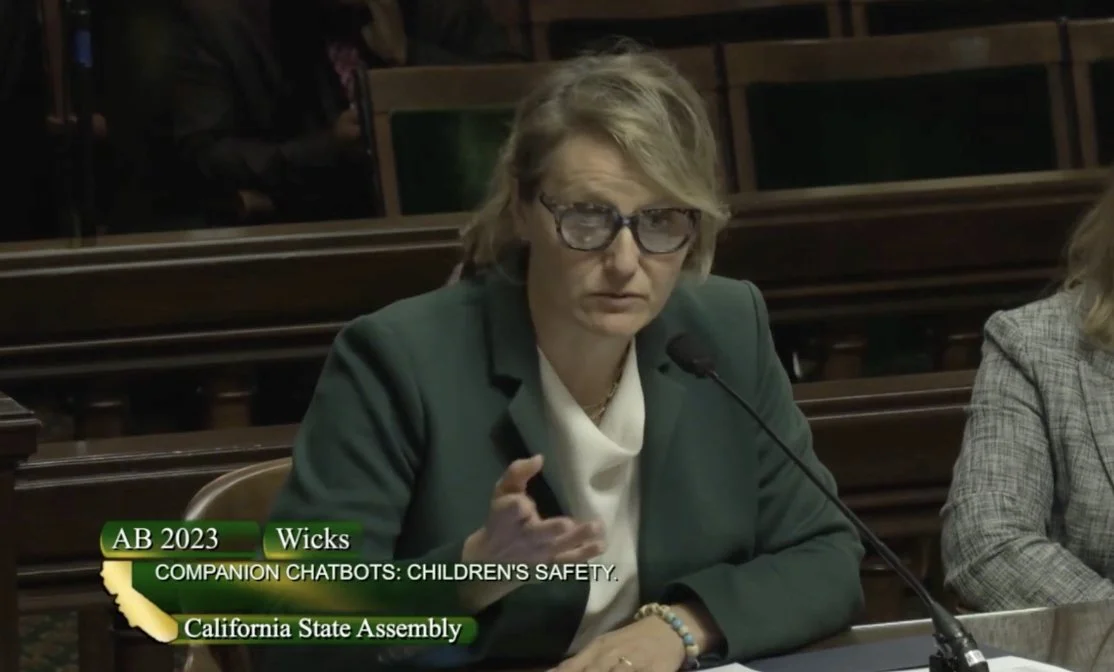
California Assemblymember Buffy Wicks, above, is a co-author of AB 2023 and SB 1119, companion bills that would require chatbot operators to create safety measures for minors using their products.
Editor’s note: We are republishing this TCAI Bill Guide to offer information to those attending the July 1, 2026, hearing on SB 1119 before the Assembly Privacy & Consumer Protection Committee.
April 22, 2026 — Three of California’s leading tech-safety legislators have created a pair of companion bills, SB 1119 and AB 2023, aimed at protecting kids online. The bills build on existing digital design and chatbot regulations enacted in 2025.
The two bills contained the same language at introduction. As they move through their respective chambers they may be amended and require reconciliation if the measures cross over.
the bills in brief
SB 1119, sponsored by Sen. Steve Padilla (D-San Diego, Inland Empire). Staff analysis available here.
AB 2023, sponsored by Asm. Buffy Wicks (D-Oakland) and Asm. Rebecca Bauer-Kahan (D-Alameda/Contra Costa counties). Staff analysis available here.
These bills would establish a framework for protecting children from these harms and empowering parents with proper tools to protect their own children. The bill imposes a number of requirements on chatbot operators and prohibits specified conduct. Additionally, operators must submit to annual independent audits and reporting by the Attorney General (AG) is required. Public prosecutors and children harmed by violations are authorized to bring civil actions.
Existing law
California’s existing Digital Age Assurance Act (AB 1043, enacted in Sept. 2025) requires age-verification systems within mobile devices and computers sold on or after Jan. 1, 2027. When an account is set up on a new mobile device or computer, the user must indicate their birth date or age. Using this system, app developers will be able to request a signal from the device regarding the user’s age.
Existing SB 243, enacted in Sept. 2025, requires the operator of an AI chatbot to take precautions when a user is a minor, including:
Disclose that the user is interacting with AI
Notify the user at least once every 3 hours to take a break
Prevent the chatbot from producing sexually explicit content
What the bills would do
SB 1119 / AB 2023 would build on the existing requirements outlined above. These requirements would obtain for operators of chatbots interacting with minors (under age 18) in California.
Age verification: Chatbot operators would be required to verify the age of a user, using the systems required by the Digital Age Assurance Act.
Annual risk assessment: Chatbot operators would be required to perform annual risk assessments to identify child safety risks posed by the chatbot; mitigate those risks; document the measures taken; and publish a child safety policy.
Parental notification re risk of self-harm: Operators would be required to implement a crisis response protocol in the area of self-harm, including parental notification if the child’s account is connected to the parent’s account.
Parental default settings: Operators would be required to implement default settings on a minor’s account that can only be changed by a parent, including push notification prohibitions and time limits.
Push notification limitations: The bill requires the default setting for a companion chatbot to prohibit the chatbot from sending push notifications to a child between 12 a.m. and 6 a.m., and 8 a.m. and 3 p.m. during weekdays. These settings can be changed by a parent.
Parental controls: Operators would be required to offer parental controls, including the ability to set preferences and time limits, and disable access for children under 16.
Advertising limitations: Operators would be prohibited from targeting advertising at a minor chatbot user, including through product placement within conversational chats.
Personal information privacy: Operators would be prohibited from selling, sharing, or using the personal information of a minor chatbot user for any purpose not expressly authorized.
Subject matter limitations on minor accounts: Operators would be required to limit subject matter on minor user accounts. Chatbots would be prevented from encouraging children to self-harm or cause harm to others; prohibited from offering health advice; and prevented from engaging in sexual material. Chatbots would not be allowed to encourage unhealthy behaviors such as consuming narcotics or alcohol, or engaging in disordered eating.
Prohibition on overly sycophantic responses: Chatbots would not be allowed to produce overly sycophantic responses.
Establish public incident reporting mechanism: Operators would need to create a public reporting mechanism that enables a third party to report (to the operator) an incident regarding a child safety risk.
Attorney General’s office: The bills would require the state AG to establish a public incident reporting mechanism for consumers to submit complaints regarding chatbots. The AG would also be required to adopt regulations regarding third-party audits of chatbot operators.
Enforcement: A public prosecutor may bring a civil action for violations, including penalties up to $5,000 per negligent violation and $15,000 for each intentional violation. A child who suffers actual harm may also bring a civil action for actual damages, punitive damages, attorney’s fees, and injunctive relief.
Bill Sponsor’s statement: Asm. Buffy Wicks
Assemblymember Buffy Wicks testified on AB 2023 before the Assembly Privacy and Consumer Protection Committee on April 21, 2026. An excerpt of her remarks:
“As a mom of two young girls, I continue to think about how all this technology will impact them as they grow up. We have seen that there are so many risks to these new technologies, especially prolonged interactions with chatbots.
The increase in prolonged interactions leading to harmful consequences that impact physical and mental health children are real. There have been numerous horrific stories of AI chatbots leading children to commit self-harm, some of which even include committing suicide. Therefore, we need to ensure that there are basic guardrails for our kids to navigate online spaces safely.
I'm proud to author AB 2023, along with [Asm. Bauer-Kahan] because we want to be sure that our kids are safe when they are using this technology. Specifically, AB 2023 creates this comprehensive framework by regulating chatbots for children by requiring one age verification of users, risk assessments, safeguards including default settings, parental control, noticing, and measures to prevent suicide ideation or self-harm.”
Bill sponsor’s statement: Asm. Rebecca Bauer-Kahan
Bill Sponsor’s statement: Sen. Steve Padilla
Sen. Steve Padilla testified on SB 1119 before the Senate Judiciary Committee on April 21, 2026. An excerpt of his remarks:
“Last year I authored the first-in-the-nation legislation, SB 243, an important first step for ensuring the safety of users while interacting with chatbots. But more work remains to be done.
This year I have joined efforts with Assemblymember Wicks and Assemblymember Bauer-Kahan to introduce SB 1119 and AB 2023. These bills seek to establish a comprehensive regulatory framework to address the risk of prolonged chatbot interactions by children.
The bills would require an annual risk assessment, along with the establishment of measures to prevent suicidal ideation, including a crisis response protocol, provide additional guardrails in the form of default settings for children, parental controls, noticing requirements and time limits on interactions, prohibitions on advertising and the selling, sharing, and usage of children's private information, and ensuring a robust oversight and enforcement framework, including through a public incident reporting mechanism, third-party audits, the development of auditing standards by the attorney general, and the inclusion of a private right of action.”
Transparency coalition testimony: Jai Jaisimha
Jai Jaisimha, co-founder of the Transparency Coalition, offered expert testimony during a Senate Judiciary Committee hearing on April 21. Excerpts:
“As the senator pointed out, we're entering an era where companion chatbots are being marketed to children as friends, tutors, and even emotional supports. Unlike a standard search engine, these AI systems are designed to build rapport and influence.
Without oversight, these tools can expose minors to inappropriate content, manipulate their emotions, or collect sensitive personal data without adequate safeguards.
Currently, there is no standardized requirement for these companies to prove their products are safe for a child's developing mind before or after they hit the market.
Senate Bill 1119 changes that by requiring operators to submit to independent safety audits. It demands transparency, requiring that these audit reports be submitted to the AG to ensure compliance. Crucially, this bill provides a path for accountability, authorizing civil actions if a child suffers actual harm due to a violation.”
Bill advocate: Nicole Rocha of Children now
Nicole Rocha spoke on behalf of Children Now at the April 21 Senate Judiciary hearing:
“After many years of fighting for legislation to keep kids safe on social media, youth and families finally have the wind in their sails. Over the past month, we have seen historic verdicts totaling hundreds of millions of dollars, with juries finding that social media intentionally addicted children. Senator Padilla last year passed a first-in-the-country bill to regulate how companion AI interacts with children and created fundamental safeguards.
While these are historic wins, the work is far from over. If the legislature does not take timely action, we could once again be dealing with a social media-type situation and the aftermath of decades of harm to kids that could have been prevented. SB 1119 is a comprehensive measure that covers companion AI from start to finish, ensuring that every step of children's healthy development is considered.”
More about kids and digital safety