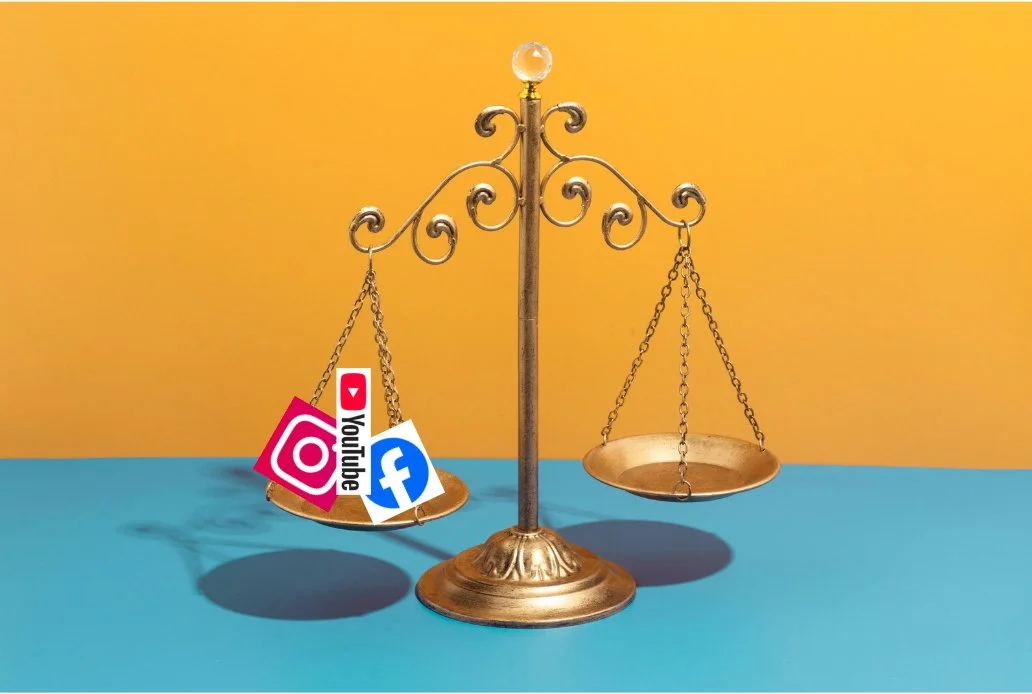
The world’s largest social media companies face several landmark trials that seek to hold them accountable for harms to children who use their products. We have a user-friendly guide to the lawsuits, what they claim, what evidence they’ve uncovered, and what they could mean for accountability in the digital world.
Aug. 17, 2026 — Opening statements are expected in federal court in Oakland, California, tomorrow morning in the third bellwether social media addiction trial.
State attorneys general from California, Kentucky, Colorado, and New Jersey allege that Meta fueled a mental health crisis in a generation of children by designing and deploying harmful features on Instagram and Facebook.
The state AGs argue that the social media company intentionally drove excessive use of their products by children and teens, harming their mental and physical health, distracting them during the school day, and disrupting their ability to sleep at night. Meta officials, meanwhile, misled users, their families, and the public about the existence and severity of those risks.
Meta said in a July court filing that the state AGs’ demands for damages would amount to more than $1.4 trillion, which is roughly the total market capitalization of the company itself.
Jury selection took place last week in the courtroom of U.S. District Judge Yvonne Gonzales Rogers. The eight-person jury will render a decision, but they are serving only as an advisory jury, with the outcome ultimately decided by Judge Rogers. The trial is expected to last at least six weeks.
The Transparency Coalition originally published this TCAI Guide to the Social Media Addiction Trials in March, as the first two bellwether cases were being readied.
Now, with the third case going to court in Oakland, we have updated the Guide to include additional information and updates about the status of other cases.
What are these ‘bellwether’ social media lawsuits?
The world’s largest social media companies face several landmark trials this year that seek to hold them accountable for harms to children who use their products.
Meta, the parent company of Instagram, and Google, which owns YouTube, face claims that their platforms were deliberately designed to addict and harm children. TikTok and Snap (owner of Snapchat) are also named as defendants in many of the lawsuits.
The lawsuits have been in the works for a number of years, and are finally coming to trial in 2026.
Juries in the first two social media trials found Meta and Google liable for the harm caused by their products.
On March 24, a jury in Santa Fe found that Meta violated a New Mexico consumer protection law by failing to protect children from sexual exploitation and to disclose the dangers of its platforms. On March 25, a jury in Los Angeles found Meta and Google liable for designing their social media platforms (Instagram and YouTube) to intentionally addict young users.
what’s the claim?
The plaintiffs claim that the social media companies caused personal injury to children and should be held accountable for that harm. Once young people are hooked, the plaintiffs allege, they fall prey to depression, eating disorders, self-harm and other mental health issues.
One of the key allegations made by the plaintiffs is that the tech companies knew about the harm their products caused kids and did nothing to stop or reduce that harm. Another claim is that these social media products were specifically designed to be addictive, like cigarettes or slot machines.
What features are addictive and/or harmful?
The lawsuits argue that features like infinite scroll, auto video play and algorithmic recommendations have led to compulsive social media use and caused depression, eating disorders and self-harm.
How significant are these trials?
The trials are being likened to the Big Tobacco trials of the 1990s, in which major cigarette manufacturers were found to have known about and hidden health risks, and targeted minors. Those trials resulted in billions of dollars in damages and the adoption of major marketing restrictions.
If the social media trials result in significant findings of harm and liability, those decisions could have a profound impact on the design and marketing of social media products. Companies like Meta could be subject to massive financial damage awards and be forced to redesign their platforms to stop the harms alleged in the lawsuits.
“The fact that a social media company is going to have to stand trial before a jury … is unprecedented,” Matthew Bergman, founder of the Social Media Victims Law Center and an attorney representing the plaintiffs, said in a press briefing.
Sacha Haworth, executive director of the nonprofit Tech Oversight Project, said: “These are the trials of a generation; just as the world watched courtrooms hold Big Tobacco and Big Pharma accountable, we will, for the first time, see Big Tech CEOs like Zuckerberg take the stand. Dozens of state attorneys general, thousands of families, and school districts nationwide are building the legal architecture to protect young people and future generations. The world is watching, Meta’s reckoning has arrived, and the consequences have just begun.”
How many lawsuits are there?
Hundreds of individuals, school districts, and state attorneys general have filed liability lawsuits against Meta, Snap, TikTok, and Google (as the parent company of YouTube).
Approximately 1,600 plaintiffs are included in the proceedings, involving more than 350 families and 250 school districts.
Because there are so many lawsuits, judges have coordinated them all in what is known as a judicial council coordination proceeding (JCCP).
JCCPs are used in product liability cases where dozens or hundreds of similar lawsuits are filed. They are also used in employment class actions, toxic exposure cases, and litigation involving wildfires, data breaches, or consumer fraud. Some well-known JCCPs have involved Roundup, talcum powder, opioids, and wildfire damages.
Why are these early trials important?
Some 22 lawsuits have been selected as “bellwether” trials, which are used as test cases to gauge juries’ reactions and potential verdicts. In other words: To see whether all the other lawsuits have a reasonable chance of success or not. Of those 22, three were chosen to proceed to trial first.
Two trials got underway in February. One was based in Los Angeles, the other in Santa Fe. The third trial is expected to open on Tuesday, August 28, in federal court in Oakland.
Los Angeles: In a California state court in Los Angeles, a 20-year-old woman stood as the plaintiff. She has been identified only as K.G.M., due to her status as a minor when the social media interactions occurred.
K.G.M. created a YouTube account at age 8, then joined Instagram at 9; TikTok at 10; and Snapchat at 11. In her lawsuit, she claims she became addicted to the social media sites as a child and experienced anxiety, depression and body-image issues as a result.
On March 25, a jury in Los Angeles found Meta and Google liable in the K.G.M. case.
Santa Fe: The trial in Santa Fe pitted the New Mexico attorney general’s office against Meta. The state alleged that the company knowingly enabled predators to use Facebook and Instagram to exploit children.
On March 24, a jury in Santa Fe found that Meta violated a New Mexico consumer protection law by failing to protect children from sexual exploitation and to disclose the dangers of its platforms.
Oakland: The federal trial beginning tomorrow in Oakland will be the first to represent school districts that have sued social media platforms over harms to children.
In this series of cases, state attorneys general (on behalf of state school districts) plan to argue that social media is a public nuisance and that the state and its school districts have had to shoulder the massive costs of treating a generation of youths suffering from addictive social media use.
How are the tech companies responding?
Meta, Snap, TikTok and YouTube all argue that there is no clear scientific link between tech use and addiction. They are expected to claim that there is no causal link between their products and the harm suffered by young users.
The social media companies also plan to cite a federal shield law, Section 230 of the Communications Decency Act of 1996, that protects them from liability for what their users post online.
Meta, which owns Instagram and Facebook, said in its opening statement that K.G.M.’s mental health issues were caused by familial abuse and turmoil. The company presented medical records to show that social media addiction was not a focus of her therapy sessions.
Doesn’t Section 230 give tech companies immunity?
Meta and TikTok have argued in federal court that they have legal immunity to the lawsuits under Section 230 of the Communications Decency Act.
A three-judge panel from the 9th Circuit U.S. Court of Appeals ruled against the companies on Aug. 10, 2026.
The judges held: “Because Section 230 merely provides a defense to liability—not immunity from suit—we lack appellate jurisdiction to review the district court’s rulings on an interlocutory basis. Therefore, we dismiss Meta’s and TikTok’s appeals.”
In its coverage of the current Oakland-based lawsuit, Ars Technica noted:
Although Section 230 limits liability for online platforms that host third-party content, Congress didn’t give companies an explicit guarantee that they will not face trials, the judges’ panel said. “When Congress wants to create immunity from suit, it knows how to say so unequivocally,” the judges said.
did some tech companies settle prior to trial?
Yes and no. TikTok and Snap settled their claims with K.G.M. prior to the opening of the Los Angeles trial earlier this year. But the two tech companies settled only their part in the K.G.M. lawsuit.
TikTok and Snap are still defendants in more than a dozen other trials expected in state and federal courts.
What evidence is being uncovered?
As in many civil trials, the evidence uncovered as part of the discovery process offers an unprecedented glimpse behind the curtain.
The evidence uncovered in the social media addiction trials has been especially eye-opening.
So many documents (emails, reports, etc.) have been filed in these cases that a team at the Tech Oversight Project has created a web site repository:
Tech Oversight Project: Evidence Uncovered
Example: “Goal is not viewership, it’s viewer addiction” (YouTube internal document)
Example: “Mark has decided that the top priority for the company […] is teens.” (Meta internal email, re CEO Mark Zuckerberg)
How long will the trials last?
The first two trials lasted about seven weeks each. This third trial is expected to run six to eight weeks long.
Regarding the larger scope of the full portfolio of social media lawsuits, it’s hard to say. If the early trials result in findings of liability and deep damage awards, that may open the floodgates to dozens if not hundreds more trials for years to come.
Another possible outcome could be a master settlement agreement along the lines of that reached in the tobacco cases of the late 1990s.
Further overviews:
CBC News: What’s at stake as Meta faces potential landmark trial in U.S. federal court
Fox Business: Meta heads to trial over alleged social media addiction, risks to children
Ars Technica: Meta can’t stop states’ $1.4 trillion lawsuit from going to trial
PBS News Hour: Landmark trial accusing tech giants of harming children
The New York Times: What to know about the social media addiction trials
The Guardian: Tech giants head to landmark US trial over social media addiction claims
coverage of the first two verdicts:
Los Angeles Times: Landmark L.A. jury finds Instagram, YouTube were designed to addict kids
Santa Fe New Mexican: Santa Fe jury reaches $375 million verdict against Meta
The Wall Street Journal: Meta and YouTube lose landmark social media addiction trial
Reuters: Meta, Google lost US case over social media harm to kids
Learn about kids and AI