As Congress declined to act, state lawmakers stepped up to engage with the most pressing issues surrounding artificial intelligence. The Transparency Coalition’s 2026 report found legislators in 30 states enacted 115 AI-related laws this year, ranging from chatbot safety laws to frontier AI model protocols. (Illustration: Michael Hart with Puscas Adryan, via Unsplash+)
Oct. 27, 2026 — This morning the Transparency Coalition released its 2026 State AI Legislation Report, the nation’s most comprehensive guide to AI-related laws enacted in 2026.
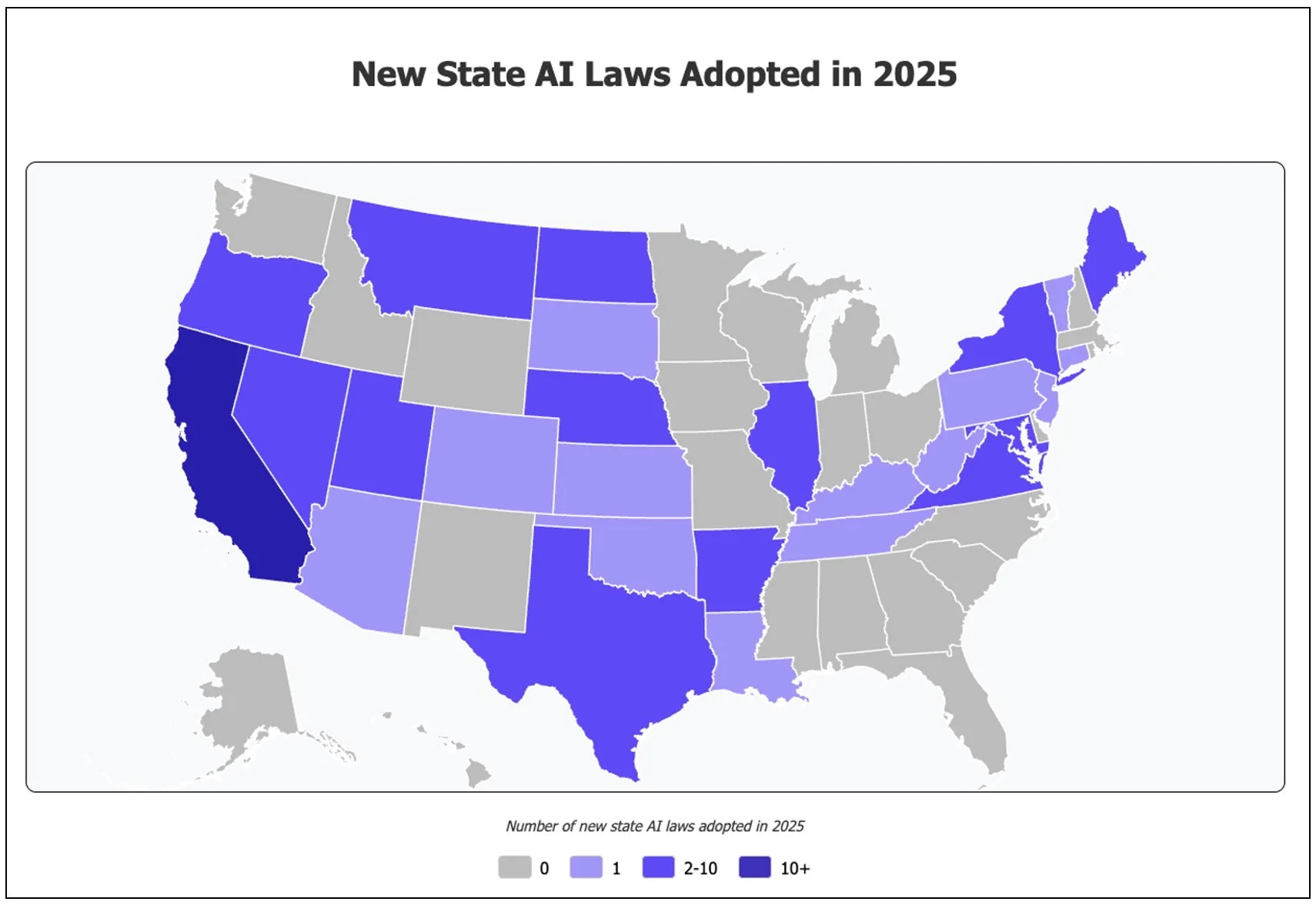
This year’s report found 115 new laws passed or enacted across 30 states between January 1 and October 15. The 115 measures tracked this year represent a nearly 58% increase from the 73 AI-related laws included in the Transparency Coalition’s 2025 report.
The report provides a state-by-state picture of how lawmakers are responding to rapidly evolving concerns around AI safety and accountability.
For up-to-the-minute coverage of AI-related bills in all 50 states, subscribe to the Transparency Coalition’s AI Legislative Update. Our weekly newsletter delivers all the latest bill movement every Friday morning.
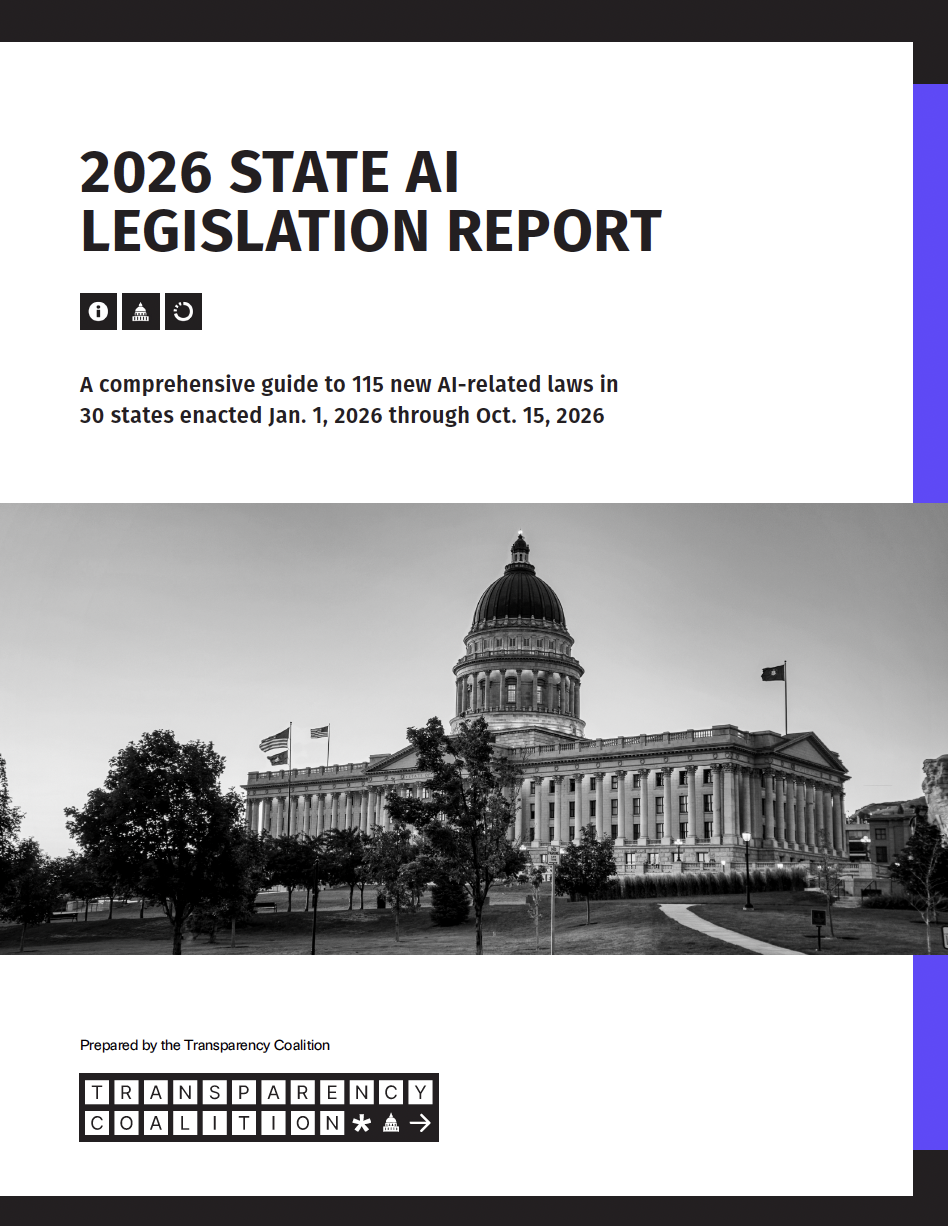
Click on image to download the full 2026 State AI Legislation Report.
Top AI issues in 2026
Protecting children from harmful chatbots and preserving human judgment in healthcare emerged as leading priorities for state lawmakers. Fourteen states advanced chatbot safety measures addressing risks including self-harm and suicidal ideation, sexually explicit content, emotionally manipulative engagement, and other potentially harmful interactions with minors.
The 115 measures tracked this year represent a nearly 58% increase from the 73 AI-related laws included in the Transparency Coalition’s 2025 report.
“State lawmakers in both parties have stepped up to the challenge of regulating AI for the good of our communities,” said Rob Eleveld, CEO of the Transparency Coalition. “Legislators are being asked to make decisions about extraordinarily complex and fast-changing technology, often with limited staff, limited time and intense pressure from industry. What stands out this year is the seriousness with which lawmakers across the country are tackling this challenge.”
Where States Took Action
The report identifies several major areas of legislative activity:
Chatbot safety and protections for children. Fourteen states advanced chatbot safety measures. Some of the strongest laws include safeguards against self-harm content, sexually explicit conversations, emotional manipulation and engagement tactics designed to keep minors interacting with a chatbot. California, Oregon, and Washington enacted particularly extensive protections.
Restrictions on addictive design. California, Colorado, Connecticut, Idaho, Illinois, Minnesota, and South Carolina adopted measures addressing addictive or compulsive design features in digital products used by children and teens, including algorithmic feeds, autoplay, rewards and other engagement mechanisms.
Human oversight in healthcare. Alabama, Colorado, Georgia, Illinois, Indiana, Iowa, Utah, and Washington enacted laws limiting the ability of health insurers to rely solely on AI or automated systems when making adverse medical authorization or coverage decisions.
Limits on AI therapy. Colorado, Maine, Rhode Island, Tennessee, and Vermont prohibited or restricted the offering of mental health therapy through AI chatbots, relying on states’ existing authority to regulate licensed healthcare professions.
AI disclosure and transparency. States continued to require clearer disclosure when AI is used in areas including advertising, customer service, campaign communications, and chatbot interactions. Washington also enacted a law requiring covered AI developers to embed provenance information in AI-generated or altered media.
Education and educational technology. Lawmakers addressed AI procurement and classroom use, digital-device policies and the role of human teachers and instructors. New measures were enacted in states including California, Illinois, Maryland, Oklahoma, Tennessee, Utah, and Virginia.
Deepfake protections. States including California, Hawaii, Kansas, Louisiana, Maryland, Tennessee, Utah, and Washington strengthened protections addressing harmful or deceptive synthetic media.
Frontier-model safety and independent auditing. Illinois enacted the AI Safety Measures Act, requiring frontier AI developers to implement risk-management frameworks and undergo annual independent third-party audits. California enacted measures establishing standards and infrastructure for independent AI auditing organizations.
What’s Coming in 2027
The Transparency Coalition expects state AI policymaking to accelerate further in 2027, with several issues likely to move to the forefront.
AI product liability. Lawmakers are increasingly examining how existing product-liability principles should apply to companies that design and deploy AI products capable of causing foreseeable harm.
Stronger chatbot safeguards. The chatbot laws enacted or advanced in 2026 vary significantly in their requirements. The Coalition expects lawmakers in several states to revisit first-generation measures and consider stronger protections.
Independent AI auditing. Illinois and California established early frameworks in 2026 for independent verification and auditing of AI systems. The report anticipates additional states examining certification, licensing and standards for third-party AI auditors.
Public procurement as a safety lever. State agencies and public school systems are major purchasers of technology. Legislators are increasingly exploring procurement standards that require AI vendors to meet higher benchmarks for safety, transparency, testing and accountability, along with third party auditing.
Protections for licensed professions. After several states restricted AI from independently providing mental health services, lawmakers may apply similar approaches in other professions where state licensing is used to protect consumers and establish standards of practice.
Frontier-model safety. Following the security incidents highlighted in the report, additional states are expected to consider requirements governing the testing, deployment and monitoring of advanced AI models.
About the 2026 State AI Legislation Report
The 2026 State AI Legislation Report is the Transparency Coalition’s second annual review of state AI policy.
The report examines measures addressing AI development, design, deployment, transparency, accountability and use. Inclusion in the report does not indicate the Transparency Coalition’s support for or opposition to a particular measure.
The report primarily covers laws enacted between January 1 and October 15, 2026, while also including a small number of measures approved by state legislatures but still awaiting gubernatorial action because of late signing deadlines. Measures addressing data center development are outside the report’s scope.
The report includes analysis of 2026 legislative trends, a forecast of emerging issues for 2027 and a state-by-state guide to new AI laws and measures.
About the Transparency Coalition
The Transparency Coalition advances policies that prioritize AI safety, transparency, and the public good, with a particular focus on protecting children. Transparency Coalition AI, a 501(c)(3) nonprofit, conducts research and educates policymakers and the public. The Transparency Coalition Action Fund, a 501(c)(4) organization, advocates for legislation and public policy addressing generative AI.
Learn more at transparencycoalition.ai.
For comparison: 2025 Legislation Report