
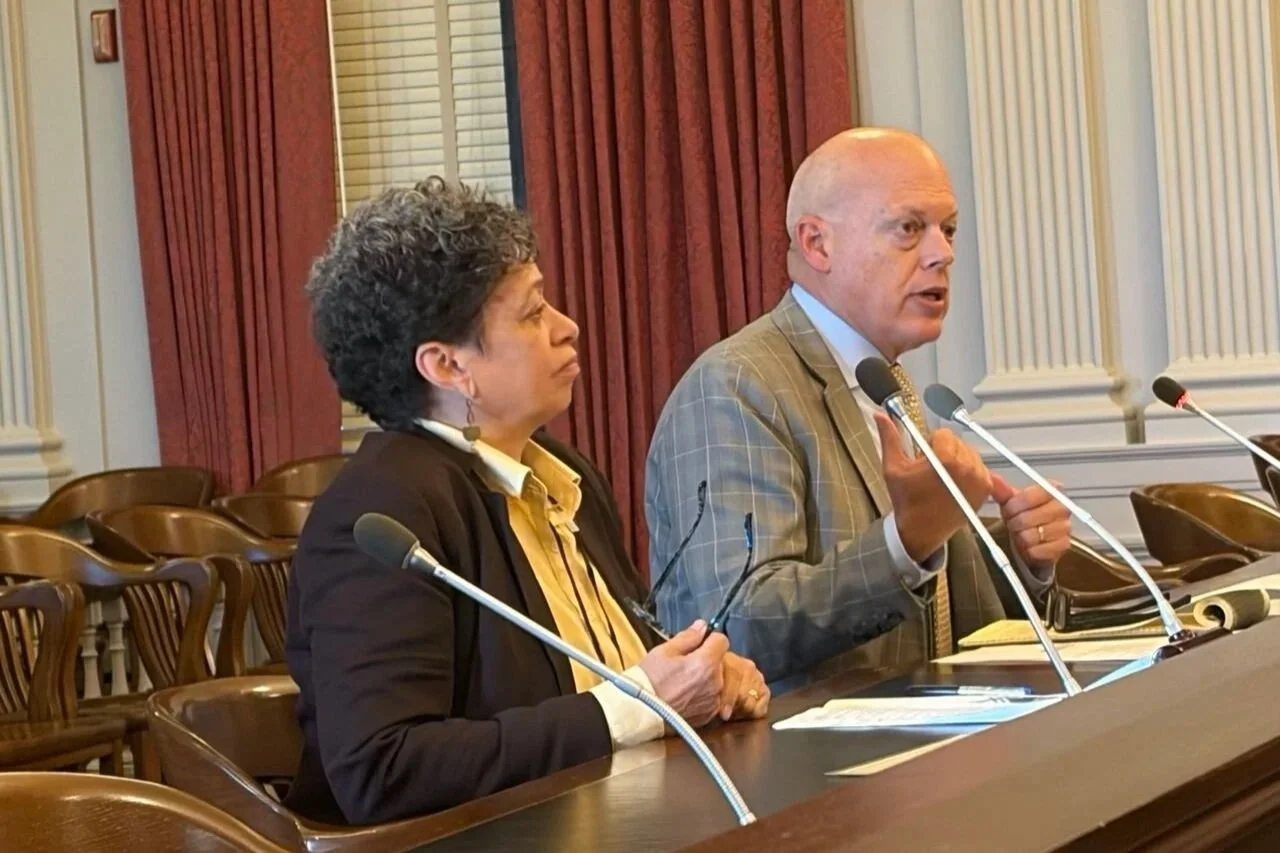
Transparency Coalition CEO Rob Eleveld, right, testified before the New Jersey Assembly’s Science, Innovation, and Technology committee on Oct. 19, 2026. Also offering perspective on the AI bills under consideration was Beverly Brown Ruggia, left, of the Consumer Federation of America.
Oct. 23, 2026 — Lawmakers in New Jersey are actively considering four significant AI-related bills in the final stretch of this year’s session. The measures focus on protecting individuals from the misuse of deepfake content, disclosing the use of AI in certain media, creating safety regulations around frontier AI models, and holding AI operators accountable for harmful activity—especially the exploitation of children.
In mid-October the Assembly Science, Innovation, and Technology Committee took up the four bills in a discussion session. Transparency Coalition CEO Rob Eleveld traveled to Trenton to offer his expertise and perspective on the bills, appearing alongside Beverly Brown Ruggia of the Consumer Federation of America, pictured above.
We have a full guide to each measure below.
The bills under consideration:
A 3065: Establishes a civil right of action for misuse of an individual’s name, image, likeness, or voice. Sponsors: Tully, Calabrese, Speight, Bagolie.
A 5089: The AI Image Disclosure Act would require the disclosure of certain AI-generated content. Sponsors: Macurdy, Park, Singh.
A 5090: The GAI Accountability Act would impose civil penalties on generative AI platforms operators engaging in harmful activity, including exploitation of children. Sponsors: Macurdy, Park, Singh, Morales.
A 5275: This is a frontier AI model safety bill that would enact requirements around the development and deployment of the most powerful AI systems. Sponsor: Macurdy.
A 3065: Name, image, likeness property right and misuse
Individual NIL as a property right: This bill establishes a person's right of publicity as a property right. The right of publicity is commonly defined as the right to prevent unauthorized commercial use of a person's name, image, likeness, or voice.
Transferrable right: Under the bill, every individual has an exclusive property right in the use of that individual's name, image, likeness, or voice in any medium in any manner, which may be assigned, licensed, or inherited by the individual's executors, assignees, heirs, or devisees. A deceased individual's executors, assignees, heirs, or devisees retain the individual's exclusive right of publicity for 10 years following death, which may be extended in perpetuity if that right is commercially exploited, or which may be terminated after two years for non-use following the initial 10 year period.
Civil and criminal liabillity: A person who knowingly infringes on an individual's right of publicity, including infringement through the use of artificial intelligence technology, shall be liable in a civil action and shall also be guilty of a disorderly person offense. A disorderly person offense is punishable by imprisonment for up to six months, a fine of up to $1,000, or both. In addition, a court may order an award of monetary damages as well as injunctive relief such as the forfeiture, seizure, or destruction of any infringing items.
Fair use exceptions: The bill sets forth fair use exceptions for criticism, comment, news reporting, teaching, scholarship, research, or other uses consistent with the federal Copyright Act of 1976 and the federal Lanham Act. The bill is intended to not affect any existing licensing or publicity contracts, or service marks, trademarks, or trade names, properly made or registered as of the effective date of the bill. The bill is also not intended to limit the rights of student-athletes under the New Jersey Fair Play Act.
A 5089: The AI Image Disclosure Act
Disclosures are required: This bill requires a covered AI provider to include a manifest disclosure and a latent disclosure in any image, video, or audio content, or in any combination thereof, created or altered by the covered provider's generative AI system.
Manifest disclosures: These are required to: (1) identify the content as AI-generated content; (2) be clear, conspicuous, appropriate for the medium of the content, and understandable to a reasonable person; and (3) be permanent or extraordinarily difficult to remove, to the extent technically feasible.
Latent disclosures: These are required to: (1) not be visible or audible; (2) convey the name of the covered provider, name and version of the GenAI system that created or altered the content, the time and date of the content's creation or alteration; (3) be permanent or extraordinarily difficult to remove, to the extent technically feasible; (4) be compliant or interoperable with widely accepted industry standards; and (5) be easily accessible.
Third party licensee requirements: Providers that license a GenAI system to a third party (licensee) must: (1) require the licensee, by agreement, to maintain the GenAI system's capability to include a latent disclosure; and (2) prohibit the licensee from preventing a licensed GenAI system from including a latent disclosure. A covered provider is required to revoke the licensing agreement with the licensee within 96 hours of obtaining actual knowledge that the licensee prevented the GenAI system from including a latent disclosure.
Social media company requirements: Social media companies must use a label to disclose any machine-readable provenance data, as that term is defined in the bill, detected in content distributed on the covered social media company's social media platform that identifies the content as AI-generated. A social media company is prohibited from deleting or removing any provenance data or digital signature from content uploaded or distributed on the covered social media company's social media platform.
Ban on ‘disclosure removal’ tools: A 5089 prohibits offering a system, application, tool, or service that is designed for the primary purpose of removing or editing latent disclosures or adding a latent disclosure to content that was not created or altered using a GenAI system.
A 5090: The Generative AI Accountability Act
This bill imposes civil liability on the owners, operators, and developers of generative AI platforms (products) that facilitate harms against children.
AI operator liable for AI system crimes: Under the bill, the owner, operator, or developer of any generative AI product that does business in New Jersey is liable for a civil penalty of $20,000 per violation they fail to prevent the GAI platform from:
engaging in conduct which, if it had been committed by a human, would constitute the crime of murder, assault, theft by extortion, theft by deception, creation of child sexual abuse or exploitation material, or endangering the welfare of children;
providing information that facilitates a user's commission of a crime enumerated above, where the providing of such information, if it had been done by a human, would constitute aiding or abetting a crime, unless that information is publicly accessible in a substantially similar form from a source other than a generative AI platform.
Affirmative defense: The bill provides an affirmative defense if the owner, operator, or developer used reasonable efforts to prevent the generative AI platform from violating the provisions of the bill. The bill provides for enforcement by the Attorney General.
A 5275: A Frontier AI Model safety bill
This is a frontier AI model safety measure that follows on similar bills recently enacted in Illinois (SB 315), California (SB 53), and New York (the RAISE Act). Pennsylvania lawmakers are currently considering two similar frontier model safety bills, HB 2800 and HB 2829.
Required submissions to state agencies: Under the bill, large frontier developers are required to:
(1) write and implement technical and organizational protocols to assess and reduce the risk of the development, storage, use, or deployment of a frontier model materially contributing to a catastrophic harm;
(2) annually submit to the Attorney General a "Risk Management Disclosure" containing a written explanation of technical and organizational protocols the large frontier developer has implemented to assess and reduce the risk of the development, storage, use, or deployment of a frontier model materially contributing to a catastrophic harm;
(3) annually review and, as appropriate, update the technical and organizational protocols the large frontier developer has implemented to assess and reduce the risk of the large frontier developer's models materially contributing to a catastrophic harm; and
(4) submit to the Attorney General a "New Model Risk Disclosure" before, or concurrently with, deploying a new frontier model or a substantially modified version of an existing frontier model, containing assessments of catastrophic risks from the frontier model, the results of the assessments, the extent to which third-party evaluators were involved, and other steps taken to fulfill the requirements of rules issued by the Attorney General, in consultation with the New Jersey Office of Homeland Security and Preparedness (OHS).
State agencies must issue rules: The bill requires the Attorney General, in consultation with the OHS, to issue rules requiring that the "Risk Management Disclosure" submitted by a large frontier developer contain language or a visual guide which maps the developer's actions to the suggested actions contained in the most recent edition of the National Institute of Standards and Technology's AI Risk Management Framework, or to a relevant use-case profile based on the framework, and whether and to what extent a risk management disclosure was written, edited, or otherwise contributed to using a generative artificial intelligence system.
Civil penalties: A large frontier developer who fails to submit any disclosures required under the bill, or who makes materially false or misleading statements about catastrophic risk in the large frontier developer's "Risk Management Disclosure" or "New Model Risk Disclosure," shall be liable for a civil penalty in the amount of $100,000 for each violation.
Auditing for compliance: The bill authorizes the Attorney General, in consultation with the OHS, to audit a large frontier developer for compliance with the provisions of the bill, or enter into a contract with a private entity to conduct an audit.
Sunset after five years: The bill expires five years after it takes effect, except that the provision requiring the Attorney General, in consultation with the OHS, to submit a list of recommendations to the Legislature expires upon the submission of the list.