These high school students drafted new rules for AI use in school. They’re pretty darn good.
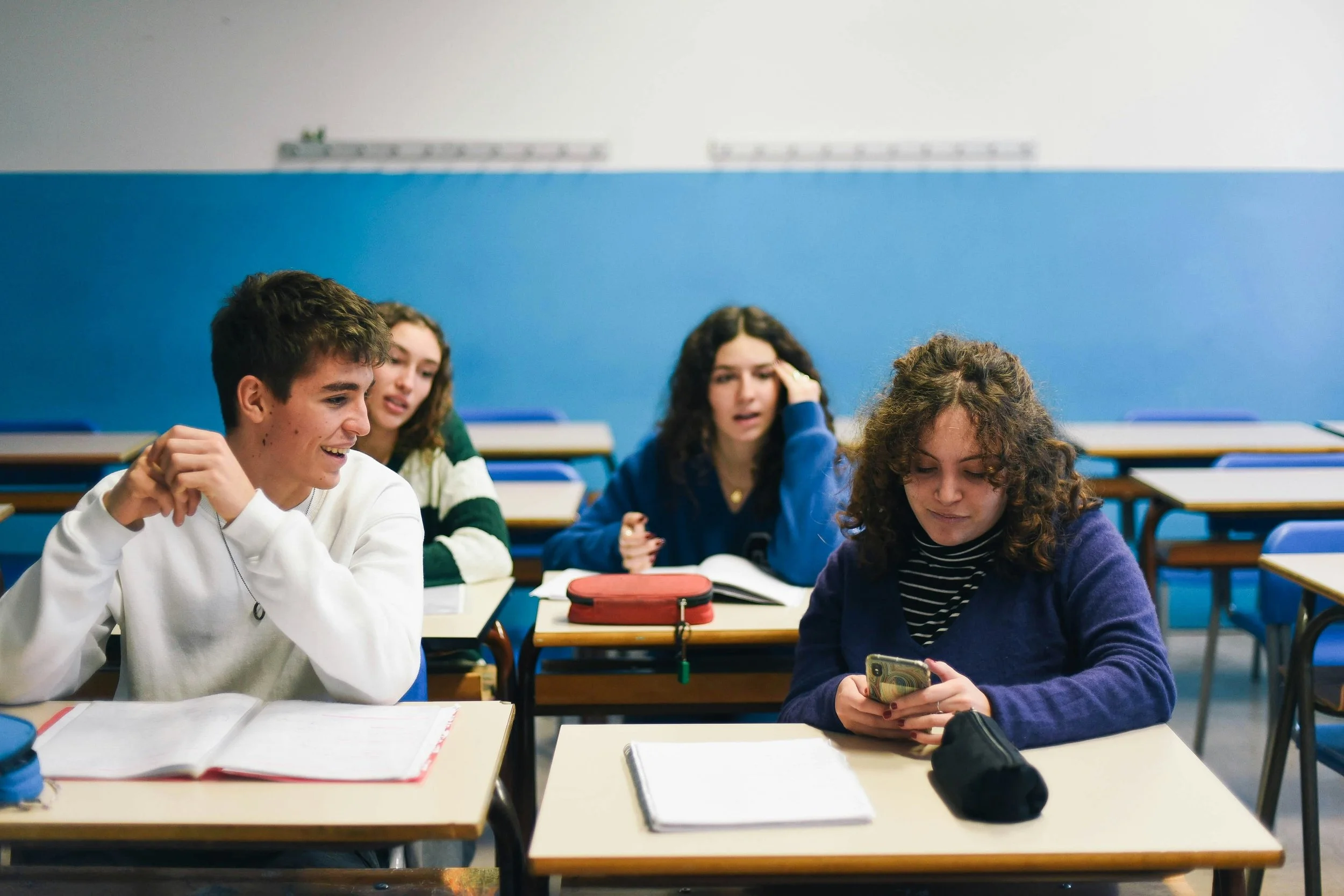
A group of 98 students from all 50 states gathered in Boston last month to craft a set of rules for the appropriate use of AI in school. (Photo: Giulia Squillace for Unsplash+)
Aug. 4, 2026 — In late July, a group of 98 high school students representing all 50 states gathered in Boston to create a one-of-a-kind document: A Congressional bill to regulate the use of artificial intelligence in school classrooms.
What they came up with is remarkable.
Their proposal, known as the Students First Act, contains a set of rules that could be a starting point for any state or national lawmaking body to consider. (We are indebted to NPR reporter Cory Turner, who filed a full report on the student gathering, for much of the information here.)
First Principles
The Act contains a number of overarching principles that apply to all K-12 situations. Those include:
Educators should always prioritize educator-student relationships by omitting AI usage in situations where human connection is irreplaceable in the learning environment.
Any organization offering generative AI services must address the known biases within that AI system, and inform their clients of those biases.
AI use, and the AI rules within the Act, must not infringe upon the judgment of teachers in managing their classroom.
Teachers and administrators must not be penalized for opting not to use AI tools in their instructional or administrative practices.
rules for students
The Act lays out a number of obligations and restrictions for students, including:
Prohibited uses: Students should not be allowed to use AI for original writing. Students are prohibited from inputting assignments directly into AI platforms. AI use is strictly prohibited on all graded assignments. Students may not use AI to complete artistic assignments.
Approved uses: Editing, brainstorming, and studying with AI should be allowed after eighth grade.
Refusing AI use must be allowed: The Act states that a student must be allowed to refuse the use of AI tools in the classroom. In these situations, an alternative assignment must be given to the student.
Prove mastery: Students permitted to use AI should have to cite how they used it and demonstrate their grasp of a subject through discussions, handwritten tests or oral defenses. This is similar to the oral defense clause recently enacted by the University of Chicago Law School, as a way to confirm a student’s knowledge of the subject on which they’re writing.
Plagiarism review: Any student suspected of using AI inappropriately should have their work reviewed not just by AI checker software (which itself can be unreliable), but also by two school officials.
Restrictions on data collection: Students must be informed of any and all data collection from them, as well as what their data would be used for, and have the right to deny unnecessary data collection.
Rules for teachers
The Act also contains restrictions around the use of AI for teachers:
Approved uses: The use of AI is allowed for tasks like lesson planning, drafting practice materials, providing feedback and improving instruction.
Teacher obligations: Just as students are expected to be transparent in their AI usage, teachers should be held to the same standard. Teachers may use artificial intelligence to support lesson planning (see above), but AI should not replace a teacher’s professional judgement or relationship with students. Furthermore, teachers must review AI-generated materials for accuracy, bias, and appropriateness before using them in class.
Prohibited uses: Teachers cannot solely rely on AI to determine grades, improper student conduct, or other choices concerning a student's education.
Inform students of AI policy: Each semester, every teacher needs to post a clear, written AI usage policy that explains when AI use is allowed and when it’s prohibited.
Full document available here
We have the full Students First Act available below.
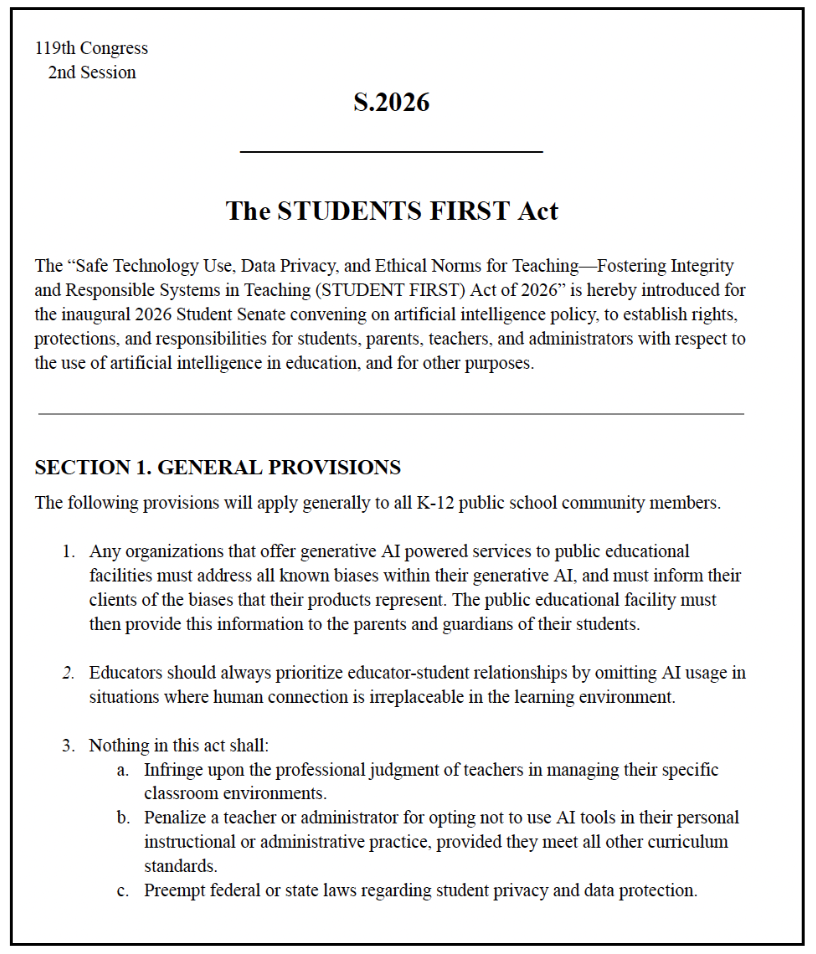
The Students First Act
A nine-page bill readymade for state legislators and Congress, courtesy of American high school students from all 50 states.
a student senate in special session
The students were brought together through a project sponsored by the Edward M. Kennedy Institute for the United States Senate, AASA (the School Superintendents Association), and Day of AI, a nonprofit from MIT’s RAISE AI literacy initiative.
The Boston-based Kennedy Institute contains a full-scale replica of the U.S. Senate chamber, which the students used for discussion, debate, and voting.
More on kids and AI