Six in ten American teens use AI for their homework. Is that smart? Or is it undermining their learning? We have resources to help parents, kids, and teachers decide. (Photo: Getty Images for Unsplash+)
Sept. 2, 2026 — With kids heading back to school, this is a critical time for parents and teachers to understand AI and talk with their students about risks and expectations.
Chatbots like ChatGPT and Claude are more powerful than ever. More teens are turning to AI for both answers and companionship. And our research-based knowledge of the dangers continues to grow.
With that in mind, we’ve gathered a back-to-school resource guide for parents, students, and teachers. We will continue to update this page as more research becomes available.
How kids are using ai chatbots right now
The rise of chatbot use among teens has been striking. As of Sept. 2026, most researchers agree on a range of 20% to 30% of teens using chatbots daily. Here’s the latest research:
Teens, social media, and AI chatbots, Dec. 2025 Pew Research survey. Findings: 64% of American teens use chatbots, 30% do so daily.
Teens in the AI era: Aug. 2026 Common Sense Media report. Findings: 6 in 10 teens use AI for their schoolwork. Fewer than half have receiving guidance on whether that use is appropriate.
51% of girls age 11 to 13 have used AI for emotional support, May 2026 Girl Scouts USA study. The same study found that among girls who use voice-assisted devices, 65% say they see them as a friend.
One in five teens use chatbots for mental health, June 2026 RAND study
Why do kids use chatbots for emotional support? Aug. 2026 Stanford study
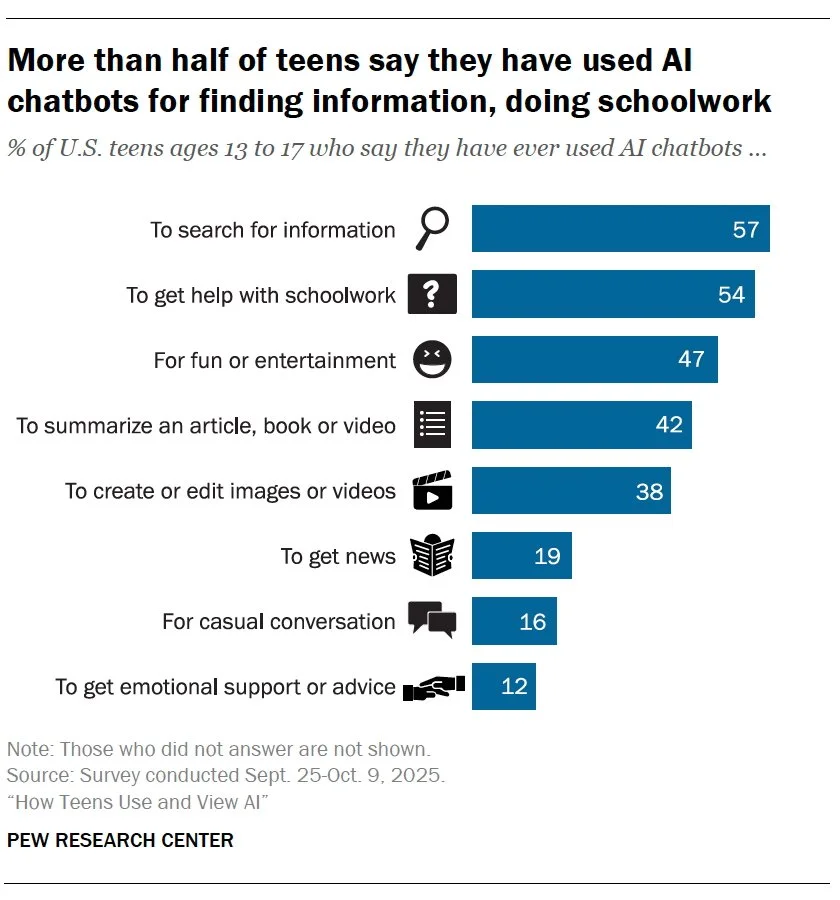
More than half of teens now use AI chatbots for help with homework.
Source: Pew Research Center, Feb. 2026
What age is appropriate for ai use?
This is an issue for every family to consider, discuss, and decide. In recent months the public discussion around kids and chatbots has evolved into two overriding questions:
Is this chatbot, or other AI product, safe for teens?
Will the use or over-reliance on an AI chatbot undermine a student’s educational learning, social skill development, or emotional growth?
One line is clear: Kids under 13 should not interact with chatbots, and should limit screen time in general. AI companies like OpenAI and Anthropic do not allow anyone under 13 to establish an account to use ChatGPT or Claude. Social media companies do not allow accounts for users younger than 13.
Individual schools and school districts are now starting to implement policies around appropriate AI use:
AI is to be banned in NYC elementary and middle schools, Sept. 2026 New York Times report on New York City schools prohibiting the use of chatbots and other AI products.
LA schools limit screen time, Aug. 2026 NPR report on the Los Angeles Unified School District banning all screens for K-1 students, and phasing in limits for elementary, middle, and high school students.
Texas school district limits AI use, July 2026 Houston Public Media report on the Katy School District outside Houston banning the AI use for K-6 students and restricting how older students use the technology.
Student use of AI, a helpful guidance from the Haddon Heights, New Jersey, school district, including appropriate AI use by grade level.
Should students use ai for homework?
AI chatbots can be really good at answering homework questions, although they’re not completely accurate. Chatbots nearly always respond to a prompt with a confident-sounding answer, but all chatbots are known to hallucinate (offer inaccurate responses). The AI models that power chatbots don’t know right from wrong, or truth from fiction. They are word-prediction machines, not all-knowing wizards.
That being said, what’s wrong with using ChatGPT to zoom through tonight’s homework assignment?
The early research indicates that students who use chatbots on practice assignments and homework don’t actually learn the material nearly as well as students without AI assistance.
Why students who use ChatGPT on homework assignments do worse on the test, Feb. 2026 Wharton School study.
Your brain on ChatGPT: Accumulation of cognitive debt when using an AI assistant for essay writing, one of the most-referenced studies, June 2025 MIT Media Lab research.
Deskilling dilemma: Brain over automation, a neurological view of “deskilling,” the gradual erosion of independent reasoning skills and competence due to an increasing reliance on artificial technology tools. Feb 2026, National Library of Medicine.
What about ‘chatgpt for teens’ or ‘study mode’?
In mid-August, OpenAI released ‘ChatGPT For Teens,’ the tech company’s new product designed for teens and young adults in the 13-to-17 year age range. The new teens-only platform includes a number of safety designs that TCAI has been advocating for, and which we applaud. (We still think a lot more could be done.)
That said, the teen version of OpenAI’s chatbot isn’t designed to maximize learning and brain development. ChatGPT does offer a “study mode” intended to help guide and educate students rather than merely cough up an instant answer. That too has its benefits and drawbacks.
Wharton School professor Hamsa Bastani, a leading authority on AI and learning, has said she has yet to come across an ‘actually good’ generative AI chatbot built for learning. Of the studies that have been done, most are negative or negligible as far as learning improvement.
TCAI Guide to ChatGPT for Teens: The good, the bad, and the law, Aug. 2026, Transparency Coalition.
I tried learning from AI tutors, a Sept. 2025 Mashable series in which tech writer Chase DiBenedetto tests the various ‘study mode’ chatbots now available.
model guidelines: Smart and safe use of ai
Earlier this summer, a group of 98 high school students gathered in Boston to create a one-of-a-kind document: A Congressional bill to regulate the use of AI in school classrooms.
Their proposal, The Students First Act, is a template for safe and smart AI use in middle and high school. We have a few of their suggested guardrails listed below.
Proposed rules for students:
Students should not be allowed to use AI for original writing. AI use is strictly prohibited on all graded assignments. Students may not use AI to complete artistic assignments.
Editing, brainstorming, and studying with AI should be allowed after eighth grade.
Students permitted to use AI should have to cite how they used it and demonstrate their grasp of a subject through discussions, handwritten tests or oral defenses.
Any student suspected of using AI inappropriately should have their work reviewed not just by AI checker software (which itself can be unreliable), but also by two school officials.
Proposed rules for teachers:
The use of AI is allowed for tasks like lesson planning, drafting practice materials, providing feedback and improving instruction.
Teachers may use artificial intelligence to support lesson planning, but AI should not replace a teacher’s professional judgement or relationship with students.
Teachers must review AI-generated materials for accuracy, bias, and appropriateness before using them in class.
Teachers cannot solely rely on AI to determine grades, improper student conduct, or other choices concerning a student's education.
Each semester, every teacher should post a clear, written AI usage policy that explains when AI use is allowed and when it’s prohibited.
Guidance for K-12 teachers
Many schools and districts are only now taking the time to consider appropriate rules and guidelines for the use or prohibition of AI in the classroom. Tech Policy Press reports that 60% of educators say their district’s AI policies are unclear, and only 18% of teachers have gotten any kind of formal guidance from school administrators.
Early guidelines released by districts like Chicago and Houston in 2024 are now considered wildly outdated. They were adopted before we knew much about the risks of chatbots for teens, and before today’s rethinking of screen time, social media, and over-reliance on technology in classrooms.
Here are the latest resources for teachers and administrators in K-12 schools:
Understanding the Evidence Base on AI in K-12 Education, a comprehensive 2026 Stanford University review of early studies on AI use and its effects on learning.
Student use of AI, a helpful guidance from the Haddon Heights, New Jersey, school district, including appropriate AI use by grade level.
A New Direction for Students in an AI World: Jan. 2026 Brookings Institute report. Findings: “At this point in its trajectory, the risks of utilizing generative AI in children’s education overshadow its benefits.”
In the US, caution rules on use of AI ahead of K-12 school year, excellent Aug. 2026 overview of the state of play in America’s school districts from Tech Policy Press.
Spotlight on using AI with purpose, an Education Week resource for teachers, administrators, and policy makers.
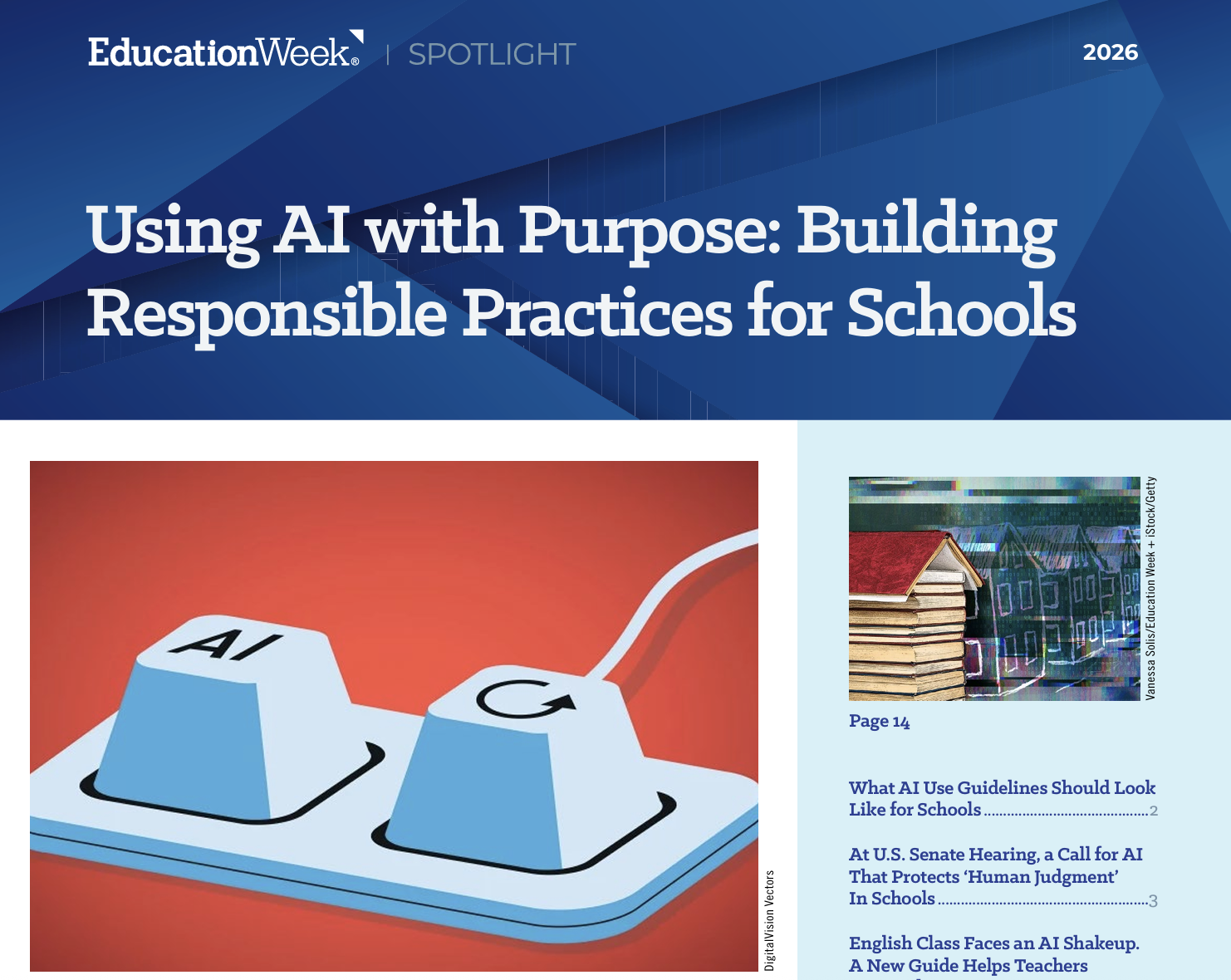
This Education Week guide is an outstanding resource for teachers, administrators, and policy makers adopting rules for AI use in their schools. Click on image to access.
Learn more about Kids and aI