TCAI Guide to ‘ChatGPT For Teens’: The good, the bad, and the law
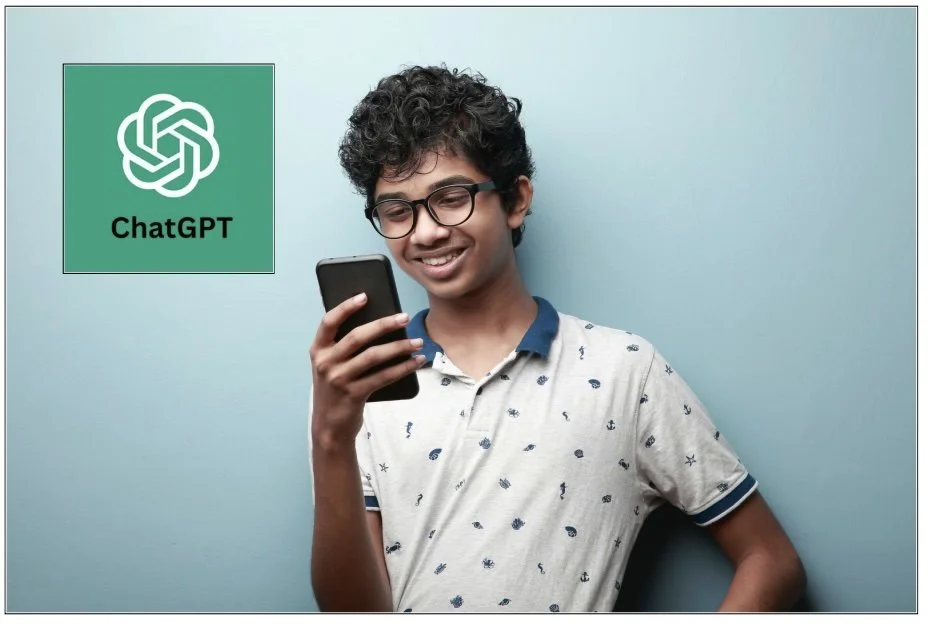
OpenAI released ‘ChatGPT For Teens’ yesterday, a product intended for users age 13 to age 17. The new chatbot includes a number of features required by recently enacted state chatbot safety laws. (Image: Getty Images for Unsplash+)
Aug. 19, 2026 — Yesterday OpenAI released ‘ChatGPT For Teens,’ the tech company’s new product designed for teens and young adults in the 13-to-17 year age range.
At the Transparency Coalition we’re encouraged by the progress this represents: The maker of the world’s most popular AI chatbot is taking a real step to remedy the reckless and harmful roll-out of ChatGPT.
We’ve also learned to be skeptical and realistic about the motives behind the release of new AI products, and the secondary status of safety within companies like OpenAI.
Many of the new safeguards embedded in ChatGPT For Kids are not purely voluntary measures implemented by OpenAI out of the company’s concern for kids’ safety. They are actually required by new state chatbot safety laws taking effect in Washington, Oregon, New York, Colorado, Connecticut, and a number of other states. Those safeguards, which were strongly resisted by the tech industry and its lobbyists during the legislative process, are now embedded in the next generation of chatbots and presented as consumer-friendly features.
With that in mind, we offer this early overview of ChatGPT For Teens.
What is ChatGPT for Teens?
This is a version of ChatGPT designed specifically for users in the age 13 to age 17 demographic. (OpenAI does not offer ChatGPT accounts to users younger than age 13.)
The company promotes ChatGPT For Teens as a product that “provides stronger built-in safety protections for teens, including features to promote healthy use and additional controls for parents.”
The teen product includes a number of designed safety features not included in the adult version.
Why would a teenager sign up for this?
Some teens will want a ChatGPT product designed for them. Some will not; a certain percentage of them will want the full adult version. If OpenAI’s guardrails work correctly, they won’t get it.
The company says its age estimation technology will automatically sort account holders into teen and adult categories.
Age estimation is quickly rising as the industry standard, using hard-ID verification as a secondary safety net. OpenAI says that adults who are misidentified as teens can verify their age through the third-party service provider, Persona.
A hole in the fence: non-account holders
There still remains a big hole in the fence. The new teen-or-adult sorting happens only with users who apply to establish a ChatGPT account with OpenAI.
It’s still possible for teens to use the adult non-account version of ChatGPT. It’s unclear whether OpenAI’s age estimation system is effective or even incorporated into non-account use of the chatbot.
Our colleagues at Common Sense Media share this concern. They wrote: “We don’t know how well OpenAI is detecting teens who are logged out or used a false age, how many parents and teens have signed up for linked accounts, how long it takes notifications to reach parents, and how often safety systems mess up and don’t send the alerts they should. Alerts that don’t work often enough or fast enough may give parents a false sense of safety. These features are well intentioned, but we need additional transparency and external testing to confirm that they perform as intended.”
‘Guiding principles’ of chatgpt for teens
OpenAI’s documentation for the new product includes this pledge:
ChatGPT for Teens has guiding principles anchored in four commitments:
1. Put teen safety first even when it may conflict with other goals.
2. Promote real-world support by encouraging offline relationships & trusted resources.
3. Treat teens like teens neither condescending to them nor treating them as adults.
4. Be transparent by setting clear expectations.
At-a-glance: What’s claimed for ‘teens’ chatbot
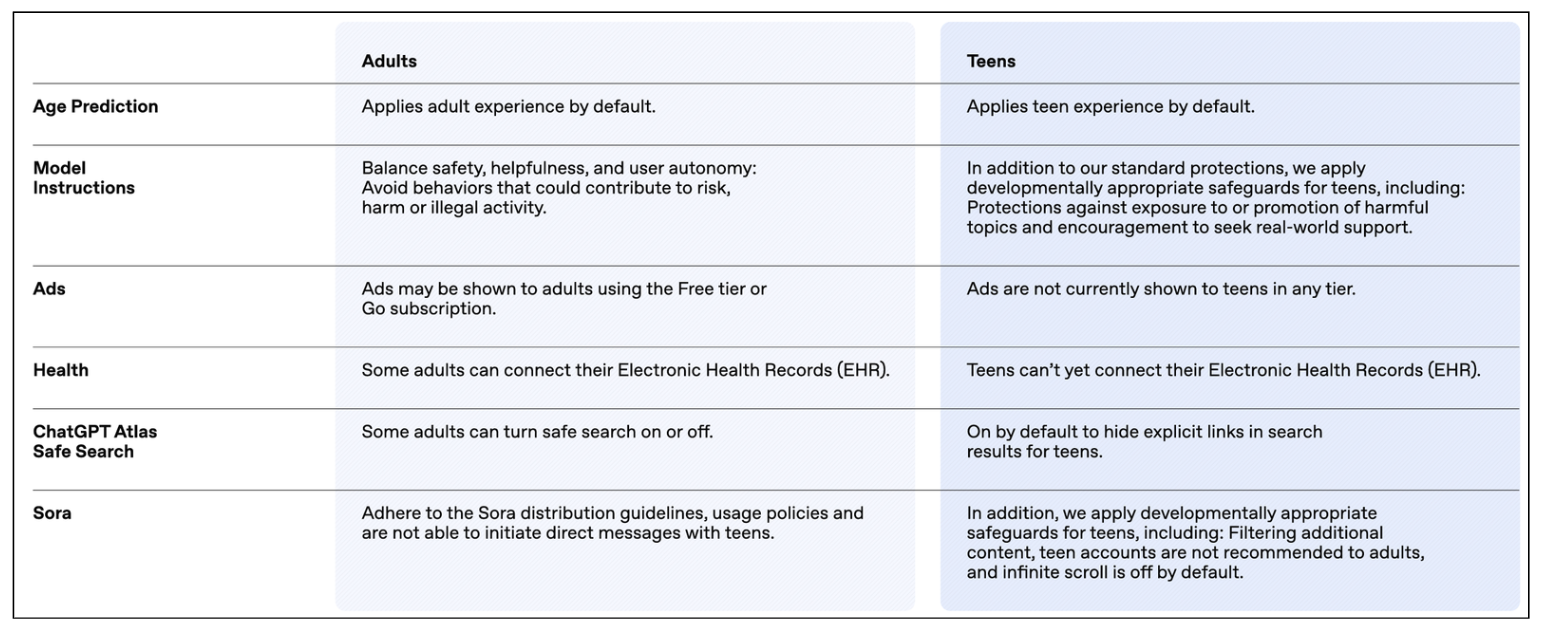
This is a chart published by OpenAI, offering the company’s comparison of the two products.
New ChatGPT safeguards: required by state law
OpenAI now takes these steps to balance safety, helpfulness, and user autonomy in adult ChatGPT:
Avoid behaviors that could contribute to catastrophic risks, direct physical harm to people, and illegal activity.
Encourage users to seek real-world support, or professional care when appropriate.
Acknowledge that it’s AI.
ChatGPT For Teens adds these protections:
Protections against exposure to or promotion of harmful topics, such as sexual, romantic, or violent roleplay; graphic violence; self-harm depictions; unhealthy or extreme beauty standards; and dangerous activities.
Encourage teens to seek real-world support from a parent or guardian, or professional care when appropriate.
Required by state law: These new safeguards in both the adult and teen version of ChatGPT were prompted and in many cases required by new state laws concerning chatbot safety.
New state chatbot laws in Washington, Oregon, California, and Connecticut require all chatbots to acknowledge that they’re AI, not human. The new state laws also require chatbot operators to identify user prompts and conversations that veer into self-harm or suicidal ideation, and respond by offering real-world support like a crisis center or other professional care.
Those same state laws prohibit AI chatbots from exposing minors (under age 18) to sexual imagery or roleplay.
The state laws were prompted—and enacted—this past year in response to alarming and repeated instances of chatbots, including ChatGPT, encouraging teens to commit suicide, hide their self-harm and suicidal ideation from parents.
Advertising policies
OpenAI currently shows ads to adults using ChatGPT’s Free tier or Go subscription.
The company says “ads are not currently shown to teens in any tier.”
TCAI comment: This is good. It also raises questions about the use of the word “currently.” There is no pledge or guarantee that ads will not be shown to teens in the future.
personal medical data
Adults can connect their Electronic Health Records (EHR) in ChatGPT Health. This product, introduced in early 2026, is only available in the U.S. and requires users to connect and sign in to medical providers.
ChatGPT For Teens does not allow this feature as of now. OpenAI says: “Teens can’t yet connect their Electronic Health Records (EHR) in ChatGPT Health.”
TCAI comment: Again, this begs the question regarding the “yet” in that sentence. Is OpenAI planning to allow teens to upload their personal medical records in the future? It’s unclear.
We strongly advise all users to refrain from entering any medical information into a chatbot prompt—and especially warn against connecting one’s personal Electronic Health Records into a chatbot.
Tech companies and their chatbots are not covered by the federal HIPAA laws that require medical professionals to uphold the highest level of data confidentiality and security. They are not covered by HIPAA because they are not medical professionals. When a user offers personal medical information to an AI chatbot they are not consulting with a doctor. They are freely offering their medical data to a tech company whose purpose is to profit from the use of data.
Take-a-Break reminders
OpenAI says its adult chatbot will send a message to a user encouraging a break after an extended conversation.
ChatGPT For Teens will send similar break reminders, but more frequently.
Required by state law: This is another area where these features are actually required by recently enacted state chatbot laws. The “take a break” reminder is a common feature of more than a dozen new state chatbot safety laws.
Safety contacts and notifications
Within an adult ChatGPT account, OpenAI offers users the option to nominate a Trusted Contact, who may be notified if the model’s automated systems and reviewers detect a serious self-harm safety concern.
With a ChatGPT For Teen account, OpenAI says: “Parent/Teen linked teen accounts automatically include alerts if we detect signs of acute self-harm or violence-related risk involving their teen; alerts are optional and reviewed by a small group of trained experts. We will not share a teen’s prompt and generation content with their parents.”
TCAI comment: This is a confusing description from OpenAI. We’re uncertain as to what would trigger an alert within a teen account, and/or who would receive that alert. Alerts are said to be optional, and reviewed by “a small group of trained experts.” Hard past experience with social media and AI products has led us to be skeptical of expert review. The phrase brings to mind a cadre of highly-qualified behavioral health experts. In practice, this sort of work has too often been offshored to third-party digital sweatshops.
A final note: what it took to prompt these changes
While we greet the introduction of ChatGPT For Teens with cautious optimism and healthy skepticism, we’re fully invested in the ongoing fight to establish AI safety. We recognize that the rollout of OpenAI’s new product is an important step forward in chatbot safety—even if it took the enactment of state laws to get it accomplished.
Leaders at TCAI and our 501(c)4 organization, Transparency Coalition Action Fund, were involved in crafting and passing some of those state laws. Tech companies aren’t required to acknowledge those laws when they introduce new products to comply with them. That’s fine. The advocates and political leaders who passed seat belt and air bag laws decades ago didn’t expect to be featured in ads for new Cadillacs. They only expected the Cadillacs to include the features that save lives.
So one cheer for OpenAI for advancing chatbot safety, and two cheers for the state legislators and governors who made it happen. There’s still a long way to go, we’re making progress, and we’ll see more in the months and years ahead.
Learn more about chatbots