
Sen. Patty Murray hosts Transparency Coalition for AI policy talk, predicts federal action in 2027
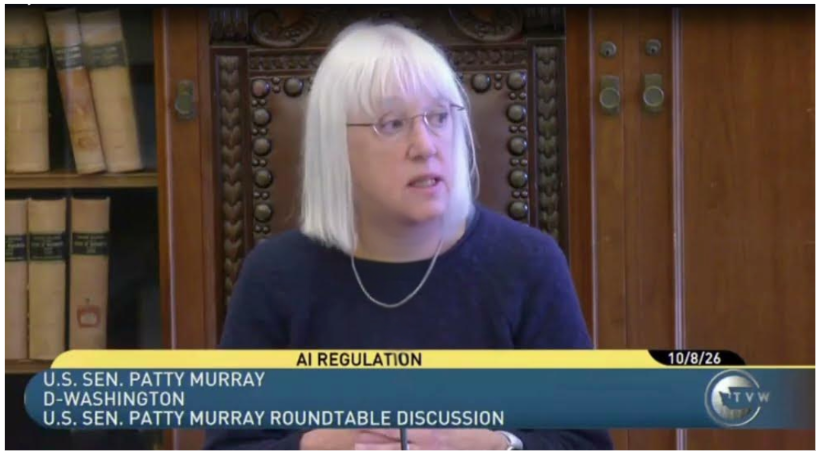
“We can’t afford to regulate AI with nothing but a pinky promise.” Sen. Patty Murray (D-WA) hosted a roundtable discussion of AI policy in Olympia yesterday. Participants included representatives from Gov. Bob Ferguson’s office, Attorney General Nick Brown’s office, state CTO Gretchen Peri, and Transparency Coalition CEO Rob Eleveld.
Oct. 9, 2026 — Sen. Patty Murray (D-WA) led a roundtable discussion on AI regulation yesterday in Olympia, calling artificial intelligence a powerful new technology with “great benefits, horrible risks” that must be addressed by Congress.
Joining Sen. Murray in the discussion were Transparency Coalition CEO Rob Eleveld; Beau Perschbacher, senior policy advisor to Gov. Bob Ferguson; Yuki Ishizuka, technology policy manager for Attorney General Nick Brown; and Gretchen Peri, CTO of Washington Technology Solutions, the state’s IT infrastructure agency.
“When I ran for office, I did so because I believe regular people deserve a say in how their government is run,” said Sen. Murray. “I feel the exact same way about the development of this technology. Regular everyday people should have a say and an ability to participate in it and earn from it as well.”
“We can’t afford to regulate AI with nothing but a pinky promise,” she added. “We cannot just wait for the worst risks of this technology to become reality before we take action.”
Sen. Murray: Opportunities and risks
“We all know there are real opportunities in AI,” Sen. Murray added. “I have seen a lot of them, whether it's in medicine, [scientific] discovery, and a lot of different areas. We all know it's going to mean disruption, and it poses real challenges and real threats that we all have to be a part of responding to. We have to make sure our constituents are safe and protected.”
Sen. Murray has called for Congress to regulate AI and been outspoken against President Trump’s efforts to ban states from regulating AI. As President Trump called AI safety concerns a “hoax” and rolled out the red carpet for Xi Jinping, Senator Murray sent a letter urging him to take the threat seriously and work out real AI safeguards with China. She recently introduced legislation to halt the A.I.-Driven Wasteful and Inappropriate Service Reduction (WISeR) model which is overruling doctors and delaying care for Medicare beneficiaries.
“Right now there is virtually no regulation of AI at the federal level,” she said yesterday. “I want America to develop and to deploy this technology in a way that is transparent and safe. We’ve got to make sure the benefits of AI are there for everyone, not just billionaires and technology experts... I had the chance last week to speak to the godfather of AI, Geoffrey Hinton. It was a really amazing conversation, and I have to say, I learned a lot. But what I learned from him is that there are a lot of risks. We need to be aware of them, and we need to deal with them. Is AI safe for our kids? Is it safe for someone with a mental health issue? Does it inflame delusions? There are risks from bad actors, whether it's a cyberattack or whether it's a deepfake scam.”
Video: Sen. Patty Murray opens an Oct. 8 roundtable discussion of AI policy, with Gov. Bob Ferguson’s senior policy advisor Beau Perschbacher offering an overview of state AI laws enacted in the past year.
Federal action on AI could follow a change in congress
Congress has failed to act on any of the many AI bills now stalled in the House and Senate. Sen. Murray indicated that a change could be coming, if one or both of the chambers were to change leadership following next month’s election. If the Senate were to move to a Democratic majority, the long-serving Sen. Murray would be one of the most senior members of leadership.
“At a minimum, I believe Congress has to put in a floor of basic bipartisan guardrails,” she said. “We need input, hearings, good testimony from our industry leaders, and I am deeply worried that is not happening on Congress right now. We have a president who says AI risks are a hoax, which is not helpful, and is totally wrong. We have him shaking hands with billionaires and saying they can regulate themselves. I don’t believe that for an instant. Congress has to take action.”
TCAI’s Rob Eleveld: Kid safety, ai audits, and liability laws are key
Transparency Coalition CEO Rob Eleveld talked with Sen. Murray about the work TCAI is doing to support legislative efforts around AI safety and transparency. He spoke about the importance of protecting kids, especially given the disastrous 20-year policy of letting social media design addictive products without any meaningful regulation. Now those same companies are at the forefront of developing harmful AI chatbots.
“These companies target kids because they're young, their brains aren't fully formed,” Eleveld said. “They can be addicted at a young age. So we have a core theme of protecting kids, and about seventy percent of our work is around bills to protect kids, especially with chatbot bills and deepfake likeness bills.”
Video: Transparency Coalition CEO Rob Eleveld describes high-priority areas of concern around AI safety and transparency.
AI companies ‘have a duty of care to not harm their customers’
Eleveld said TCAI will also focus in 2027 on two other areas of AI policy: third-party audits and product liability law.
“We’re working on ways to support robust third-party audits” of AI safety and compliance,” he said. “Auditing leads to transparency. We know about auditing because it’s used in finance. In cybersecurity, there's a SOC-2 compliance requirement. If you sell to a bank, which I did in my for-profit days, you have to prove that you're SOC-2 compliant, which is a fairly rigorous annual audit.”
“These are standard things," he said, and AI systems should be required to undergo similarly rigorous audits before they’re deployed.
Product liability laws already exist, Eleveld said, but legislative action is needed to make it clear that AI models, systems, and tools are products whose makers are required to exercise a duty of care to not harm consumers.
“Product liability laws have 125 years of history,” he said. They’re the reason we trust over-the-counter medicine. They’re why we trust the brakes in our cars. AI is absolutely a product that should be subject to the same laws. Product liability law doesn't get impacted by First Amendment issues because it doesn't say what you can or can't build. It just says if you're going to build a product, there is a duty of care to not harm your customers.”
Finding a way to elevate ‘human-focused, trustworthy innovation’
State leaders emphasized the need for legislative action, both at the state and federal level, to shape AI innovation that helps humans and improves communities while minimizing the technology’s harms.
“We need guardrails to ensure that AI development does not infringe on our rights, harm our families, or pose an existential risk to our country,” said Washington Attorney General Nick Brown. “Congress should act swiftly to put these protections in place, and I appreciate Senator Murray’s leadership on this issue.”
“Artificial intelligence is reshaping how we work and serve the public, so Washington is approaching this moment with intention,” said WaTech’s Gretchen Peri, the State Chief Technology Officer for Washington. “The statewide AI strategy we’ve developed is committed to human‑focused, trustworthy innovation, and gives state agencies the tools, guardrails, and shared platforms they need to deploy AI safely and transparently. Backed by new state laws that reinforce accountability and public trust, we’re proving that government can lead AI adoption with responsibility, foresight, humanity, and dignity.”
Further resources
The full roundtable was broadcast by TVW, which has an archived video of the event available.
Sen. Patty Murray’s media release on the event is available here.
The Transparency Coalition Action Fund (TCAF) has crafted four model bills for the 2027 legislative session, covering:
AI Product Liability: Holding tech companies accountable for the design and manufacture of safe products.
AI Chatbots and Kids Digital Safety: Building on learnings from TCAF’s successful 2026 bill, and adapting to evolving technology, this improved chatbot safety bill establishes best-in-class safeguards.
Educational Technology Procurement and Use: Ensuring the safe and appropriate procurement and use of technology in the classroom.
State AI Procurement: Guiding state agencies through the AI procurement process, ensuring product safety and transparency for state employees and all users.
For complete bill language contact Transparency Coalition Action Fund co-founder Jai Jaisimha.