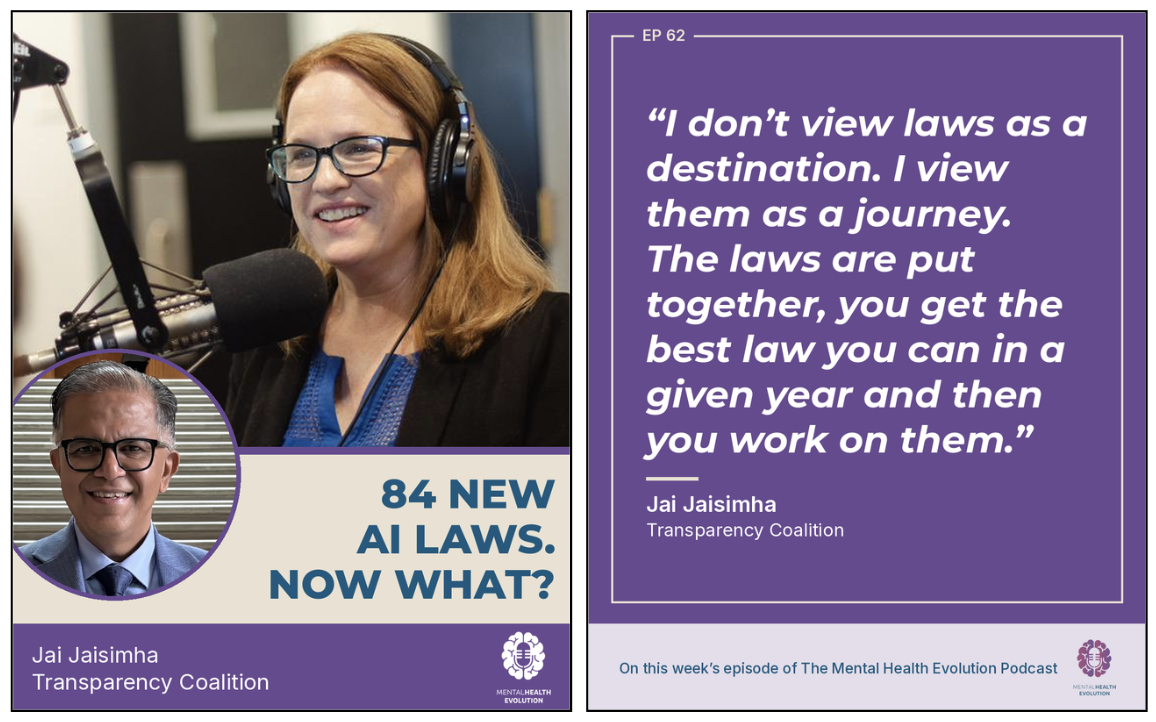
Oct. 30, 2026 — Transparency Coalition Co-founder Jai Jaisimha recently sat down with Rachel Harrison, host of the podcast The Mental Health Evolution, to talk about how AI is affecting health care.
Jaisimha touched on the factors driving this year’s surge in state AI legislation, and considered the various ways in which artificial intelligence tools are showing up in clinical settings.
We have an excerpt as well as the full conversation linked below.
Watch the full interview:
excerpt: ‘Lawmakers are listening’
This is an excerpt from Jai’s conversation with The Mental Health Evolution podcast host Rachel Harrison.
Rachel Harrison:
In your organization’s mid-year report you found 84 new AI laws in 27 states just in the first six months of 2026. [Editor’s note: That figure increased to 115 new laws in 30 states by Oct. 15.]
For people who have not been tracking this closely, can you give us a sense of this pace? It sounds dramatic, like it's accelerated quite a bit. What’s driving legislators to act now?
Jai Jaisimha:
The people that legislators pay the most attention to are their constituents.
This year, more than ever, constituents are speaking up about their fears, their hopes, and their concerns about artificial intelligence.
A year or two ago, I'd show up talk with legislators about artificial intelligence and people would say, "What is that?" I'd have to explain things. Now people crack open the New York Times every day and there's news item after news item about various AI-related harms and anxieties people are experiencing.
That has been one prime mover. The second is that every year for the past few years organizations like ours have tried to educate legislators. So there was a learning curve that people were climbing. I think we got some critical mass this year where more legislators were up to speed. Even when bills failed in 2025, the legislators involved in those bills said they wanted to take another whack at it this year.
Both those factors have been important in terms of driving the acceleration of AI bills over the past year.
Rachel Harrison:
For our audience of business owners in the health care industry, as well as clinicians and patients, which categories of AI legislation are most directly related or relevant to that work?
Jai Jaisimha:
There's a small body of legislation purposefully focused on mental health, especially as it pertains to the use of chatbots for patient-facing mental health therapy.
The American Psychological Association, for example, is actively involved. I think next year we will probably see more legislation around this issue. This past year was largely about general-purpose consumer use of chatbots with a focus on the mental health impacts that occur sometimes. They become caught up in treating the chatbot like a trusted person. And the outputs of chatbots can sometimes be confusing, misdirecting, or worse.
Certainly in, in terms of clinical use, there's widespread use of AI for clinical note-taking, transcription, and so on. But that’s not patient-facing.
I think the legislation affecting patients will be around healthcare data handling, privacy, patient opt-in, things of that sort. In terms of patient-facing AI, there are concerns about how much can or should be done with a clinician's supervision. Should AI be used as a app that can be used by a patient when they're not interacting with the clinician? How much transparency does the clinician have regarding what a patient is saying to the chatbot? At what point is a clinician alerted?
These are complex issues that will have to be dealt with in a future round of legislation. Some medical industry stakeholders might prefer clinician review. Others might prefer some other human-in-the-loop review. Others might prefer no review at all. Those will be the questions that will mix with the limitations of AI technology, and be debated to ensure that legislation protects everybody in the ecosystem.
Hear the full podcast episode
Listen to the full episode here: The Mental Health Evolution.
every ai law enacted in 2026