
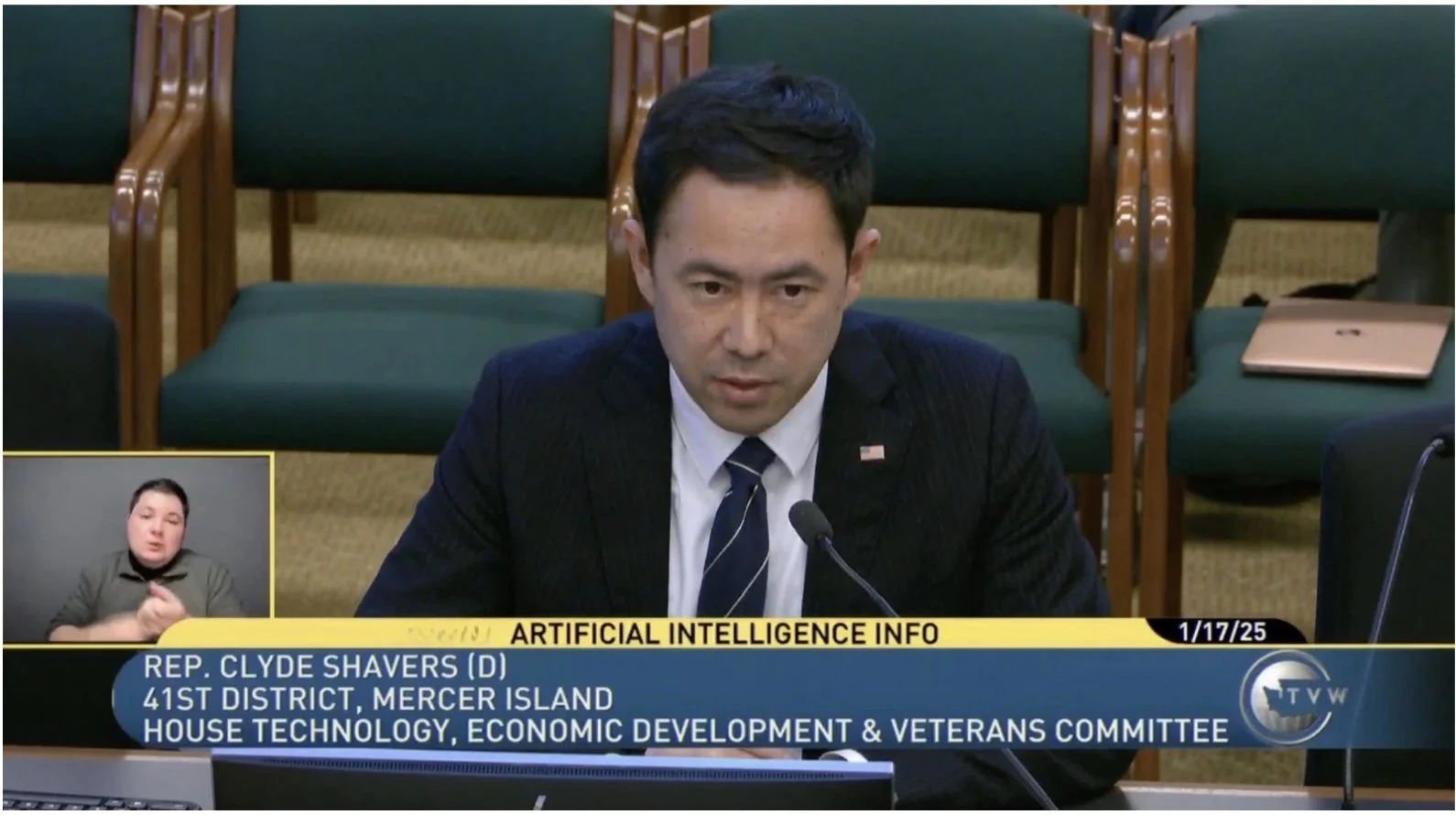
Rep. Clyde Shavers, seen here testifying last year, worked with the Transparency Coalition to craft HB 1170, an AI transparency measure. The bill was adopted and moved to the desk of Gov. Bob Ferguson on March 11.
March 12, 2026 — In a significant win for AI transparency and disclosure, the Washington legislature last night gave final approval yesterday to HB 1170, which would require AI operators to inform users when content is developed or modified by artificial intelligence.
The bill, sponsored by Rep. Clyde Shavers (D-Whidbey Island) and developed in partnership with the Transparency Coalition AI (TCAI), has been a top-priority measure for TCAI over the past two legislative sessions. HB 1170 now moves to the desk of Gov. Bob Ferguson, who has 20 days to act on the measure.
The Washington legislature is scheduled to adjourn later today, March 12.
Notifying consumers when AI has been used
The Act requires AI developers to embed provenance data in the media their AI creates, which will allow consumers to discover whether the developer’s AI was used to create that content.
Providers of generative AI systems can easily access technology to label or detect content created using their proprietary AI systems. The bill states: “By ensuring that the public has access to reliable provenance data, the providers of gen AI systems can improve the public's ability to assess the accuracy and authenticity of synthetic content, thereby helping to reduce risks of misinformation.”
Key provisions in the bill include:
Provenance data requirements: "Covered providers"—entities with over 1,000,000 monthly users—must include metadata or watermarking (provenance data) in AI-generated or "materially altered" images, video, and audio.
Material alteration: Significant changes to content require disclosure, but minor edits like resizing, cropping, or color adjustments do not.
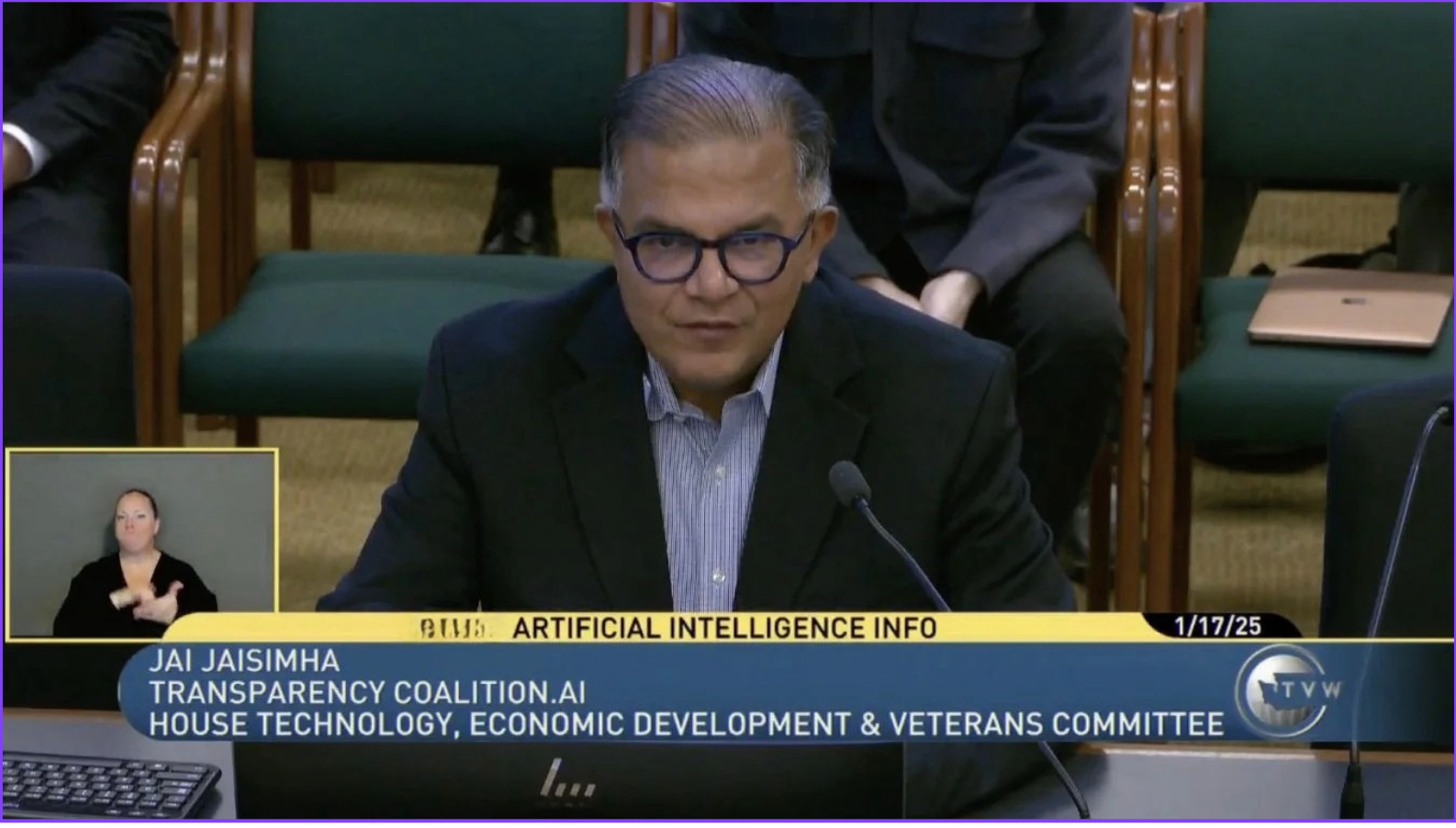
Transparency Coalition COO Jai Jaisimha, seen here testifying during an AI hearing in Olympia earlier this year, offered technical and policy expertise on the bill.
High priority bill for TCAI
Transparency Coalition co-founders Jai Jaisimha and Rob Eleveld have been offering expertise to legislators and advocating for the passage of HB 1170 since early 2025. The passage of the bill marks a milestone for the organization and for AI transparency nationwide.
“We celebrate the passage of HB 1170 which will bring much needed transparency to AI generated and modified content,” Jaisimha said following the final passage of the bill. “With this bill—which we hope will soon become law—Washington state becomes one of the national leaders in helping everyday citizens navigate the often confusing world of AI-generated content.”
Establishing a consistent standard across states
The Washington bill closely aligns with the transparency measure adopted by California in late 2024, known as SB 942. Codifying similar requirements into law in Washington, home of Microsoft, Amazon, and a thriving entrepreneurial tech industry, will protect consumers while establishing a consistent industry standard for all AI developers.
Rep. Shavers offered the measures as balanced proposals that “ensure consistency and clarity for developers operating across state lines.” The goal of the legislation, he said, is to forward the core principle of transparency while not stifling innovation.
The bills, he added, “are positioning Washington as a leader in ethical artificial intelligence development.” They “balance innovation with responsibility, and insure that technological progress serves the interest of all of our citizens.”
Holding tech companies to their word
Tom Kemp, the author and tech policy thought leader, testified in favor of HB 1170 earlier this year, prior to being named executive director of the California Privacy Protection Agency.
Kemp, who collaborated on the California version of HB 1170, emphasized the bipartisan nature of the measure. “This bill is largely based on a bipartisan proposal at the federal level, the AI Labeling Act of 2023, co-sponsored by Sen. John Kennedy (R-LA) and Sen. Brian Schatz (D-HI).”
The bill only applies to the largest providers of generative AI, Kemp added, “so it doesn’t stifle start-ups in California or Washington.” It builds on a pledge that major tech companies made in 2023 to “develop and deploy mechanisms that enable users to understand if audio or visual content is AI-generated, including robust provenance.”
That pledge remains on OpenAI’s own web site. Despite the pledge, the ChatGPT developer has failed to develop or release those mechanisms.
“This bill,” said Kemp, “codifies that pledge,” holding tech companies to their promise.