
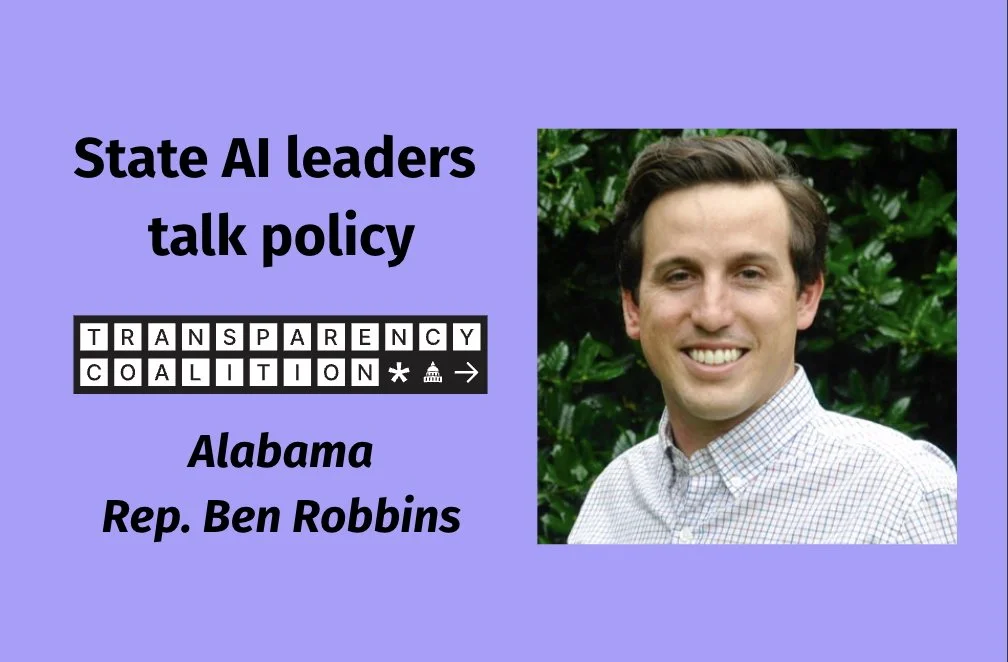
Jan. 26, 2026 — Alabama State Representative Ben Robbins (R-Coosa and Talladega County) is a seventh-generation resident of Talladega County (yes, where the NASCAR track is), a community leader, and a family man. A relative newcomer to politics, Robbins won a 2021 special election to fill out the term of his late predecessor, who had represented District 33 for 42 years.
Now in his second term, Rep. Robbins has introduced 2026 measures to protect children from social media and addictive algorithms, as well as a bill to create an AI and Children’s Internet Safety Study Commission.
When he’s not in the state capitol, Robbins serves on the local library board and volunteers for Habitat for Humanity. We grabbed a few minutes with him in the family car, with his wife driving and their five-year-old son riding in the backseat.
Video interview: Alabama Rep. Ben Robbins
Q&A with Rep. Ben robbins
Issues that reach all corners of alabama
TCAI: Can you tell us about the district you represent in Alabama?
Rep. Ben Robbins: I represent House District 33. It’s a rural district that has part of Talladega County and Coosa County. So, uh, it's a rural district in East Central Alabama.
TCAI: Do you have the Talladega Speedway in your district?
Rep. Robbins: I do not have the speedway in my district, but yes, that's, you know, near us within the county.
‘Make sure we allow children to be children’
TCAI: Can you tell us a little bit about what led to your interest in legislation around kids, technology, and artificial intelligence?
Rep. Robbins: WelI, have a five-year-old son. He's actually in the car with me. You might hear him in the background.
I started to hear and read more studies about child development and think about the world in which he's growing up. And I wanted to make sure that we allow children to be children—really, that’s the main thing driving me to pursue these issues.
Protecting kids from data collection abuse
TCAI: You've got kind of a couple different issues that you've filed some bills on this year. You've got HP 171 and 173. These are bills that are concerned with addictive feeds, notification, limits regarding minors online, that sort of thing. What would those bills do?
Rep. Robbins: The purpose of those bills, both of them really, is to regulate the way in which the data of minors is collected and stored.
I think we do have a problem. We need to make sure that we aren't collecting data from minors and then using that data to either sell them products or to push them [to continue using the product], whether that might be a feed or it might be a video, to keep them online longer.
That ties into the algorithms. I just personally think that it's not proper to create a product that has algorithms that draw you in and keep you on their device longer and longer and longer and longer and longer.
So those two bills are meant to create a framework where you can't store the data of minors, and you can't then use that data. And we’re requiring safer algorithms for children when they are on those devices. That's kind of a compromise bill, instead of imposing an outright ban on access for minors.
A bill that I introduced last session for social media, that was an outright ban. I toned it down a little bit this year to try to find common ground where we can get something passed and at least make some progress for children.
Giving parents a way to manage digital access
TCAI: Are you hearing about this issue from constituents, from neighbors, from, you know, fellow parents around your district?
Rep. Robbins: Yes, and not just in my district but across the state and the nation.
I hear from other parents that are concerned about their children, concerned about the world and the way in which technology is advancing so fast.
I mean, I don't consider myself old by any stretch of the imagination, but technology has changed so much in the way in which social media or AI or any form of technology has become so much more addictive. And it’s become so much more a part of people's lives.
As Amy Coney Barrett said in the recent Supreme Court case about online pornography, there are just so many ways children can get to the internet and you can’t block every single way. It becomes very difficult for parents.
And so I think that we have to have some legislative acts to try to make it a safer environment for parents and children. Because even the parents that want to keep their children safe don't even know how.
It’s not just a gut feeling I have. The more I read about people like Jonathan Haidt [the author of The Anxious Generation] and that movement, and read sociology and psychology reports that define these problems scientifically, the more I’m compelled to say there’s a need for this.
We’re seeing the problems it’s causing with children in terms of anxiety, lack of interaction with others, and depression, suicide, lack of social development. I think that if we don’t act, those problems will continue to worsen. Not just in my district, but in Alabama and across the nation.
Neurological and biological data privacy
TCAI: Another area you’re active in, this legislative session, is regarding personal privacy and the use of data, especially biological, neurological, and DNA data. Tell us about the need there.
Rep. Robbins: The more you peel back the onion, the more you think about other issues. You see the need not just for protecting children, the way in which a child engages with AI or with social media, but you start to think about the data that is being collected on all of us and how that data is being used.
We have HIPAA laws to protect all of our medical-grade data. But we don't have the same laws concerning data that you hand over every day with your devices, or how that's to be regulated and handled. I found that to be concerning—an individual providing information through a health app, or a sleep meditation app, there's a lot of biometric data that we are handing over that is not being protected.
We have set a precedent with HIPAA. We should follow that on the commercial side with apps in any form of technology.
Looking at AI chatbots and kids
TCAI: You’ve also you expressed interest in AI and concerns around that area. Are you bringing anything forward in the near future there in Alabama?
Rep. Robbins: Yes, I think some of the sentiment I already expressed about social media, I think parlays directly into AI. I think that we've got to do something. I understand the executive order from Donald Trump, wanting to make sure militarily and in other ways we don't fall behind China. And I'm not anti-technology. I think that tech makes our lives easier, it allows business to operate more efficiently than they ever have in the past. But new technology does present new issues.
AI is one of those where the regulatory process, the legislative process, has not caught up with this rapid expansion of technology.
I think that we do have an obligation to protect children. One of the things I’m looking at and have bills prepared for is in the area of chatbot companions and way in which children can or cannot communicate with them.
I think we also have concerns tying in with privacy and AI. We've got to think about whether your name, image, and likeness is a property right. Do you have a right to it? And where does that right extend? We've never really tied those threads together. I think tying name, image, and likeness together goes back to my thoughts about the bill on neuro privacy.
We never necessarily embedded it into our Bill of Rights, but we do have a freedom of consciousness and a freedom of thought. That means you have a freedom to be who you choose to be. And you have the right to yourself.
Now that AI can duplicate you, make an image of you saying something that you never said, what is your recourse against an individual who does that? I think that it goes beyond just defamation because it is really a property right, a Constitutional right to who you are in yourself.
Meet more state AI policy leaders
The latest news on state AI bills
