During the state legislative season TCAI offers weekly updates every Friday on a variety of AI-related bills making progress in around the nation.
Get your weekly update delivered via email every Friday morning by subscribing to the AI Legislative Update newsletter:
AI bill action this week
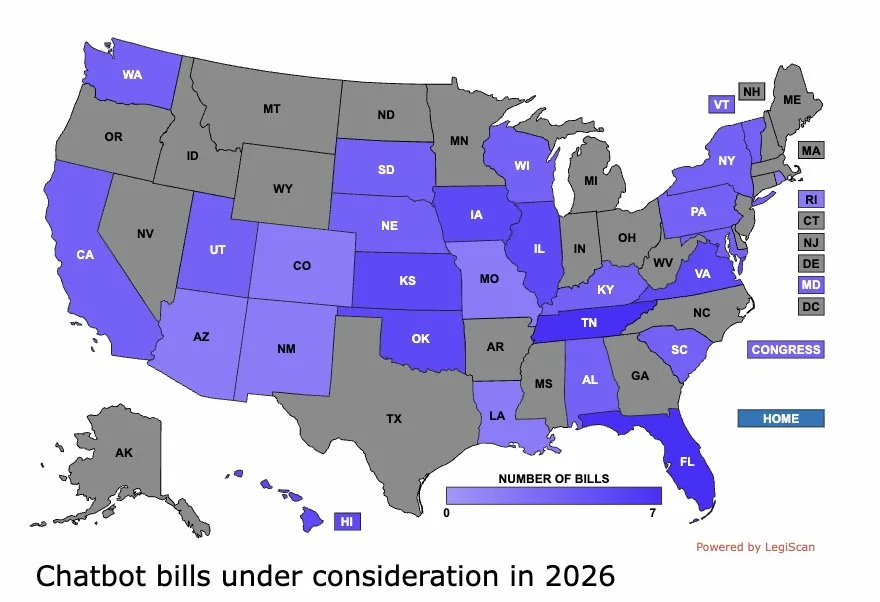
This week: New York legislators wrapped up their 2026 session after sending seven AI-related bills to Gov. Kathy Hochul. Rhode Island passed a therapy chatbot ban. Colorado Gov. Jared Polis exercised his veto power on a bill that would have prohibited the use of algorithmic pricing in the state. Arizona lawmakers struck a budget agreement with Gov. Katie Hobbs, clearing the way for adjournment in the next few days.
Arizona: Legislators finally came to budget agreement with Gov. Katie Hobbs on Wednesday, with a final vote looking likely for Thursday or Friday. That could end this year’s session—but three AI bills remain alive seeking final passage.
California: California’s 30 remaining AI-related bills have crossed over and now undergo consideration in second-chamber committees. Next deadline: The scheduled July 2 one-month summer adjournment. Lawmakers then return Aug. 3 with a sine die date of Aug. 31.
Colorado: Gov. Polis signed four AI-related bills into law., but on June 2 he vetoed HB 1210, an algorithmic pricing bill.
New York: A number of AI-related measures are now on the move in Albany. S 9408A would ban the sale of AI chatbot toys; the bill was quickly approved by both Senate and Assembly this week. The Senate approved S 6954, an AI disclosure bill, along with S 1169, a high-risk audit and algorithm discrimination bill.
Rhode Island: This past week the House and Senate both approved a therapy chatbot ban (H 7349). Also moving: S 2010 (health care AI use transparency), and S 2195 (chatbot safety). All are now scheduled for committee hearings or votes.
Arizona
Republican legislators finally found agreement with Democratic Gov. Katie Hobbs on a final state budget, with a final vote expected by Friday, June 12. Adjournment should follow soon after. One AI-related bill was passed and sent to Gov. Hobbs this past week, with three others awaiting final votes.
Approved:
HB 2592 would require every state agency to identify opportunities to implement AI systems that reduce administrative burdens, and eliminate regulations that restrict the adoption of AI systems. A reconciled bill found final passage on June 9 and has been sent to Gov. Hobbs. (Rep. Wilmeth)
Three AI-related bills remain in play:
HB 2133 would amend the state’s existing statute on the unlawful disclosure of images depicting states of nudity or specific sexual activities. The law would include the “synthetic depiction” of images not allowed under existing law. Conference committees have wrangled over differing versions of the bill since early April. The Senate gave final approval to a reconciled bill on June 9, with a 16-12 vote. Now we’ll see if the House does the same. (Rep. Kupper)
HB 2311 is a chatbot safety bill. It would require a chatbot operator to disclose that the user is interacting with AI, and prohibits points/rewards/gamification of interaction for account holders who are minors (under 18). Operators would be prohibited from producing images of sexual content or statements that the user should engage in sexual conduct. (That’s for all users, not just minors.) Operators must offer parental controls for account holders under 13 years of age. Approved by the House on Feb. 24, approved by the Senate on June 9. Motion to reconsider vote in Senate on June 10. (Rep. Rivero)
SB 1786 concerns the required inclusion of provenance data in video, image, or audio created or altered by generative AI. Approved by full Senate on March 3, approved by full House on April 15. On April 27 Rep. Carbone requested the Senate to return SB1786 for the purpose of reconsideration. Odds are looking slim for passage prior to adjournment. (Sen. Petersen)
California
California’s 30 remaining AI bills have crossed over and are now under review by their secondary chamber committees.
Assembly bills on the move:
AB 2 would make a social media platform liable for specified damages if the platform fails to exercise ordinary care or skill by causing injury to a child. Approved by Assembly in May 2025, now with Senate. Originally scheduled for June 8 hearing with Senate Privacy, Digital Technologies, and Consumer Protection Committee, but that was postponed by author on June 5. (Asm. Lowenthal, et al.)
AB 412 is a copyright protection bill that passed the Assembly during the 2025 session and was held over. It would require AI developers to document any copyrighted materials used to train an AI model, and make available a mechanism allowing a rights owner to submit a request for information regarding their copyrighted material and its use. It’s now moving again in the Senate, with the Judiciary Committee giving approval 6-2 on June 8. (Asm. Bauer-Kahan, Asm. Kaira)
AB 1159 would apply the state’s existing student privacy protections (under KOPIPA and ELPIPA) to digital operators with knowledge that the site, service, app, etc, is used for and marketed for school purposes. Approved by Assembly on Jan. 26. Approved and reassigned to Senate Privacy cmtee on June 10. (Asm. Addis)
AB 1609 concerns customer service chatbots. Approved by full Assembly on May 27, sent to Senate. Working through amendments with Senate Privacy as of June 10. (Asm. Zbur)
AB 1651 relates to the use of AI in the development or administration of the State Bar exam. Full Assembly approval 68-0 on April 16, sent to the Senate Judiciary Committee on May 6. (Asm. Dixon)
AB 1883 is a similar workplace surveillance bill. Passed out of suspense. Approved by Assembly on May 27, sent to Senate. Still with Rules Committee as of June 11. (Asm. Bryan)
AB 1979 concerns the use of AI in healthcare services. Approved by Assembly 48-15 on May 21, sent to Senate. Referred to Privacy, and Health committees on June 3. (Asm. Bonta)
AB 1988, the Preventing AI User Self Endangerment (PAUSE) Act concerns AI chatbot safety. Approved by Health Cmtee and sent to Appropriations on April 22. Passed full Assembly on May 21, sent to Senate. Assigned to Privacy, and Health committees on June 3. (Asm. Pellerin)
AB 2023 and SB 1119 are companion bills concerning chatbots and children’s safety. AB 2023 was approved by the Committee on Privacy & Consumer Protection on April 21, sent to Assembly Appropriations. Senate version referred April 21 to Senate Appropriations, now set for hearing on May 11. (Asm. Bauer-Kahan, Asm. Wicks, Sen. Padilla) AB 2023 approved by Assembly on May 26, sent to Senate. Assigned to Privacy, and Judiciary committees on June 3. (SB 1119 was approved by the full Senate 39-0 on May 19 and sent to the Assembly.)
AB 2025 is a real estate AI disclosure bill that would require the disclosure of AI used to digitally alter any promotional materials regarding the sale of real property. Approved by Assembly on May 14. Approved and reassigned to Senate Privacy on June 8, now working through amendments. (Asm. Pellerin)
AB 2071 would require digital health to be taught as part of existing courses in health education in California schools. Passed Assembly 75-0 on May 28, sent to Senate Education Committee on June 10. (Asm. Hoover, Sen. Umberg)
AB 2148 would explicitly state that a public school employee and a contractor providing services in a public school specifically means a natural person. Approved by the full Assembly, 76-0, on May 4. Approved by two Senate committees, sent to consent calendar on June 10. (Asm. Muratsuchi, Asm. Hoover)
AB 2392 is an Ed Tech bill that would require the California Community Colleges and the California State University, and would request the University of California, before providing a Gen AI system to students, faculty, or staff, to convene a joint working group to present recommendations for procurement standards and training, submitted by Jan. 1, 2028. Approved by Assembly, 77-0, on May 26, sent to Senate Education and Privacy committees on June 10. (Asm. Fong)
AB 2545 would establish the California Artificial Intelligence Worker Impact Data Assessment Project and would establish the California Artificial Intelligence Worker Impact Data Assessment Project Advisory Panel in the EDD. The bill would require the EDD to perform an assessment of data sources and collection methods regarding the use and impact of advanced artificial intelligence systems on the labor force. Approved by Assembly on May 21, now with Senate, hearing scheduled June 17 with Senate Labor Committee. (Asm. Schiavo)
AB 2575 concerns the use of AI in health care. Approved by Assembly on May 27, assigned to Senate Health and Privacy committees on June 10. (Asm. Ortega)
AB 2713 adjusts the existing California AI Transparency Act. The Act currently requires a large online platform to provide a user interface that makes information clearly and conspicuously available to users. The act requires that information to include whether provenance data or digital signatures are available. This bill would instead require that information to include whether provenance data or digital signatures are embedded into, attached to, or otherwise associated with the content. Approved 74-0 by Assembly on May 21, sent to Senate. Assigned to Senate Privacy committee on June 3. (Asm. Wicks, Asm Aguiar-Curry)
Senate bills moving forward:
SB 300 would strengthen existing laws regarding chatbots, by requiring companion chatbot operators to prevent its chatbot products from producing or facilitating the exchange of any sexually explicit material or proposing sexually explicit content. Approved by full Senate, 38-0, on Jan. 26, assigned to Assembly P&CP cmtee on May 11 . (Sen. Padilla)
SB 574, Sen. Umberg’s bill from 2025, was amended and re-referred to the Senate Appropriations Committee. The bill would establish protections and standards for attorneys licensed by the state, with regard to their use of AI. Approved by Senate on Jan. 29, sent to Assembly.
SB 719 would amend an existing law that requires the Department of Technology to submit an annual report to the legislature with an inventory of all high-risk automated decision systems used by state agencies. Approved by Senate on third reading on Jan. 26, sent to Assembly C&CP Cmtee, working through amendments as of June 10. (Sen. Cabaldon)
SB 813, Sen. McNerney’s bill from 2025, was revived and re-referred to the Senate Appropriations Committee. The bill would establish a California AI Standards and Safety Commission. Approved by Senate, 31-7, in Jan. 27 vote, sent to Assembly P&CP Cmtee on May 4.
SB 867 would prohibit the inclusion of companion chatbots in toys. Approved by Senate on May 28, now with the Assembly P&CP as of June 4. (Sen. Padilla, et al)
SB 903 concerns the use of AI and the transcription of patient information in professional mental health therapy. Approved by full Senate 39-0 and sent to Assembly on May 19. Hearing scheduled June 16 with Assembly Business cmtee. (Sen. Padilla, Sen. Rubio)
SB 928 is a bill concerning the protection of California State University employees from the encroachment of artificial intelligence. Specifies that CSU instructors must be human, not AI. Approved by full Senate, 37-0, on April 23, passed out of Assembly Committee on Higher Education on June 9. (Sen. Cervantes)
SB 947 This bill would establish worker protections regarding the use of AI and automated decision systems (ADS). Approved by Senate 29-9 on May 19 and sent to Assembly. Working through amendments with L&E cmtee as of June 4. (Sen. McNerney, Sen. Reyes)
SB 951, is a ditigal displacement notice bill, requiring 90-day notice from certain covered employers before any technological displacement affecting 25% or more of the workforce. Approved by full Senate 28-9 on May 20, sent to Assembly. (Sen. Reyes)
SB 1000 modifies existing law regarding AI disclosure and provenance data. Approved with urgency clause by Senate 33-1 on May 19. Sent to Assembly Committee on P & CP. (Sen. Becker)
SB 1015 expands existing law regarding contact with a minor with intent, to include threats or extortion induced through the use of AI-generated deepfake images. Approved 33-0 by the Senate on May 22, sent to the Assembly Public Safety Committee on June 1. (Sen. Strickland)
SB 1050 would require disclosures about the use of AI in advertisements. Approved on May 28, now with Assembly Privacy and Judiciary cmtees as of June 4. (Sen. Ashby)
SB 1111 concerns AI and digital replicas. Existing law prohibits the false impersonation of another person with the intent to steal or defraud. This bill would clarify that false impersonation includes the use of a digital replica with the intent to impersonate another. Approved by full Senate, 36-0, on April 30, now with the Assembly Privacy and Public Safety cmtees. (Sen. Ashby)
SB 1119, a chatbot safety bill, companion to AB 2023, see under AB 2023 above. Approved by Senate Judiciary, referred to Appropriations on April 21. Approved by full Senate 39-0 on May 19. Sent to Assembly Privacy and Judiciary cmtees as of June 4. (Sen. Padilla)
SB 1146 adds artificial intelligence provisions to existing false advertising law around health-related consumer products. Approved by full Senate 36-0 on May 18. Sent to Assembly Privacy and Judiciary cmtees. (Sen. Gonzalez)
SB 1159 would specify that, for purposes of the California Public Records Act and other open meeting acts, “person,” “interested person,” “participant,” “member of the public,” and any other similar terms do not include artificial intelligence systems, autonomous agents, robots, or other nonhuman entities, whether physical or digital. Passed by full Senate, 38-0, on May 4, working through amendments with Assembly Privacy cmtee, hearing scheduled June 23. (Sen. Cabaldon)
SB 1181 is a bill concerning legislation to protect the mental health, safety, and well-being of children and adolescents in California by addressing the growing impact artificial intelligence and digital technologies have on youths’ mental health development. Approved by Senate on May 28, now working through amendments in Assembly committees. (Sen. Hurtado)
Colorado
Colorado lawmakers wrapped up their 120-day session on May 13. Prior to adjournment, these five AI-related bills were approved and sent to Gov. Polis:
SB 189: This revised version of Colorado’s 2024 AI Act replaces algorithmic discrimination requirements with a lighter framework governing automated decision-making technology; eliminates risk management programs and annual impact assessments; and introduces a new liability and indemnification framework. (Sen. Coleman, et al.) Approved by House on May 9, approved by Senate on May 12. Signed by Gov. Polis on May 14.
HB 1263, a chatbot safety bill, includes standard notification requirement, with parental access tools, ban on sexually explicit/emotional dependence content, and prohibition on gamifying engagement. Affects minors (under 18) only. Senate final passage May 11, House passage May 12. Signed by Gov. Polis on May 29. (Sen. Camacho, et al)
HB 1210 is a dynamic pricing bill, concerns limitations on the use of intimate personal data to make inferences that affect a person’s financial position. Senate final passage May 6, House final passage May 7. Vetoed by Gov. Polis on June 2. (Rep. Bacon, et al., 25 co-sponsors total)
HB 1195 is concerned with the use of AI related to psychotherapy services. Senate final passage May 11, House final passage May 12. Signed by Gov. Polis on June 3. (Rep. Mabrey, et al)
HB 1139 deals with the use of AI in health care. Approved by House on March 16, approved by Senate on May 11. Signed by Gov. Polis on June 2. (Rep. Joseph, Rep. Lieder)
Hawaii
Lawmakers adjourned sine die on May 8. Of Hawaii’s six AI-related bills introduced, two were approved and sent to Gov. Josh Green. Both bills still awaited signature as of June 11.
SB 3001 requires AI operators to issue certain disclosures to account holders and users, develop protocols to prevent the production of suicidal ideations in account holders and users, establish protections for minor account holders of conversational artificial intelligence services. (Sen. Keohokalole, et al) Approved, sent to Gov. Josh Green on May 8.
HB 2137 is an AI deepfake bill that prohibits certain harmful uses of digital imitations, and requires the disclosure of the use of synthetic performers in advertising. (Rep. Lee, et al) Approved, sent to Gov. Green on May 7.
ILLINOIS
Illinois lawmakers stretched their final weekend past the actual definition of weekend, working through the night until at last declaring sine die at 4:30 a.m. Monday morning, June 1.
In the end, the legislature accomplished quite a lot on the AI policy front. Five AI-related bills were approved and sent to Gov. J.B. Pritzker, including the landmark SB 315 frontier model safety bill.
The five bills given final approval were:
SB 315: The Artificial Intelligence Safety Measures Act
SB 318: The Prohibition on Bots Purchasing Tickets Act
SB 343: Prohibiting Rental Property Price Fixing with AI
SB 2909: Prohibiting the Use of AI for Teacher Evaluations
SB 3114: Restricting the Use of AI in Health Care Approvals
See our full coverage of all approved bills in the article below:
Louisiana
This year’s session adjourned sine die on June 1. These five AI bills were enrolled and sent to Gov. Landry.
HB 119, concerning unlawful conduct involving images of another person created by artificial intelligence. Enrolled and sent to governor on June 1. (Rep. Fontenot)
HB 369 would require the disclosure of the use of AI in campaign telephone communications. Approved by the House on April 14, approved by the Senate on May 25, signed by Gov. Landry on May 29. (Rep. Bayham)
HB 459 relates to the use of AI in political campaigns. Enrolled and sent to governor on June 1. (Rep. Landry)
HB 475 would require a medical patient’s consent prior to recording a medical visit. Approved 97-0 by the House on April 14, approved by Senate on May 18, re-approved by both chambers May 28. Signed by Gov. Landry on June 2. (Rep. Berault)
SB 386, would require social media platforms to allow users to opt out of providing personal information. Approved 36-0 by Senate on April 8, by the House on May 18, signed by Gov. Landry on May 29. (Sen. Connick)
Massachusetts
Several AI-related bills are in play:
S 243 and S 264 are separate AI disclosure bills that require consumer notification for software or computer program that simulates human conversation or chatter through text or voice interactions.
S 994 concerns algorithmic rent setting. New draft in the Senate as of March 12. (Sen. Friedman)
S 2632 concerns the use of AI in healthcare decision-making. With Senate Ways & Means as of April 2.
H 1931 concerns the use of AI in CSAM. House study order on March 26. (Rep. Paulino)
H 4616 concerns the use of AI in healthcare prior authorizations. Reporting date extended to June 15, 2026, in the House.
H 76 concerns the dissemination of AI-generated deceptive election-related communications. (Rep. Farley-Bouvier.)
S 301 would establish the Massachusetts Information Privacy and Security Act. (Sen. Finegold.)
H 666 would require public schools to have a policy regarding the use of personal electronic devices on school grounds and during school activities. (Rep. Peisch, Rep. Lipper-Garabedian.)
Michigan
Michigan has these AI bills in play:
SB 760 is a kids chatbot safety bill. The bill would prohibit chatbot operators from offering products to minors unless it is not capable of encouraging the minor to engage in self-harm, suicidal ideation, violence, consumption of drugs or alcohol, or disordered eating. The chatbot may not offer mental health therapy to the minor without the direct supervision of a licensed or credentialed professional, and it may not discourage the covered minor from seeking help from a qualified professional or a parent or guardian. Approved by full Senate on April 29, now with House Communications Committee. (Sen. Polehanki, Sen. Geiss)
HB 5899 would create a state artificial intelligence pilot program. Sent to House Rules Committee on May 19. (Rep. Greene, et al)
HB 5771 is an AI surveillance pricing consumer protection bill. Now with the House Economic Competitiveness Committee. (Rep. Arbit, et al)
Missouri
Missouri lawmakers adjourned sine die on Friday, May 15.
One bill of significance to AI policy was approved and sent to Gov. Kehoe.
SB 1019 modifies several provisions relating to health care, including a prohibition on the offering of AI therapy chatbots. Advertising an AI chatbot as capable of offering therapy services, a mental health diagnosis, or representing itself as a mental health professional is subject to a $10,000 fine for first offense, and $20,000 for second and following offenses. Enforced by attorney general. Truly agreed to and finally passed on May 15, sent to governor. (Sen. Crawford)
New hampshire
This year’s session runs through June 30. Only one AI-related bill, SB 657, appears to have a chance of passage.
SB 657 creates the Artificial Intelligence Oversight Act, which would establish a division within the state attorney general’s office to monitor and act on artificial intelligence issues that affect consumers. Passed full Senate on voice vote on March 26. Passed full House on May 14, now in conference. (Sen. Kwoka, et al)
HB 1124 concerns the right to compute. Approved by the House on a voice vote, March 11, sent to Senate Judiciary Committee on March 17, hearing scheduled for April 21. Referred to interim study on May 13. (Rep. Ammon, et al.)
SB 640 concerns the use of artificial intelligence to provide services requiring a professional license. The bill would prohibit the use of an AI system posing as a state-licensed counselor or therapist. Approved by the full Senate on March 12. The House has scheduled a public hearing on April 15. Voted inexpedient to legislate on May 14, effectively killing the bill. (Sen. Pearl, et al.)
NEW Jersey
New Jersey has two bills dealing with AI issues:
S 1802 would require the New Jersey Office of Information Technology to establish minimum requirements for an AI safety test for artificial intelligence technology sold, developed, deployed, used, or offered for sale in the state. Referred to Senate Commerce Committee. (Sen. Singleton, Sen. McKnight.)
SR 52 is a resolution urging generative AI companies to make voluntary commitments regarding employee whistleblower protections. Referred to Senate Labor Committee. (Sen. Mukherji, Sen. Lagana.)
New York
Legislators in Albany wrapped up the 2026 session on June 1 by passing a kids chatbot safety bill, an AI training data transparency act, the FAIR News Act, a data center moratorium, and a ban on AI-assisted surveillance pricing. Gov. Hochul now has until Dec. 31 to sign the bills.
AI-related legislation approved and sent to Gov. Kathy Hochul:
S 9051, is a kids chatbot safety bill that prohibits artificial intelligence chatbots from using features which are considered unsafe for minors; defines terms; specifies what are considered unsafe features; and provides for private rights of action. (Sen. Gonzalez)
A 6578 establishes the Artificial Intelligence Training Data Transparency Act, which would require developers of Gen AI models or services to post on the developer's website information regarding the data used by the developer to train the generative artificial intelligence model or service, including a high-level summary of the datasets used in the development of such system or service. (Assm. Bores, et al., and Sen. Gounardes)
S 6954 is an AI disclosure bill that would require synthetic content creation system providers to include provenance data on synthetic content produced or modified by a synthetic content creations system that such provider makes available. (Assm. Bores, Sen. Gounardes.)
S 8451 would enact the New York Fundamental Artificial Intelligence Requirements in News Act (FAIR Act). Provides transparency requirements for news media content composed, authored, or otherwise created through generative AI. (Sen. Fahy, et al.)
A 9349, a bill prohibiting the practice of surveillance pricing. (Asm. Torres)
A 11560, the Responsible Data Center Development Act, would establish a statewide one-year moratorium on the permitting of hyperscale data centers with a peak load of more than 20 megawatts. (Asm. Barrett, Sen. Gonzalez)
A 3411,a warning label bill, was approved earlier this session by both chambers. This bill requires the owner, licensee or operator of a generative artificial intelligence system to conspicuously display a notice on the system's user interface apprising the user that the outputs of the generative artificial intelligence system may be inaccurate. (Asm. Vanel, et al)

Ohio
AI-related bills under consideration:
HB 185 is a deepfake protection bill that would expand Ohio’s Right of Publicity law by eliminating the requirements that an individual’s persona have commercial value and that the unauthorized use be for a commercial purpose in order for there to be a violation of the law. Scheduled for hearing, House Committee on Technology & Innovation, June 2. (Rep. A. Mathews, Rep. T. Mathews)
HB 665 is concerned with AI and algorithmic pricing. Referred to Committee on Technology & Innovation on Feb. 4. (Rep. Cockley, et al)
HB 524 would impose penalties on entities whose AI models suggest harming one's self or another person. With Committee on Technology & Innovation. (Rep. Cockley, et al.)
HB 579 would regulate the use of artificial intelligence by health insurers. With House Insurance Committee. (Rep. Schmidt.)
HB 525 would regulate the use of AI systems by state-licensed therapists. With House Health Committee. (Rep. Cockley, et al.)
HB 469 would declare artificial intelligence systems nonsentient and prohibit them from obtaining legal personhood. With Committee on Technology & Innovation. (Rep. Claggett.)
HB 628 would create an independent verification organization license for verifying artificial intelligence risk mitigation. With Committee on Technology & Innovation. (Rep. Mathews, et al.)
HB 786 would prohibit use of an artificially generated depiction of a minor for obscene purposes. Referred to House Judiciary Committee on March 25. (Rep. Klopfenstein, et al)
HB 813 would require AI-generated products to have a watermark, and would require AI systems to disclose. Introduced April 13. (Rep. Cockley, et al)
SCR 14 and HCR 31 are companion resolutions urging Congress to reject any moratorium on state AI laws. Referred to Senate Financial Institutions Committee on Feb. 11, to House Tech & Innovation Committee on Feb. 4. (Sen. Blessing, Rep. Cockley)
Pennsylvania
Pennsylvania has a number of AI-related bills in play:
HB 2006 is the Artificial Intelligence in Companionship Applications Safety Act. This bill requires safeguards built into companion chatbots, especially concerning suicidal ideation and/or self-harm. With Communications & Technology Committee. (Rep. Shusterman, et al)
SB 1090 is an AI disclosure bill that requires certain disclosures and safeguards relating to the use of artificial intelligence. Approved by the Senate, 49-1, on March 17. Now with the House Communications & Technology Committee. (Sen. Pennycuick, et al)
HB 2100 is a bill to regulate the use of mental health chatbots and artificial intelligence by mental health therapists. (Rep. O’Mara, et al)
HB 1857 would require business entities to disclose the use of artificial intelligence in certain consumer interactions, and establish the right of consumers to human review in high-impact decisions. (Rep. Waxman, et al.)
HB 1993 concerns the use of artificial intelligence in mental health therapy. (Rep. Shusterman, et al.)
HR 331 is a resolution urging the Pennsylvania Supreme Court to adopt safeguards governing the use of artificial intelligence by attorneys. (Rep. Krupa, Rep. Banta.)
Rhode Island
Lawmakers are scheduled to adjourn June 30. Under consideration:
S 2010 promotes transparency and accountability in AI use by health insurers. Approved by full Senate on June 9. (Sen. Ujifusa, et al.)
S 2195 requires operators of AI chatbots to create safety features regarding suicidal ideation, and physical or financial harm to others. Sent to Senate AI & Emerging Technology Committee, scheduled for hearing May 14. Approved by Senate on May 21, hearing scheduled with House Innovation Cmtee on June 4. (Sen. Urso, et al)
S 2197 concerns the use of AI in mental health treatments. Sent to Senate AI & Emerging Technology Committee, scheduled for hearing May 14. Approved by Senate on May 21, scheduled for hearing with House HHS Cmtee on June 4. (Sen. Urso, et al)
S 2266 prohibits the use of algorithmic pricing by landlords. (Sen. Mack, et al)
H 7119 would require a DOA inventory of all state agencies using artificial intelligence (AI); establishes a 13 member permanent commission to monitor the use of AI in state government. Held for further study as of April 8. (Rep. Lombardi, et al)
H 7349 establishes regulations regarding the use of AI in mental health care. Referred to House Health & Human Services Committee, held for further study on March 3. The bill came back to life in early June, with the HHS committee scheduled to hear an amended version on June 4. The House approved the substitute bill on June 8, the Senate approved on June 10. (Rep. Spears, et al)
H 7350 is an AI chatbot safety bill. Held for further study on April 8. (Rep. Spears, et al)
H 7538 would require healthcare providers to inform patients of the use of AI to memorialize patient visits. Approved by full House on April 16. Substitute bill in Senate June 8, recommends for passage June 9. (Rep. Tanzi, et al)
H 7543 would require AI-generated video or imagery be disclosed as AI. Held for further study on April 8. (Rep. Voas, et al)
H 7767 and S 2499 would create a comprehensive framework to regulate the use of AI in the workplace. Sent to House Labor Cmtee on April 15. (Rep. Noret, Sen. Gu, et al)
H 8242 is a therapy chatbot bill that would ensure therapy services are delivered by qualified, licensed professionals. Held for further study on April 2. (Rep. Shallcross-Smith, et al)
Vermont
Lawmakers adjourned sine die on Friday night, May 29. Two AI-related bills gained final approval as the clock ticked down:
H 211 concerns data brokers and personal information. Approved by House on March 25, by Senate on May 28, sent to governor May 29. (Rep. Priestley, et al)
H 816 is a therapy bot ban, which would regulate the use of AI in the provision of mental health services. Approved by both chambers in conference and sent to governor. (Rep. Berbeco, Rep. Arsenault, Rep. Priestley)
Vermont’s bill on the use of AI in election campaigns, S 23, was signed by Gov. Scott and enacted earlier this year. H 814, concerning the recognition of personal neurological rights, was signed and enacted by Gov. Scott on May 18.
Track AI legislation in 2026