
German court holds Google liable for AI hallucination: Read the full decision here

A regional court in Germany has found Google liable for harmful hallucinations produced by its ‘AI overview’ product. The court laid out precisely why the traditional liability shield for search engines does not hold for AI-produced material.
June 15, 2026 — In an important decision that could have implications for AI liability and government regulation, a German court has found Google directly liable for harm caused by false statements generated by its AI overview function. The court found that Google’s AI overview does not have the same status and liability protection as its classic search engine.
We have the full court ruling, translated from the original German, reprinted below.
Overview of the case
In its May 28, 2026, ruling, the Regional Court of Munich prohibited Google from spreading false claims about two Munich-based publishers through its AI-based search overviews.
Earlier this year a series of queries resulted in Google’s AI overview falsely linking the publishing company Verlagshaus24 to scams, subscription traps, and sketchy business practices. As first reported by Decoder: “According to the court, the AI mixed up information about other, genuinely sketchy companies with the plaintiffs and drew connections that didn't appear in any of the linked sources. The publishers sent Google a cease-and-desist letter, but Google didn't respond appropriately.”
Previous case law had established that search engines were not legally liable for the results turned up in response to a query. In its ruling, the German court held that “because the AI used by the defendant independently compiles the information in the overview and summarizes it into a summary text, this constitutes an independent presentation for which [Google] is responsible.”
“The false factual assertions impair the plaintiffs' social standing as businesses,” the court held, “and in the absence of a legally binding cease-and-desist declaration, there is also a risk of repetition. The plaintiffs therefore have a right to an injunction, which is also urgent in view of the ongoing infringement of rights and the impact of this continuous publication of untrue and defamatory statements on business operations.”
Google’s argument, which the court did not find persuasive, held that Google “merely operates a search engine that automatically displays the data and information of third parties in accordance with search queries. The defendant is therefore not itself responsible for data processing, does not adopt the information of third parties in the "overview with AI" as its own, and is accordingly only liable if it is made aware of an obvious infringement of rights.”
The German court did not agree. Google is liable, the court said, “because the disputed display of the ‘results with AI’ is not a mere display of search results, but rather content attributable to it.”
The court added: “This ‘overview with AI’ represents [Google’s] own statement made by its own AI offered to users.”
The court offered some critically important distinctions between a search engine and an AI overview. The AI results aren’t simply displayed as links or short previews, “but rather are summarized the presented in the site’s own words.” This demonstrates, the court said, “that the AI offered and used by the defendant independently processes the search results.” In this way, Google created independent statements that went beyond the individual search results offered by its classic search engine.
“Since the defendant introduced the artificial intelligence itself and offers it to users,” the court held, “it must also be held accountable for its results, as it alone has influence over the AI's offering and the algorithms it uses.”
Google officials provided this statement to Decoder:
"We invest deeply in the quality of AI Overviews to ensure that the overwhelming majority of responses provide accurate information, and they are designed to reflect the information that exists on the web. We’re carefully reviewing this decision, which is not yet final," a Google spokesperson said.
full court decision (translated)
The full Munich Regional Court decision follows below.
The case number is LG München I, Endurteil v. 28.05.2026 – 26 O 869/26.
The court’s decision has been translated from the original German (via Google Translate) and should not be relied upon as absolutely legally accurate. The Transparency Coalition is reprinting the full decision here in the interest of informing legislators, policy makers, and thought leaders in the AI space.
Facts of the case:
The plaintiffs [the publisher Verlagshaus24] seek an injunction against the defendant [Google] prohibiting the display of AI-generated answers in a search engine.
The plaintiff in case 1) is a publishing house that encompasses 12 publishing imprints, including those from the subject areas of "...". It operates the online shop ... through which it offers the publications of its imprints. The plaintiff in case 2) is a subsidiary of the plaintiff in case 1) and publishes, under the imprint "GeraMond," primarily books and magazines in the field of "Technology & History".
The defendant operates an internet search engine at google.de in Germany. After a user enters search terms, the search engine displays results sorted by relevance using specific algorithms. In addition, the search engine offers a supplementary search result format that uses generative artificial intelligence (AI) to compile and display representative results.
This format, labeled "Overview with AI," automatically summarizes automatically generated information and displays links to third-party websites that are likely to contain information relevant to the entered search terms. Individual sections of the overview text are linked with a link icon. Clicking this icon opens a separate box displaying search results with hyperlinks, snippets, and potentially preview images that may be relevant for reference or further research related to that section of the overview text. Furthermore, next to the "Overview with AI" display, there is an icon consisting of three stacked dots. Clicking this icon opens a box labeled "Information about the source" with further explanations.
By letter from their attorney dated February 2, 2026, the plaintiffs demanded that the defendant cease and desist from using the disputed overview text in search queries, inter alia, at... and submit a legally binding declaration to refrain from doing so; the letter was also sent by email to ... (Exhibit ASt 10). By email of the same date, the defendant stated that it was unable to process the complaint sent to this address and referred to the option of submitting an application at ... (Exhibit ASt 11). Thereupon, the plaintiffs resubmitted their complaint via the aforementioned online form (Exhibit ASt 12 and AG 13). By email dated February 24, 2026, the defendant requested further information regarding the inquiry (A. AG 13).
In the meantime, search queries using the keywords ... and "fraud scheme" have yielded other overview texts, no longer at issue in dispute, which, among other things, expressly pointed out that "..." should not be confused with the "dubious ... mentioned in a similar context."
The plaintiffs state that, on January 20, 2026, a search query within the G... search using the search terms "... and "fraud scheme" displayed the following overview text under "Overview with AI" (Exhibit ASt 6):
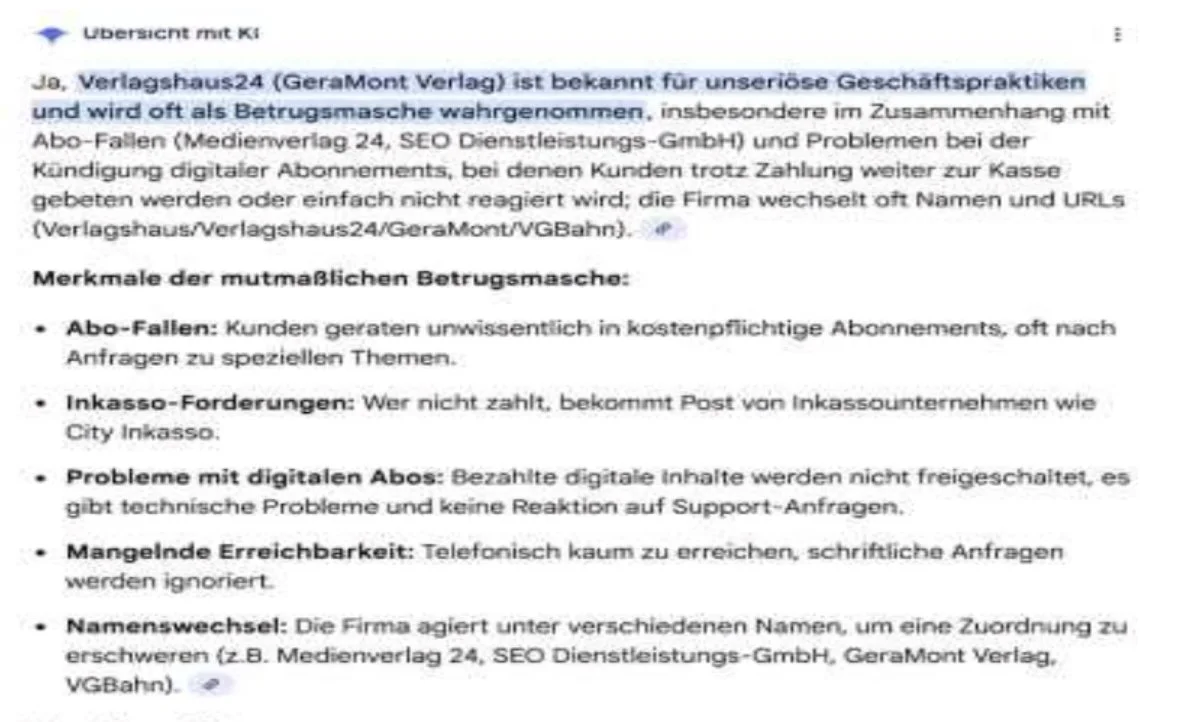
Both overview texts refer as a source to an article entitled "Beware of ... the lawyers ..." (Appendix ASt 8).
A search query on February 10, 2026 – after a warning had been issued – yielded a summary text that was similar in essential points, the content of which is referenced in Appendix ASt 13.
Complaint: Infringement of corporate personality rights
The AI-generated overview text in question infringes the plaintiffs' corporate personality rights because it unfairly associates them with fraudulent schemes and disreputable business practices. In this respect, it constitutes untrue factual assertions because the publication includes information concerning other companies – specifically "...and the company..." – with which the plaintiffs have no connection whatsoever.
Because the AI used by the defendant independently compiles the information in the overview and summarizes it into a summary text, this constitutes an independent presentation for which the defendant is also responsible.
Therefore, the defendant cannot rely on the privileges of Articles 4-6 of Regulation (EU) 2022/2065 of the European Parliament and of the Council of 19 October 2022 on an internal market for digital services and amending Directive 2000/31/EC (Digital Services Act; hereinafter: DSA).
The false factual assertions impair the plaintiffs' social standing as businesses, and in the absence of a legally binding cease-and-desist declaration, there is also a risk of repetition. The plaintiffs therefore have a right to an injunction, which is also urgent in view of the ongoing infringement of rights and the impact of this continuous publication of untrue and defamatory statements on business operations.
The plaintiffs request:
The defendant in relation to the plaintiff in the injunction proceedings is subject to the following conditions:
a fine to be determined by the court for each instance of non-compliance (and, in the event that this cannot be collected, detention) or detention for up to six months (fine in individual cases not exceeding EUR 250,000.00;
total detention not exceeding 2 years;
detention to be served on the members of the management) pursuant to Section 890 of the Code of Civil Procedure. to prohibit
The defendant [should be enjoined from making claims about plaintiff Verlagshaus 24] and/or to disseminate [these] claims about the plaintiff:
the plaintiff would commit fraudulent schemes or disreputable business practices, be known for doing so, or there would be indications of such;
the plaintiff is in contact with the companies... or SEO Dienstleistungs-GmbH;
the plaintiff would lure customers into “subscription traps”, i.e., unknowingly cause customers to take out paid subscriptions;
the plaintiff would rely on telephone calls that did not take place or unexpectedly invoice for services such as "company listings" or "premium gold packages" after such telephone calls;
the plaintiff would continue to demand payment from customers even after payment has already been made;
the plaintiff would often change names and URLs or operate under different names to make identification more difficult;
the plaintiff would not unlock paid digital content;
the plaintiff allegedly sells subscriptions and engages in debt collection in an unscrupulous manner;
as shown below in the context of a search on Google in so-called overviews using AI:
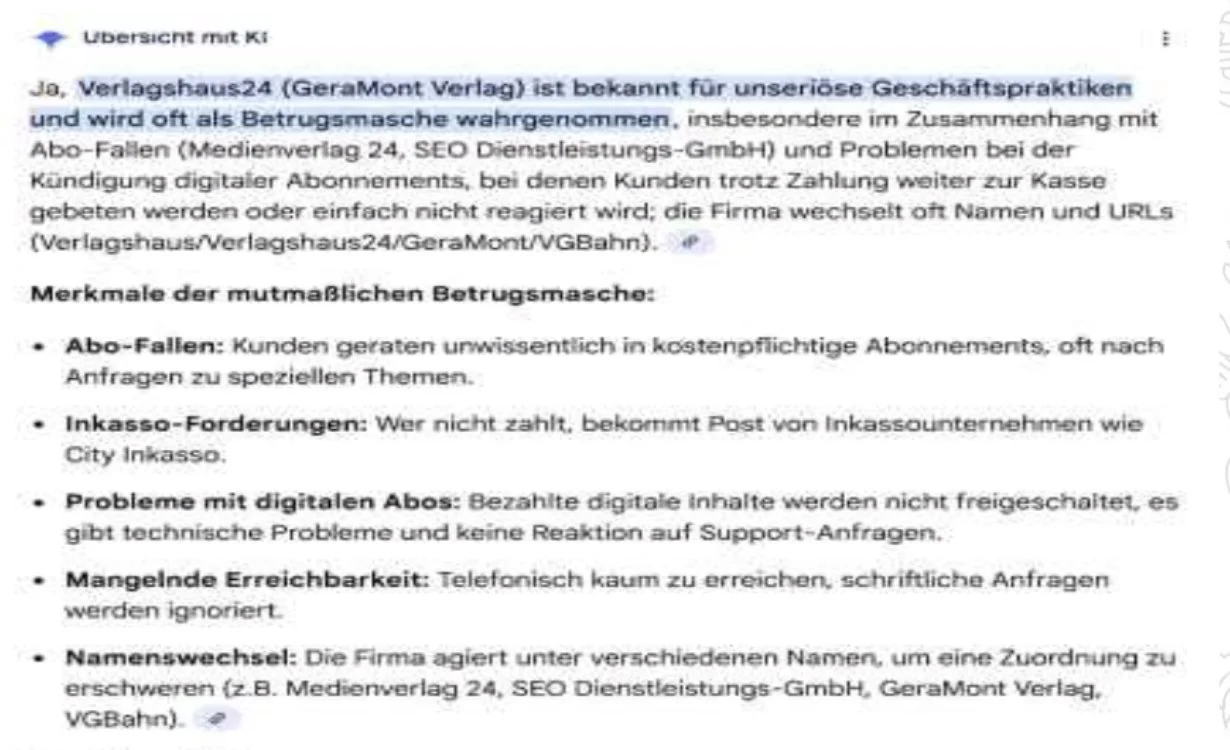
2. The defendant in the proceedings is subject to the following conditions in relation to the plaintiff in the second instance: a fine to be determined by the court for each instance of non-compliance (and, in the event that this cannot be collected, detention) or detention for up to six months (fine in any individual case not exceeding EUR 250,000.00; total detention not exceeding 2 years; detention to be served on the members of the management) pursuant to Section 890 of the Code of Civil Procedure.
to prohibit
to assert and/or disseminate such assertions about the applicant in case 2):
- the applicant in case 2) allegedly commits or is known to commit fraudulent schemes or disreputable business practices;
- the applicant in case 2) is in contact with the companies...;
- the plaintiff in case 2) would lure customers into “subscription traps”, i.e., unknowingly cause customers to take out paid subscriptions;
- the applicant in case 2) would continue to demand payment from customers even after payment has already been made;
- the applicant in case 2) would often change names and URLs or operate under different names to make identification more difficult;
- the applicant in case 2) would cooperate with the ...;
- the applicant in case 2) would not unlock paid digital content;
- the applicant in case 2) could not be reached by telephone and ignored written requests;
- the plaintiff in case 2) allegedly sells subscriptions and engages in debt collection in an unscrupulous manner;
as shown below in the context of a search on G... in a so-called overview using AI:
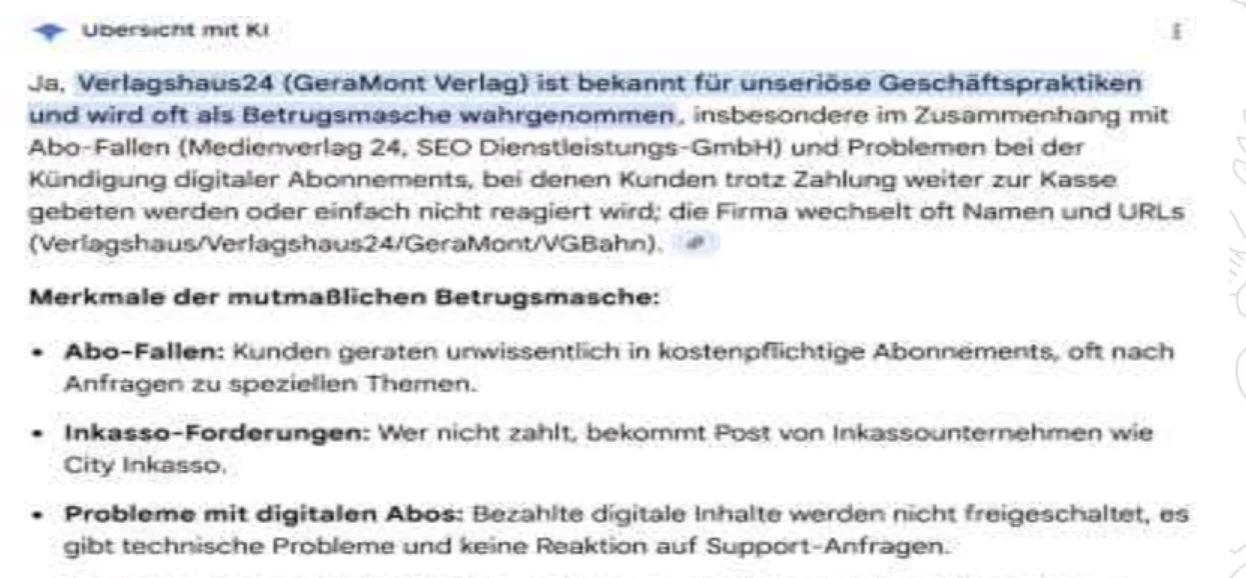
The defendant (Google) responds:
The defendant argues that the applications are already too vague because they do not reveal which specific search terms and underlying information they refer to; furthermore, they are not "assertions" by the defendant, so the specific form of infringement has been incorrectly identified, and finally, the scope must be limited to the territory of the Federal Republic of Germany.
Notwithstanding the foregoing, there is also no claim for injunctive relief. A claim under Article 17 of Regulation (EU) 2016/679 of the European Parliament and of the Council of 27 April 2016 on the protection of natural persons with regard to the processing of personal data and on the free movement of such data, and repealing Directive 95/46/EC (General Data Protection Regulation; hereinafter: GDPR) is precluded because the plaintiffs are not natural persons.
Furthermore, a claim under Sections 1004, 823 et seq. of the German Civil Code (BGB) is not applicable because the defendant could, at most, be held liable under the principles of indirect liability, and the requirements for this are not met. This is because the defendant merely operates a search engine that automatically displays the data and information of third parties in accordance with search queries. The defendant is therefore not itself responsible for data processing, does not adopt the information of third parties in the "overview with AI" as its own, and is accordingly only liable if it is made aware of an obvious infringement of rights. However, this has not occurred sufficiently, neither through the notification of February 2, 2026, in the online form nor through the cease-and-desist letter. This is because no readily apparent infringement of rights arises from either, as the lack of connection between the plaintiffs and the companies "...must be denied for lack of knowledge," and the alleged untruthfulness of the further statements in the overview text is not substantiated at all.
Furthermore, neither the notification nor the cease-and-desist letter explains why the plaintiffs in case 1), who are not even mentioned by name in the overview text, and the plaintiffs in case 2), whose company name is only found in parentheses, are even affected in their own rights.
Notwithstanding the foregoing, no legal infringement has actually occurred. The plaintiffs have neither alleged nor credibly demonstrated why the challenged statements are untrue. Nevertheless, the user reviews for plaintiff 1) on relevant rating portals, e.g., ...(A. AG 2), ...(A. AG 3), ...(A. AG 4), and ...(A. AG 5), show numerous negative assessments and accounts of paid but unfulfilled subscriptions and unfriendly customer service, to which plaintiff 1) consistently responds with the same standard reply. Customers have also complained about the plaintiffs in various discussion forums, addressing unjustified payment reminders or debt collection proceedings, missing or delayed services, difficulties with customer service, and even changes in the plaintiffs' names and URLs. Reference is made to A. AG 6-9 in this respect. The information provided was indeed based on information from third-party websites and was not recognizably unlawful.
Finally, the applicant had also fulfilled its duty of care, as the text in question was no longer accessible due to a revision using machine learning. Consequently, there was also no risk of recurrence, and the necessary urgency requiring a preliminary injunction was no longer present.
For further details of the facts and the parties' submissions, reference is made to the exchanged written pleadings with attachments and to the minutes of the oral hearing of 23 April 2026.
The court explains the reasoning behind its decision:
The admissible application for a preliminary injunction is largely well-founded.
The plaintiffs have a claim against the defendant for an injunction to prevent the statements in dispute from being made to the extent specified, pursuant to Sections 1004 and 823 Paragraph 1 of the German Civil Code (BGB) in conjunction with Article 2 Paragraph 1 and Article 19 Paragraph 3 of the German Basic Law (GG), because their corporate personality rights are violated by the AI-generated responses, for which the defendant must be held accountable. No further claim exists. In detail:
I) The application for an interim injunction is admissible.
1. The Munich I Regional Court has international jurisdiction pursuant to Article 7 No. 2 of Regulation (EU) No. 1215/2012 of the European Parliament and of the Council of 12 December 2012 on jurisdiction and the recognition and enforcement of judgments in civil and commercial matters (hereinafter: Brussels I Regulation). This provision covers infringements of personality rights through publications, irrespective of whether they are asserted by a natural or a legal person (Federal Court of Justice, judgment of 14 January 2020 – Case No.: VI ZR 495/18 – para. 13; Higher Regional Court of Munich, judgment of 6 August 2024 – Case No. 18 U 2631/24 – para. 19; all decisions, including those cited below and unless otherwise indicated, are cited from the juris database). The element of the offense "place where the harmful event occurred or is likely to occur" is to be interpreted to mean that a person whose personal rights are alleged to have been violated by a publication about them on the internet may bring an action before the courts of the Member State in which the center of their interests is located (see BGH, loc. cit., para. 14). Accordingly, the German courts – and, moreover, the Munich I Regional Court also has local and subject-matter jurisdiction pursuant to Sections 32 of the Code of Civil Procedure and 71 para. 2 no. 7 of the Courts Constitution Act – are competent because the plaintiffs have their registered office in Munich and the statements in question can be accessed in Germany and, in particular, within the jurisdiction of the Munich I Regional Court.
2. The application is sufficiently specific. The statements whose injunction is sought can be identified with sufficient precision by referring to the specific form of infringement (“as described below…”). The specific search query, which, moreover, according to undisputed submissions, is suggested by the defendant's own program when the company name is entered into the search field using the so-called “autocomplete” function, is therefore not necessary to determine the scope of the infringement.
II) The application is also predominantly well-founded under the applicable German law pursuant to Sections 1004, 823 Paragraph 1 of the German Civil Code (BGB) in conjunction with Article 1 Paragraph 1, Article 2 Paragraph 1 of the German Basic Law (GG).
1. In the present case, German law is applicable pursuant to Art. 40 para. 1 sentence 2 EGBGB.
1.1. The provisions of the GDPR – which generally take precedence over national law – are not applicable because the applicants are not natural persons within the meaning of Article 1(1) and (2) GDPR.
1.2. The provisions of Regulation (EU) 2024/1689 of the European Parliament and of the Council of 13 June 2024 laying down harmonised rules on artificial intelligence and amending Regulations (EC) No 300/2008, (EU) No 167/2013, (EU) No 168/2013, (EU) 2018/858, (EU) 2018/1139 and (EU) 2019/2144 and Directives 2014/90/EU, (EU) 2016/797 and (EU) 2020/1828 (Artificial Intelligence Regulation, hereinafter: AI Regulation) are also not applicable because – insofar as they are already applicable in terms of timing pursuant to Article 113 AI Regulation – they only provide for the possibility of lodging a complaint with the competent market surveillance authority, in addition to and “without prejudice” to the legal remedies already provided for in Union law and in the national law of the Member States (Recital 170 AI Regulation).
1.3. Claims arising from non-contractual obligations due to the infringement of personal rights – e.g., from Sections 1004, 823 Paragraph 1 of the German Civil Code (BGB) in conjunction with the general right of personality (Article 1 Paragraph 1, Article 2 Paragraph 1 of the German Basic Law (GG)) or the corporate personality right (Article 2 Paragraph 1, Article 12 Paragraph 1, Article 14 Paragraph 1, Article 19 Paragraph 3 of the German Basic Law (GG)) – are expressly excluded from the scope of Regulation (EC) No. 864/2007 of the European Parliament and of the Council of 11 July 2007 on the law applicable to non-contractual obligations (Rome II Regulation) pursuant to Article 1 Paragraph 2 Letter G.
Therefore, in cross-border legal disputes, the applicable law is governed by Article 40 of the Introductory Act to the German Civil Code (EGBGB). The injured party can then demand that the law of the state in which the infringement occurred be applied (Federal Court of Justice, judgment of February 27, 2018 – Case No. VI ZR 489/16 – para. 21 et seq.).
In the present case, the profiles in dispute are primarily aimed at German-speaking users, so the infringement also occurred in Germany. The plaintiffs also requested the application of German substantive law in their application. Accordingly, German (express) law is applicable in this respect.
1.4. These national legal provisions are not superseded by the provisions in Articles 6 and 16 et seq. of the DSA, because these provisions only concern liability privileges within the scope of application of the DSA, and moreover, Article 6(4) of the DSA – like Article 14(3) of the E-Commerce Directive before it – leaves unaffected the possibility that a judicial authority under the legal system of a Member State may require a service provider to cease or prevent an infringement, and this specifically and primarily covers civil law claims for injunctive relief and cessation (Higher Regional Court of Frankfurt, judgment of March 4, 2025 – Case No. 16 W 10/25 – para. 13 et seq.).
2. The applicants are directly affected and therefore have standing to sue because they are both named in the "Overview with AI" submitted as Exhibit ASt 6 and are thus identifiable. The same applies to applicant 1) with regard to the further "Overview with AI" submitted as Exhibit ASt 7.
3. In the present case, the defendant is liable according to the principles of a direct infringer pursuant to Sections 1004, 823 Paragraph 1 of the German Civil Code (BGB) in conjunction with Article 2 Paragraph 1, Article 19 Paragraph 3 of the German Basic Law (GG), because the disputed display of the “results with AI” is not a mere display of search results, but rather content attributable to it.
3.1. As a disturber within the meaning of Section 1004 of the German Civil Code (BGB), any person who has caused the disturbance or whose conduct gives rise to a fear of impairment is generally considered to be a disturber – regardless of fault.
The provision covers both the direct disturber, who has adequately caused the impairment through their own conduct, and the indirect disturber, who has in some way willfully and with adequate causation contributed to bringing about the unlawful impairment. In this sense, supporting or exploiting the actions of an independently acting third party is sufficient, provided the person being sued had the legal means to prevent this action (see, among many others, the German Federal Court of Justice (BGH) judgment of July 28, 2015 – Case No. VI ZR 340/41 – para. 34 with further references).
To distinguish between direct and indirect infringers, the decisive factor with regard to search engine operators is whether they merely make search results discoverable through links or whether they adopt the content as their own (Federal Court of Justice, judgment of February 27, 2018 – Case No. VI ZR 489/16 – para. 28). "Appropriation is assumed if the party being sued has outwardly recognizably assumed responsibility for the content published on their website, which must be assessed from the perspective of a reasonable average user based on a comprehensive consideration of all relevant circumstances," although "caution is generally advised when assuming identification with the third-party content" (Federal Court of Justice, ibid.).
3.2. The plaintiffs have credibly demonstrated that the disputed "overview with AI," as shown in Exhibits ASt 6 and ASt 7, were indeed displayed in response to the search query. Regardless of whether the defendant can even validly deny this by claiming lack of knowledge pursuant to Section 138 Paragraph 4 of the German Code of Civil Procedure (ZPO), Exhibits ASt 5 and ASt 5a (emails from Mr. K. to Mr. S. with the respective "overview with AI" attached) and Exhibit ASt 13 (printout of the entire first page of results when using the search function) are sufficient to support the plaintiffs' assertion that the disputed "results with AI" are displayed when the company name "Verlagshaus24" and the term "fraud scheme," offered via the so-called "auto-complete function," are entered.
3.3. This “overview with AI” according to the exhibits ASt 6 and ASt 7, as stated above (under No. 3.1), represents the defendant’s own statement made by its own AI offered to users.
Firstly, search results are not simply displayed as links or short previews (snippets) – in whatever order – but rather the results of the search query are summarized and presented in the site's own words and according to its own structure. This begins with an introductory affirmation of the query ("Yes, V.24 (GM Verlag) is known for dubious business practices..." or "Yes, there are indications of fraudulent schemes and dubious practices in connection with Verlagshaus24..."), which already goes beyond the mere presentation of links. It continues with an independent thematic structuring of the response, not presented or included in the subsequent results from third-party sites. This structuring begins with an introductory summary, followed by a compilation of the "Characteristics of the Alleged Fraud Scheme" / "Typical Fraud Schemes," and concludes with a recommendation for action under "What You Can Do" / "What You Should Do."
All of this demonstrates that the AI offered and used by the defendant independently processes the search results. In this way, the defendant creates independent statements that go beyond the individual search results displayed later via links.
Since the defendant introduced the artificial intelligence itself and offers it to users, it must also be held accountable for its results, as it alone has influence over the AI's offering and the algorithms it uses.
Above all, the "AI-powered overview" contains statements that are not even mentioned in the search results. None of the links provided establish a connection between the plaintiffs and a "...or claim frequent name changes between...". These are statements made by the defendant herself, going beyond the mere presentation of the search results. If only the search results themselves were displayed, the article by the law firm LL, submitted as Exhibit ASt 8 and entitled "Beware of...", would hardly have been shown, and certainly not as the primary source documenting the statements in the "AI-powered overview." This is because it contains no reference whatsoever to the plaintiffs.
Therefore, this is an independent statement created by the AI offered by the defendant, which the defendant must be held accountable for as the provider (also within the meaning of Art. 3 No. 3 of the AI Regulation).
How the ‘AI Overview’ is different from a search engine
3.4. In this respect, the situation here is also different from the facts underlying the decisions of the German Federal Court of Justice (BGH) on search engines (judgment of 27 February 2018 – case no. VI ZR 489/16) and on the “auto-complete function” (judgment of 14 May 2013 – case no. VI ZR 269/12), which were cited by both parties.
3.4.1. With regard to search engines, the German Federal Court of Justice (BGH) extended the considerations that argue for only limited liability of hosting providers as indirect infringers to providers of internet search engines as well, stating that it cannot reasonably be expected of a search engine provider to verify whether the content found had been lawfully posted before it was made searchable, because such a proactive duty of verification would contradict the purpose and function of a search engine. Without the assistance of search engines, the internet would be practically unusable for individuals due to the overwhelming flood of data, so that ultimately the use of the internet as a whole depends on the existence and availability of search engines. “Because of their essential importance for making the internet usable, no duties of care may be imposed that would jeopardize or disproportionately impede the operation of search engines. The assumption of a general duty of care—which is practically impossible to implement—would seriously call into question the existence of search engines as a business model that has been approved by the legal system and is socially desirable” (Federal Court of Justice, judgment of February 27, 2018 – Case No. VI ZR 489/16 – para. 34 with further references). Since the search engine operator is generally not in any legal relationship with the authors of the content displayed in the search results, it is usually impossible for them to determine and assess the facts due to the lack of contact with the operators of the individual websites. Therefore, specific duties of care only apply “when they have received concrete information indicating an obvious and readily apparent infringement of rights” (Federal Court of Justice, ibid., para. 35 with further references).
The situation is different, however, with regard to the "AI-powered overview" at issue here.
As explained, it does not merely display search results from websites with which the defendant has no contact and whose content it cannot readily verify. Rather, it makes independent, new, and substantive statements based on an evaluation and linking of content from various third-party websites. The content of these new statements, generated by the defendant's AI, is indeed subject to review by the defendant—even if only through appropriate control mechanisms—at least by comparing the underlying third-party websites with its own statements based on them.
Furthermore, an "AI-powered overview"—unlike the display of pure search results in search engines—is by no means essential for using the internet.
Displaying search results via links already makes the "flood of data" usable for the individual; in contrast, an "AI-powered overview" structures and evaluates data according to a system not immediately apparent to the user, thus channeling—depending on the underlying algorithm—the answer to the search query. While many may consider this desirable and a way to simplify the search process, it is by no means essential for managing the data deluge identified by the German Federal Court of Justice (BGH).
Why ‘AI Overview’ is not autocomplete
3.4.2. Regarding the question of liability for the so-called "auto-complete function," the German Federal Court of Justice (BGH) stated that the activity via the search term completion function is not merely technical, automatic, and passive, nor is it limited solely to providing information for access by third parties. Rather, the query data of the users is processed in a separate program that forms combinations of terms, so that the provider is generally responsible for the offer in the form of its own search suggestions (BGH, judgment of May 14, 2013 – Case No. VI ZR 269/13 – para. 26). "In cases of impairment where a breach of duty is a (partial) cause," as the BGH explains, "a case-by-case assessment is necessary to avoid excessive liability. The responsibility of the party who failed to act is limited by the criteria of the possibility and reasonableness of preventing the adverse outcome" (BGH, ibid., para. 27). Therefore, it is important to consider, among other things, whether the affected party controls the source of the disturbance or can influence someone who is capable of ending the disturbance. For user search queries, this is generally only the case when the operator of the search engine with a keyword completion function becomes aware of the potential infringement resulting from the search query using that function (Federal Court of Justice, loc. cit., para. 29 et seq.).
However, the "AI-powered overview" in this case goes significantly further. It doesn't concern the search query or the search term completion ("scam"), nor the individual search results displayed via links, but rather an independently generated statement that, based on the weighting of the search results and an evaluation of the content, formulates its own answer (not question) and offers it to the user.
This is not contradicted by the fact that, as the defendant argues, reasonable users recognize through the links to third-party websites that the summary in the "overview with AI" is based on the content stored there by third parties and that the search engine thus clearly does not assume any responsibility for the content of this information and does not adopt it as its own.
Firstly, as already explained, the summary at issue here is by no means based solely on third-party content, but rather represents an independent compilation and evaluation that goes beyond these third-party websites – not least with regard to the link between the plaintiffs and a “…”, which certainly does not arise from third-party websites.
Secondly, it may be true that users can use the links to check whether the content of the third-party sites actually corresponds with the “AI-generated overview”, and are also generally aware that this is necessary because information generated by AI should not be blindly trusted, as the defendant argued in the oral proceedings – yet the possibility that a statement can be falsified through further research does not generally absolve the author from liability for that statement. This is recognized for those who read quickly, so-called "front page readers" (Federal Constitutional Court, judgment of January 14, 1998 – Case No. 1 BvR 1861/93 – para. 133; Higher Regional Court of Munich, judgment of July 31, 2014 – Case No. 18 U 308/14 – para. 25), if and insofar as the statement is self-contained and understandable even without further reading (e.g., in the magazine's interior), and the same applies to self-contained teasers on a website or app (Higher Regional Court of Cologne, judgment of May 21, 2024 – Case No. 15 W 34/24 – para. 40; Regional Court of Munich I, judgment of November 24, 2014 – Case No. 9 O 19238/14 – para. 28), and the same considerations must also apply to the "overview with AI": it, too, is self-contained and understandable. It contains a self-contained statement with independently understandable content and no indication of other possible interpretations or even content-related unreliability, so that users regularly have no reason to additionally check the displayed answer to their search query.
Moreover, this would significantly diminish the benefit of the function as asserted by the defendant if the "overview with AI" were generally recognized as unreliable and each of the displayed links had to be independently verified.
3.4.3. Even though the German Federal Court of Justice (BGH) in both decisions ultimately emphasizes the functionality of the search engine as an aspect for denying any duty to review (BGH of May 14, 2013 – Case No. VI ZR 269/13 – para. 39; BGH of February 27, 2018 – Case No. VI ZR 489/16 – para. 34 with further references) and assumes action only after notification by the affected parties and only in the case of an obvious infringement of rights, these considerations are not applicable to the present “AI-generated overview.” This is because, unlike the situation with linked third-party websites, the AI-generated overview no longer merely contains third-party content with which there is no contact, but rather an independent weighting and presentation of this content according to its own algorithms, which are not influenced by third parties, but by the defendant as the provider. It offers an additional function without which the use of the search engine would nevertheless be possible (and is possible), and without which users would certainly be able to find results even in the "flood of data".
Furthermore, although the defendant stated in the oral proceedings, it neither demonstrated nor even credibly proved that the use of AI in search engines would be rendered entirely impossible if providers like the defendant were held liable for their own independent statements.
In this respect, it might be worth considering affirming a duty to examine the content of the specific statement only when its potential illegality is pointed out. However, the plaintiffs indisputably did so, both by email and via the online form provided by the defendant. Limiting the duty to examine only obvious legal violations does not appear appropriate, particularly with regard to the system's functionality, because the defendant could easily review the content of the "Overview with AI" and the sources of information on which it is based, even without contacting the third parties who provided the websites. However, the defendant failed to do so, even after being notified by the plaintiffs.
Conversely, limiting the defendant's liability for its own AI-generated statements as a service provider to a duty to review reports of obvious illegality would inevitably create a gap in the protection of general personality rights and corporate personality rights for those affected by the statements. This is because, if and insofar as the statements are independent—as is the case here—the affected parties cannot seek injunctive relief from the third parties whose websites were included in the search query, since these third parties did not make the statement in question. Instead, the statement is only presented and disseminated by the search engine operator in the "AI-generated overview."
Similarly, the search engine operator would not be obligated to take further action (such as deletion or cessation of the statement and subsequent hearing of the third parties) in the case of statements that are not obviously illegal—but only become so after thorough examination.
Consequently, those affected would lack sufficient legal recourse in cases of statements that infringe on their personality rights but are not obviously illegal. This also argues against applying the considerations regarding the search engine function and the “auto-complete function” to the “overviews with AI” at issue.
3.5. As a result of all this, the applicants can claim against the respondent as a direct infringer with regard to the “Overview with AI” and the respondent accordingly cannot rely on a liability privilege under Art. 6 para. 1 DSA because it does not act solely as a hosting provider, nor on a liability privilege for search engine operators in the sense of a “notice-and-takedown procedure”.
4. The plaintiffs have a right to an injunction against the statements in dispute in the two challenged “overviews with AI” to the extent specified in the judgment pursuant to Sections 1004, 823 Paragraph 1 of the German Civil Code (BGB) in conjunction with Article 2 Paragraph 1, Article 19 Paragraph 3 of the German Basic Law (GG), because their corporate personality rights are violated by them – also when weighed against the legitimate interests of the defendants.
4.1. The right to an injunction against a statement exists pursuant to Sections 1004 and 823 Paragraph 1 of the German Civil Code (BGB) if the statement in question violates the affected person's general right of personality under Article 1 Paragraph 1 and Article 2 Paragraph 1 of the German Basic Law (GG) and Article 8 Paragraph 1 of the European Convention on Human Rights (ECHR), when weighed against the right of the person making the statement to freedom of expression protected by Article 5 Paragraph 1 of the German Basic Law and Article 10 Paragraph 1 of the ECHR. It is recognized that the personal scope of protection of the right of personality also extends to legal entities in the form of the so-called corporate personality right, pursuant to Article 19 Paragraph 3 of the German Basic Law (BGH, judgment of July 28, 2015 – Case No. VI ZR 340/14). This extension of the scope of protection is particularly justified if a legal person is affected in its social standing as an employer or as a business enterprise by a statement (Federal Court of Justice, judgment of 04.04.2017 – Case No. VI ZR 123/16 – para. 16).
4.1.1. The general right of personality (Article 1 Paragraph 1, Article 2 Paragraph 1 of the Basic Law) and the corporate right of personality (Article 2 Paragraph 1, Article 19 Paragraph 3 of the Basic Law) are designed as an open framework right, the specific characteristics and limits of which must be determined in each individual case. In doing so, both Article 1 Paragraph 1, Article 2 Paragraph 1 of the Basic Law and Article 8 Paragraph 1 of the European Convention on Human Rights, on the one hand, and Article 5 Paragraph 1 of the Basic Law and Article 10 of the European Convention on Human Rights, on the other, must be taken into account as guiding principles for interpretation with regard to the content, scope, and reach of the right, as well as with regard to the meaning of the statement in question (Federal Constitutional Court, judgment of November 3, 2025 – Case No.: 1 BvR 573/25 – para. 29; Federal Constitutional Court, judgment of November 9, 2022 – Case No. 1 BvR 523/21 –). Paragraph 13; Federal Court of Justice (BGH) judgment of December 15, 2009 – Case No. VI ZR 227/08 – Paragraph 11; Federal Court of Justice (BGH) judgment of December 18, 2018 – Case No. VI ZR 439/17 – Paragraph 10; Federal Court of Justice (BGH) judgment of December 17, 2019 – Case No. VI ZR 249/18 – Paragraph 18). The general right of personality is therefore not granted unconditionally, but finds its limits in the constitutional order, including the rights of others, which also includes the right to freedom of expression pursuant to Article 5 Paragraph 1 of the Basic Law (GG) and Article 10 Paragraph 1 of the European Convention on Human Rights (ECHR). Conversely, the right to freedom of expression finds its limits in general laws pursuant to Article 5 Paragraph 2 of the Basic Law, which include, among others, the provisions of Sections 1004 and 823 of the German Civil Code (BGB) and Sections 22 and 23 of the German Copyright Act (KunstUrhG), and the right to personal honor (Federal Constitutional Court, judgment of November 3, 2025 – Case No.: 1 BvR 573/25 – para. 29; Federal Constitutional Court, judgment of December 8, 2011 – Case No. 1 BvR 927/08 – para. 18; Federal Constitutional Court, judgment of November 9, 2022 – Case No. 1 BvR 523/21 – para. 12).
4.1.2. The starting point for examining whether a violation of general or corporate personality rights has occurred, as the Federal Constitutional Court clarified, among other things, in its decision of November 9, 2022 (Case No. 1 BvR 523/21 – para. 15; see also Federal Constitutional Court decision of November 3, 2025 – Case No. 1 BvR 573/25 – para. 33), is "the ascertainment of the content of the contested statement, in particular the clarification of how, according to its objective meaning, it infringes the personality rights of the person concerned. The aim of the interpretation is to determine the objective meaning of a statement. Therefore, neither the subjective intention of the person making the statement nor the subjective understanding of the person affected by the statement is decisive, but rather the meaning that it has according to the understanding of an unbiased and reasonable public. The wording of the statement must always be the starting point. However, this does not definitively determine its meaning. Rather, it is also influenced by the linguistic context, in the context in which the controversial statement is made and the surrounding circumstances under which it is made, insofar as these were recognizable to the recipients.”
Starting from this, the content of the individual statements must first be interpreted in order to determine the type of utterance as a statement of fact or an expression of opinion.
4.1.2.1. Statements of fact are characterized by an objective relationship between the statement and reality. They refer either to concrete events or conditions of the external world (external facts) or of human mental life (internal facts), defined by space and time and belonging to the past or present. Opinions, on the other hand, are characterized by the speaker's subjective relationship to the content of what is expressed. Crucially, for a statement to be classified as a statement of fact, it must be verifiable by means of evidence (Federal Constitutional Court, judgment of November 9, 2022 – Case No. 1 BvR 523/21 – para. 17). Particularly in the case of statements of fact that could damage someone's reputation, the balancing of conflicting interests to assess the admissibility of the statement is significantly determined by the truthfulness of the assertions. True factual assertions must generally be accepted, even if they are detrimental to the person concerned, whereas untrue ones do not (established case law, cf. e.g. BGH of 22.02.2022 – Case No.: VI ZR 1175/20 – para. 25; OLG Munich of 05.03.2024 – Case No. 18 U 2827/23 – para. 45).
4.1.2.2. In contrast, expressions of opinion are characterized by the subjective relationship of the person expressing them to the content of what is expressed (Federal Court of Justice, judgment of December 16, 2014 – Case No. VI ZR 39/14 – para. 8) and therefore cannot be “true” or “untrue”, “right” or “false”. At most, they can be comprehensible or incomprehensible, shared, understood, or rejected. Their protection under Article 5 Paragraph 1 of the Basic Law is therefore broader and is limited only by the general right of personality of the person about whom the opinion is expressed, as explained above.
Therefore, a balancing of interests must always be undertaken between the personal rights of the individual concerned on the one hand and the freedom of expression of the person expressing the opinion, which is also guaranteed in Article 5 Paragraph 1 Sentence 1 of the Basic Law, on the other (Federal Constitutional Court, judgment of February 14, 1973 – Case No. 1 BvR 112/65 – para. 28; Federal Constitutional Court, judgment of December 8, 2011 – Case No. 1 BvR 927/08 – para. 18; Federal Court of Justice, judgment of November 15, 1994 – Case No. VI ZR 56/94 – para. 64).
Expressions of opinion generally enjoy the protection of freedom of expression afforded by Article 5 Paragraph 1 of the Basic Law, regardless of their validity, value, or accuracy. They do not lose this protection even if they are expressed sharply and excessively, because it is one of the guarantees of freedom of expression that a critic can, in principle, express his (criminal) legal assessment of events as his legal opinion, even if this does not withstand objective scrutiny, so that it is irrelevant whether the defendant's legal opinion is tenable, as long as the criticism does not prove to be mere defamatory criticism (Higher Regional Court of Munich, judgment of March 5, 2024 – Case No. 18 U 2827/23 – para. 46).
4.1.2.3. If an expression based on value judgments can prove to be a statement of fact if and insofar as it simultaneously evokes in the addressee the idea of concrete events clothed in the value judgment, then, on the other hand, if it contains both factual and value judgment elements in an inseparable way, it must be treated as an expression of opinion in its entirety if it is characterized by these value judgment elements (Federal Constitutional Court, judgment of March 21, 2007 – Case No. 1 BvR 2231/03 – para. 21) or if these value judgments are a prerequisite for the formation of the opinion (Federal Constitutional Court, judgment of October 25, 2012 – Case No. 1 BvR 901/11, para. 20). For where factual and evaluative elements are combined and together constitute the meaning of an expression, the concept of opinion must be interpreted broadly in the interest of effective fundamental rights protection: “Insofar as an expression in which facts and opinions are intertwined is characterized by elements of commentary, belief, or opinion, it is protected as an opinion by the fundamental right. This applies in particular if a separation of the evaluative and factual content would eliminate or distort the meaning of the expression. If, in such a case, the factual element were considered decisive, the fundamental right to freedom of expression could be significantly curtailed” (Federal Constitutional Court, judgment of November 9, 2022 – Case No. 1 BvR 523/21 – para. 17).
The same considerations apply to statements expressing an evaluation of factual events, because "in cases where both forms of expression are combined and together constitute the meaning of a statement, opinion within the meaning of Article 5 Paragraph 1 Sentence 1 of the Basic Law must be interpreted broadly in the interest of effective fundamental rights protection. If a statement in which facts and opinions are intertwined is characterized by elements of commentary, belief, or opinion, it is protected as an opinion by the fundamental right. This applies in particular if a separation of the evaluative and factual content would eliminate or distort the meaning of the statement. If, in such a case, the factual element were considered decisive, the fundamental right to freedom of expression could be significantly curtailed.
Likewise, a conclusion presented to the average reader as a presumption, in which the character of the statement by elements of commentary and belief is preserved, does not generally constitute an assertion of fact, but rather an expression of opinion." (BVerfG of November 3, 2025 – Ref.: 1 BvR 573/25 – Rz. 34).
4.2. Based on these standards, the plaintiffs have a right to an injunction against the statement that they "commit fraudulent schemes or disreputable business practices, are known to do so, or that there is evidence of such activities."
4.2.1. This statement is contained in the first sentence of the “Overview with AI” submitted as Exhibit ASt 6 (“Yes, ... is known for dubious business practices and is often perceived as a scam…”) and contains, on the one hand, the factual core that knowledge of dubious business practices or scams exists among an unspecified, but certainly larger, group of people, because otherwise something or someone would not be “known for…”. At the same time, however, it also contains the evaluative classification that the business practices of the applicants are dubious and are perceived as a scam, “especially in connection with subscription traps (…, p….”). Thus, in light of the paramount importance of freedom of expression, and in light of the above (under 4.1.2.3), the statement must be considered an expression of opinion.
4.2.2. Nevertheless, this expression of opinion proves to be inadmissible when weighing the conflicting interests.
4.2.2.1. It must be noted at the outset that expressions of opinion cannot themselves be "true" or "untrue," nor do they need to be "well-founded" or "convincing," nor do they even need to be justified. The protection afforded by Article 5 Paragraph 1 of the Basic Law exists regardless of "whether the expression is rational or emotional, well-founded or unfounded, and whether it is considered by others to be useful or harmful, valuable or worthless" (Federal Constitutional Court, judgment of November 9, 2022 – Case No. 1 BvR 523/21 – para. 25). However, the balancing of interests with the affected parties' fundamental right to conduct business must at least take into account whether the conclusion is based on true facts or on an arbitrary, unfounded assessment (Federal Constitutional Court, judgment of November 9, 2022 – Case No. 1 BvR 523/21 – para. 28).
4.2.2.2. In the present case, the allegation of disreputable business practices and the use of fraudulent schemes is likely to significantly impair the perception of the plaintiffs in business dealings, as it affects the core activity of their business, namely the distribution of the publications they offer.
4.2.2.3. In contrast, the challenged statement is primarily based on an alleged "connection with subscription traps (...H)." However, the plaintiffs have credibly demonstrated, through the affidavit submitted as Exhibit ASt 14, that no connection actually exists between them and a "..." or the company ... . The defendant has not countered this with any substantiated arguments; the links mentioned in the "Overview with AI" also do not indicate any connection, nor does any such connection arise from other exhibits submitted by the defendant. Therefore, this connection must be treated as untrue for procedural purposes, and accordingly, the challenged statement is already based on a false factual premise.
Even insofar as the defendant refers to user reviews on relevant rating portals (A. AG 3 – AG 10), firstly, this does not in any way establish the truthfulness of the statements made there, and secondly, there is no reliable information on "subscription traps" or a connection to a ... or the company ..., so that no true factual basis for the expression of opinion has been presented in this respect either.
4.2.2.4. Weighing the plaintiffs' right to their corporate personality, protected by Article 2 Paragraph 1 and Article 19 Paragraph 3 of the German Basic Law (GG), against the legitimate interests of the defendants caused by the contested statement, particularly in business transactions, the latter must yield in this case. While the defendants, as a legal entity under foreign law, can generally invoke Article 5 Paragraph 1 and Article 19 Paragraph 3 of the German Basic Law, it must be considered here that the expressed opinion was primarily generated by AI and is therefore not an expression of the expressing individuals' own convictions, but rather the result of an algorithm. In this respect, the defendants' offering of AI-supported research is primarily an expression of their business activities and, at most, a secondary expression of their interest in freely expressing their opinions and beliefs and thus participating in public discourse and opinion formation.
Secondly, it must be considered that this expressed opinion deserves less protection where it is based on untrue facts. It is irrelevant that the Federal Court of Justice (BGH) has, in individual cases, deemed a critical assessment permissible even if it is unfounded and no verifiable reasons can be given (BGH, judgment of March 10, 2026 – Case No. VI ZR 194/23 – para. 28 et seq.), because in the present case, there is no lack of justification; rather, the decisive factor is that the stated facts are untrue.
4.2.3. Consequently, in the specific balancing of interests, the interest of the defendant recedes behind the plaintiffs' right to corporate personality, which is impaired by the statement, so that the statement is unlawful and a claim for injunctive relief must be affirmed.
4.3. Furthermore, the plaintiffs have a right to an injunction against the statement that they are “aligned with the companies…”
4.3.1. This statement is included in the "Overview with AI" submitted as Appendix ASt 6 and in the "Overview with AI" submitted as Appendix ASt 7, in the lists in parentheses, and is in principle accessible to proof, so that it is a statement of fact.
4.3.2. However, the procedural untruth of this factual assertion has been credibly demonstrated, as already explained, by the affidavit submitted as Exhibit ASt 14; in this respect, reference can be made to the above statements (No. 4.2.2.3).
4.3.3. However, if the statement is untrue, it infringes the corporate personality rights of the plaintiffs, and accordingly, a claim for injunctive relief exists.
4.4. The plaintiffs also have a right to an injunction against the statement that they "lure customers into 'subscription traps', i.e., unknowingly cause customers to enter into paid subscriptions".
4.4.1. This statement is included in the first bullet point under “Characteristics of the alleged fraud scheme” and, in accordance with the principles set out above (under 4.1.2.3), is to be regarded as predominantly characterized by opinion and belief and thus as an expression of opinion.
4.4.2. Here, too, however, there is a lack of factual basis, so that in the balancing of the infringement of the plaintiffs' corporate personality rights by this statement against the interests of the defendant, the latter must yield. This is because neither can it be inferred from the customer reviews submitted by the defendant (A. AG 3 – AG 10) in any factual sense that customers are lured into such "subscription traps" by being unknowingly enrolled in paid subscriptions (the reviews deal with dissatisfaction with the service and processing of subscriptions and orders, not with subscriptions unknowingly concluded), nor do the third-party reviews offer any indication of their factual reliability. It is well established that review portals do not verify the truthfulness and legality of reviews posted by third parties unless they are notified of a legal violation (e.g., pursuant to Art. 6, Art. 16 DSA).
4.4.3. Accordingly, there is also a right to an injunction in this respect; in addition, reference can be made to the considerations under Nos. 4.2.2.3 and 4.2.2.4.
4.5. Furthermore, the plaintiff in case 1) has a right to an injunction against the statement that they would “refer to telephone calls that did not take place or unexpectedly invoice for services such as ‘company listings’ or ‘premium gold packages’ after such telephone calls”.
4.5.1. The statement relates only to the applicant in case 1) – as the operator of Verlagshaus24 – and is contained only in the “Overview with AI” submitted as Exhibit ASt 7. In one by no means far-fetched interpretation, it can be understood as meaning that the applicant bills customers for services such as “company listings” or “Premium Gold Packages” based on telephone calls that either did not actually take place or at least not as described. Therefore, the statement is admissible as evidence and must be considered a statement of fact.
4.5.2. The factual assertion must be considered untrue for procedural purposes, not least because it is clearly based on the article by the law firm LL submitted as Exhibit ASt 8 (which is also linked in this respect), but this article does not actually refer to the applicant in case 1). The respondent has also presented nothing else regarding the veracity of the statement. The factual assertion is therefore untrue.
4.5.3. However, no legitimate interest in making an untrue statement of fact is apparent in the present case, so that the applicant for the injunction no. 1) also has a claim for injunctive relief in this respect.
4.6. Furthermore, the plaintiffs have a right to an injunction against the statements that they would
- “Continue to request payment from customers even after payment has already been made”,
- “often change names and URLs or operate under different names to make it difficult to identify them”,
- “do not unlock paid digital content” and be
- "Not reachable by phone and would ignore written requests".
4.6.1. These statements, which can be found in the “Overview with AI” submitted as Annex ASt 6, are also subject to proof and therefore to be regarded as statements of fact.
4.6.2. However, they are likely to significantly impair the reputation and public perception of the plaintiffs in business dealings and in the public sphere. Therefore, applying the principles established in Sections 186 and 187 of the German Criminal Code (StGB), the burden of proof and substantiation for the veracity of the reputation-damaging statement rests with the defendant. The defendant has failed to substantiate the veracity of the statement. The mere fact that these statements may originate from individual reviews by unknown users on rating portals is insufficient to assess their veracity, let alone substantiate it. The defendant has also failed to demonstrate that it—or the AI it employs—subjected the statements to any kind of verification.
4.6.3. The defendant cannot claim that she merely provided or linked to the statements of third parties as search results, because she has adopted these claims as her own, at least insofar as she formulates the statements now at issue based on them, which are not contained in the reviews of third parties on rating portals in this way and in this exact form.
4.6.4. The defendant has therefore failed to meet her burden of proof and the statements are to be regarded as untrue in procedural terms and must therefore be refrained from.
4.7. The plaintiffs are therefore entitled to an injunction against the statements in question to the extent specified in the judgment, and the risk of repetition has not been eliminated. While it is true that, as the defendant has argued and as evidenced by A. AG 11, the “overviews with AI” displayed in response to the search query differ from the original ones at issue here, the defendant has neither issued a legally binding declaration to cease and desist that would provide the plaintiffs with sufficient protection against future infringements and thereby eliminate the risk of repetition, nor can it be definitively ruled out – even according to the defendant's own submissions – that the statements in question will not be displayed again due to the algorithms used.
4.8. Finally, the claim for injunctive relief is not limited to the territory of the Federal Republic of Germany, but the fundamental principle of the provisions of the Brussels I Regulation (Recast) implies not only the jurisdiction of the court hearing the case for the cross-border dispute between the applicants and the respondent pursuant to Article 7 of the Brussels I Regulation (see above I No. 1), but also the recognition of the effect of the decision rendered within the scope of application of the Brussels I Regulation (Recast) pursuant to Article 36(1) of the Brussels I Regulation (Recast).
4.9. In this respect, the application for the issuance of the preliminary injunction is therefore justified to the extent stated.
5. No further claim exists.
5.1. Applying the principles set out above (under No. 4.1), the applicants have no right to an injunction against the statement that they would “cooperate with the ...”.
5.1.1. The assertion of a collaboration between the applicants and a ... is subject to proof and is therefore to be regarded as a statement of fact.
5.1.2. However, the mere assertion of cooperation with a debt collection agency is not so detrimental to one's reputation in business dealings as to place the burden of proof and substantiation on the defendant under the principles of Sections 186 and 187 of the German Criminal Code (StGB). Rather, it would have been incumbent upon the plaintiff to substantiate the falsity of the statement. This, however, did not occur; the affidavit submitted as Exhibit ASt 14 also fails to address this point.
5.1.3. Accordingly, there is no right to an injunction in this respect.
5.2. Finally, the plaintiffs also have no right to an injunction against the statement that they "sell subscriptions and engage in debt collection in an unscrupulous manner." Such a statement is not found in either the "Overview with AI" submitted as Exhibit ASt 6 or the "Overview with AI" as Exhibit ASt 7. At most, it represents a value judgment drawn by readers after reading the "Overview with AI."
However, such an opinion, possibly formed by readers, cannot be prohibited in light of Article 5 Paragraph 1 of the Basic Law. Even according to the principles of so-called "creation of impressions," a covert assertion, i.e., one that can be inferred "between the lines" of a statement, can only be inadmissible if it is a statement of fact that presents itself to readers as a compelling conclusion. Otherwise, the person expressing an opinion would have to be required to speculatively anticipate and reject all possible conclusions, which would lead to an unacceptable restriction of freedom of expression (Federal Court of Justice, judgment of November 22, 2005 – Case No. VI ZR 204/04 – para. 17; Federal Court of Justice, judgment of July 2, 2019 – Case No. VI ZR 494/17 – para. 30; Federal Court of Justice, judgment of April 27, 2021 – Case No. VI ZR 166/19 – para. 12). Therefore, for a possible expression of opinion that can be inferred between the lines of other statements, the protection afforded by Article 5 Paragraph 1 of the Basic Law must prevail.
III)
The decision on costs is based on Section 92 Paragraph 1 of the German Code of Civil Procedure (ZPO). The ruling on provisional enforceability (regarding costs) is based on Sections 708 No. 6 and 711 of the ZPO for the defendant. For the plaintiffs, however, the judgment is provisionally enforceable anyway, as it was issued by way of preliminary legal protection.