Guide to Pope Leo XIV’s encyclical on artificial intelligence, ‘Magnificent Humanity’
Pope Leo XIV has issued an in-depth papal encyclical on the need for AI to lift human dignity and the common good. We have early analysis and a link to the full document.
May 25, 2026 — Pope Leo XIV on Monday issued a remarkable 42,300-word papal encyclical on artificial intelligence.
Titled Magnifica Humanitas: On Safeguarding the Human Person in the Time of Artificial Intelligence, the full official English-language version can be found here. The title is Latin for Magnificent Humanity.
The encyclical letter speaks of Pope Leo XIV’s desire to protect human dignity and agency in an age in which AI is emerging and growing at near-overwhelming speed. The letter covers a wide variety of AI-related topics, including responsibility and transparency, the dignity of work, and special concerns for families and young people. The overall theme speaks to the pontiff championing human autonomy, freedom, “the dignity of individuals” and the importance of guiding the power of AI for “the common good.”
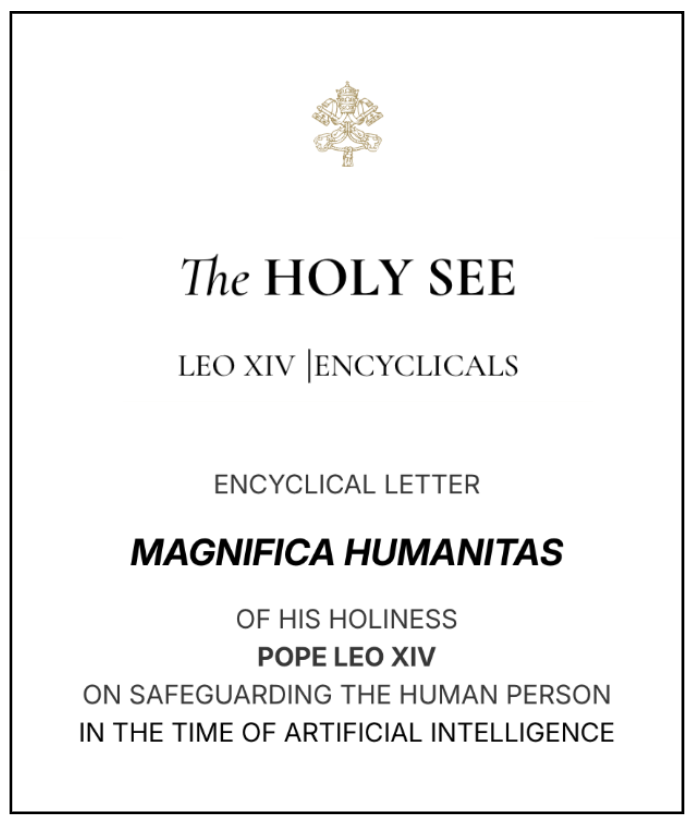
Read the full document
Select image to open full English-language version of the encyclical.
‘it is necessary to establish adequate regulatory tools’
Pope Leo writes: “In recent years, it has become increasingly evident how rapidly and profoundly digitalization, artificial intelligence (AI) and robotics are transforming our world. Technology should not be considered, in itself, as a force antagonistic to humanity. On the contrary, it has formed part of our history since the beginning as ‘a profoundly human reality, linked to the autonomy and freedom of man.’”
He notes that “each phase of progress has also revealed the ambiguity of tools that can cause harm when not oriented toward the good. Today, however, we find ourselves facing a new situation. The power and prevalence of emerging technologies are interwoven into the fabric of daily life, shaping decision-making processes and deeply affecting the collective imagination: ‘Never has humanity had such power over itself.’ New technologies open up a horizon extending in directions that are imaginable but not yet fully predictable. This complicates the assessment of their potential impact and the long-term effects they may have on both the dignity of individuals and the common good.”
“It is necessary,” the pontiff writes, “to establish adequate regulatory tools capable of upholding justice and curbing the distorting effects of technological power.”
concern over ‘technological power’ in private hands
The issue, he adds, “is not limited to regulation.”
“In the past, it was largely up to the State to guide and direct innovation. Today, however, the main drivers of development are private, often transnational, parties that are endowed with resources and the capacity to intervene that surpass those of many Governments. Technological power thus takes on an unprecedented, predominantly private aspect, which makes it even more challenging to discern, govern and direct such power toward the common good.”
The encyclical calls for:
Government regulation of private AI developers
Protection and retraining for workers whose jobs are threatened by AI
Education to help students think critically about the technology
Protections to shield children from AI-generated violent, sexualized, or fake information
Human-in-the-loop safeguards to ensure that humans remain responsible for all decisions regarding the use of weapons
The pope addresses the importance of work for both individuals and society.
“A society that guarantees employment to only a small fraction of the population, despite having a high level of technical development, risks exposing many to forced inactivity,” he wrote.
Key sections
We’ll highlight a number of the encyclical’s sections that are especially pertinent.
The Transparency Coalition welcomes individuals of all faiths. In our analysis we strive to present the pope’s message accurately, neither excising nor emphasizing the theological strands that weave through the encyclical.
‘Building for the Common Good’
In this section, Pope Leo XIV writes:
“Building a city founded on the common good” implies building on a firm relationship with God. That includes a call to embrace life “in all its fullness” and its many dimensions.
Building for the common good “means accepting the limits and weakness of humanity without considering them an error to be corrected.” Do not be misled by deceptive goals, such as the prospect of a technology that promises to free us all from weakness, “and models of wellbeing that leave behind entire populations.”
A worthier goal: Building a world in which everyone can flourish. That will require shared responsibility and courage.
Let’s not encourage naïve enthusiasms or unfounded fears. Instead, “let us establish standards for discernment.” Those standards should be translated into action in the form of “responsible planning, the assessment of human and social impact, the inclusion of the most vulnerable, the promotion of digital literacy and guiding research and industry toward justice and peace.”
‘Remaining human’
In this section, the pope writes:
“In the era of artificial intelligence, when human dignity is threatened by new forms of dehumanization, ours is the pressing duty to remain profoundly human.”
“We must lovingly safeguard the grandeur of humanity bestowed upon us.” No machine can ever replace that.
Don’t be afraid to get your hands dirty:Join in the effort.
Pope Leo writes: “Let us not be afraid to get our hands dirty on the ‘construction site’ of our time.”
“I ask everyone,” he adds, “to abandon the construction of yet another Tower of Babel” separating people “and to join forces in building up the common good, so that humanity will never lose its beauty, and the world once again will come to recognize the human heart as the place where God desires to dwell.”
‘The Essential Dignity of work’
In this section Pope Leo addresses the oft-heard promise of AI enthusiasts: that technology will soon eradicate the need for humans to work.
He writes:
“Work is not simply an instrument; it expresses and enhances the dignity of our lives.”
“It is a requirement of the human condition, a normal path toward maturity, development and personal fulfillment. In this regard, financial assistance to the poor may at times be necessary in emergencies, but it cannot become the sole response, since the goal is to enable each person to live with dignity through his or her own work.”
Build AI around the human person, not solely around performance.
The new ways of working with AI “are not necessarily better,” the pontiff writes. “While AI promises to boost productivity by taking over mundane tasks, it frequently forces workers to adapt to the speed and demands of machines, rather than machines being designed to support those who work.”
“Current approaches to technology can paradoxically de-skill workers, subject them to automated surveillance and relegate them to rigid and repetitive tasks.”
“The need to keep up with the pace of technology can erode workers’ sense of agency and stifle the innovative abilities they are expected to bring to their work.”
“In order to avoid this drift, it is necessary to design systems that are centered on the human person and not solely on performance.”
The need for government rules and regulation around ai
Pope Leo writes:
In the age of AI “it is no longer possible to rely solely on the ‘invisible hand’ of the market.”
“Politics has the task of orientating economies and technologies to the common good, promoting dignified work, social inclusion and an equitable distribution of the benefits of innovation.”
There is also a need for international cooperation “capable of defining common strategies, especially in favor of the most vulnerable countries and people, in order to promote development and overcome welfare dependency.”
Governments must adopt ‘criteria for firm action.’
In practical terms, those rules and regulations should ensure that the economy favors human dignity. These principles should be followed:
Transparency and accountability: “When data and algorithms influence credit distribution, personnel selection or access to services and opportunities, [those decisions] must be understandable, contestable and subject to oversight, so that individuals are not reduced to mere profiles.”
Inclusion and access: “The benefits of innovation must be paired with investments in skills, infrastructure and essential services to ensure that technology does not widen the gap between those who have and those who have not.
Ensure equity: “Taxation, social protection and industrial policies must correct the imbalances created by the concentration of wealth and power.”
“These criteria,” writes the pontiff, “do not constitute a curb on innovation; instead they make it civilized and humane.”
Families and young people: The risks and Hope of AI
The family, the pope writes, “is a fragile social good immediately affected by the economic and technological transformations reshaping the nature of work.”
“It thus requires cultural, juridical and economic support. The devastating impact of unemployment and job insecurity on family structures is well known. In the short term, it may seem advantageous to reduce labor costs or maximize financial efficiency, but in the long term this undermines the very foundations of social coexistence. While technological successes are celebrated, the social fabric is progressively eroded, as if by a silent virus.”
Job insecurity can be particularly devastating to young people. “Work is not merely a source of income but a crucial sphere in which identity is formed, friendships and relationships are forged, practical responsibilities are learned and one’s vocation is discerned.”
“This gives rise to a specific public responsibility.” Government has the duty to support business activity by fostering conditions favorable to employment, promoting work where it is lacking and defending it in times of crisis, since it is a primary good for families and for society.” Here the pope’s message is centered on the primacy of work for the betterment of humans and society, not the accumulation of capital.
“Finally, social ties must be supported, with networks and educational communities that accompany life choices and prevent uncertainty from giving rise to loneliness or addictions. If implemented, these technological transformations can be navigated without undermining the capacity to build the future, which is what makes a society prosperous.”
On mental health and digital addiction
“The subtler forms of addiction linked to the ‘digital attention economy’ should not be underestimated,” writes the pope, “since platforms and services are often designed to capture users’ time and attention, exploiting their vulnerabilities and weakening their inner freedom.”
“When business models thrive on human weakness, the person is treated as a means rather than as an end. Those who design or finance such systems bear a moral responsibility that cannot be ignored.”
“There is an urgent need to promote technologies that strengthen interior freedom by fostering education in digital sobriety and the protection of minors, thus countering models that exploit vulnerability.”
The dangers of massive data control
The pope addresses the risk of “social control made possible by the massive collection of data and use of algorithmic systems.”
“When every action — movements, purchases, relationships and preferences — leaves a trace, a new form of power emerges, namely the power to profile, predict and influence behavior, often without individuals being fully aware of it.”
Freedom in the digital age requires “clear rules, transparency, recourse, and limits on intrusive technologies”
When these massive datasets are used to make life-changing decisions, “such as access to credit, employment or essential services,” there’s a risk of undermining freedom and discriminating against the vulnerable.
Control isn’t always exercised through explicit prohibitions, “but also through the architecture of visibility: what is amplified or rendered invisible, what is rewarded or penalized.” These shape opinions and choices, fostering conformity and self-censorship.
“Freedom in the digital age is not merely a matter of interiority but also a public concern. It calls for clear rules, transparency, the possibility of recourse and proportionate limits on the use of intrusive technologies, so that technology will remain at the service of the human person and not become a form of control over consciences.”
Humans are not ‘a resource to be optimized’
“At the root of these problems,” writes the pope, “lies a technocratic and post-humanist mentality that tends to regard the human person as an object to be manipulated or a resource to be optimized, removing all safeguards against the unchecked pursuit of profit.”
Too often the goal is pure efficiency, “rather than respect for freedom and human dignity.”
“Some post-humanist currents even go so far as to envision ‘second-class’ human beings, subordinate to the interests of elites who consider themselves superior. This troubling prospect becomes all the more serious when combined with technological tools that exponentially increase the capacity for control and selection. Even certain forms of structural indebtedness, which keep entire peoples in conditions of dependence, reflect the same mentality, in new forms, that tolerates relationships of subordination akin to slavery.”
AI isn’t magical, it’s created by working Humans
“Nothing in the world of AI is immaterial or magical,” the pope writes.
“Every seemingly immediate and flawless response” of a chatbot “is the result of a long chain of mediation, involving vast networks of natural resources, energy infrastructure and, above all, people.”
“A significant part of the digital economy’s functioning relies on the silent work of millions of people engaged in essential yet largely unseen activities, such as data labeling, model training and content moderation, often involving disturbing material.”
These workers are often young people, predominantly women, working under demanding conditions for minimal wages. “Added to this invisible labor is the even harsher work of extracting the resources required for the production of the devices and microprocessors on which AI depends.”
Efficiency is not enough. AI must be guided to support human dignity and the common good.
“It is not enough to invoke efficiency, nor to celebrate the benefits of innovation, if they are built on a chain of exploitation that remains deliberately hidden. If technology promises emancipation, yet produces new forms of global subordination, it stands in contradiction to the fundamental principle of human dignity.”
“The fight against new forms of slavery is a decisive test for the ethical discernment of AI and digital transformation.”
The pope highlights the urgent need for action that keeps individual dignity and the common good “as the guiding criteria for every personal, social and political choice.”
“Without this ethical and humanizing reflection, the growing power of digital systems could lead us toward new atrocities that are no less shameful than those of the past that we now deplore, while we continue to present ourselves as ‘advanced’ and ‘civilized’ societies.”