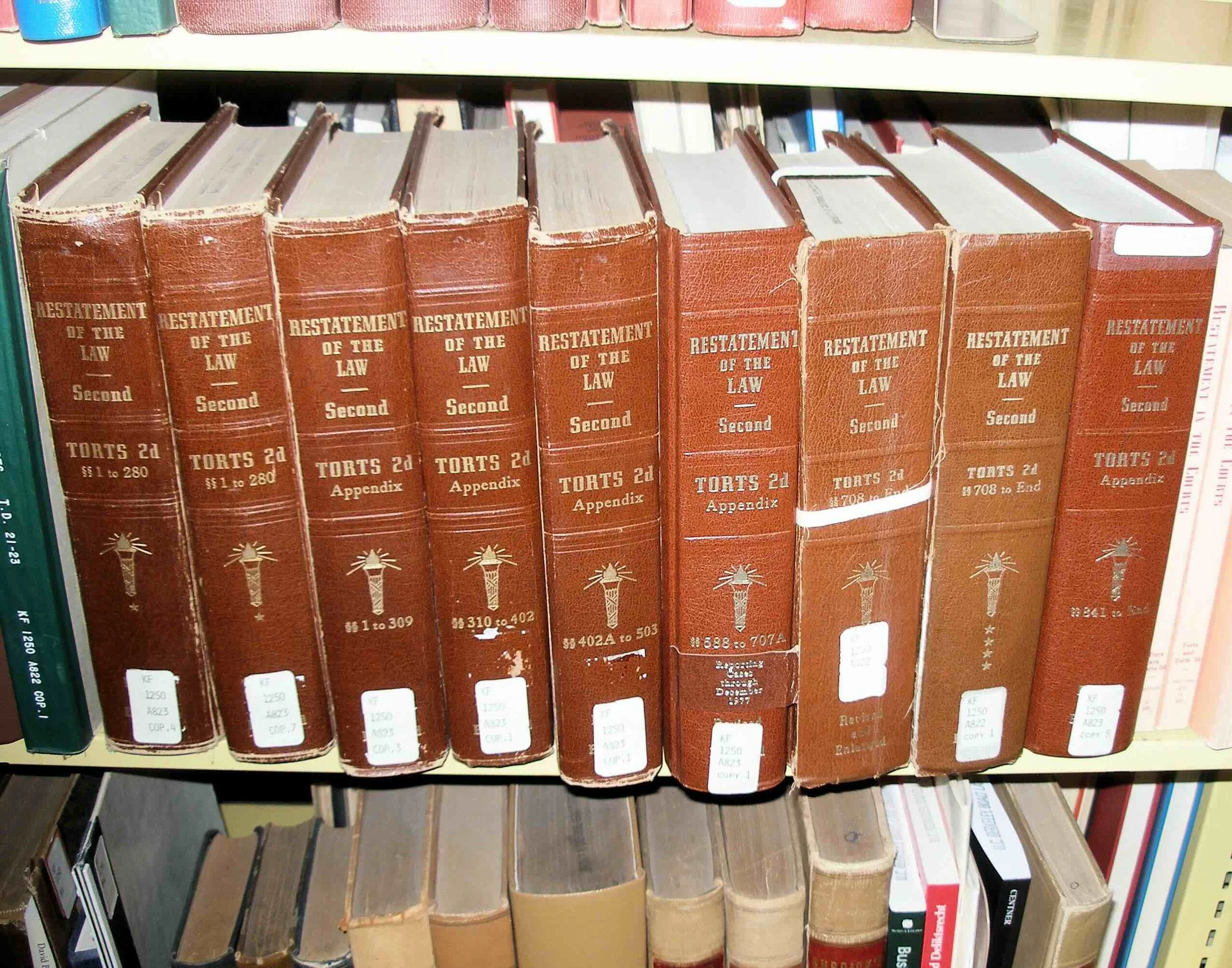
The Restatement of Torts is a set of guidebooks that offer information about liability case law to lawyers and judges.
Editor’s note: State lawmakers will consider a number of bills concerning AI product liability in 2027. The Transparency Coalition created this product liability series to help those of us who aren’t lawyers understand the basics of product liability law.
Nov. 16, 2026 — American liability law has developed mostly through the tradition of common law. Common law forms much like a footpath in a forest. No one plans the path. Each person who walks the path makes it clearer, and others follow.
In the same way, specific cases have established and expanded the field of liability law. Case law hasn’t been the only input, though. Over the years state lawmakers have codified principles of tort law through the legislative process. A third factor has also shaped the rules around products, manufacturers, injury, victims, and restitution: the Restatement of Torts.
References to “the second or third Restatement of Torts” may come up during discussions of AI product liability bills. This is a brief guide to the Restatement for non-specialists.
The American Law Institute: 100 years of restatements
In the 1920s a group of prominent judges, lawyers, and legal scholars grew concerned about the confusing uncertainty of American common law. They formed a nonprofit organization, the American Law Institute (ALI), tasked with sorting and simplifying those laws.
The Institute—which now consists of 3,000 elected members—publishes various Restatements of the Law, which summarize generally accepted principles of common law developed through state court decisions. These publications help inform lawyers and judges about established legal principles.
ALI’s work on torts—the body of law concerned with civil harms—may be its best known never-ending project. The initial version of the Restatement of Torts, published in 1939, took 16 years to complete. The revised version, Restatement (Second) of Torts, published in 1979, required 24 years of research and ran to four volumes with seven supplements. (It’s pictured above.)
The third version was commissioned in 1991 and is currently in its final phase of publication. Restatement (Third) of Torts is a monumental undertaking: a 35-year updating of the second version. It’s mostly complete, and the final volumes continue to be published as they become ready. The most recent updates concern liability for economic harm (May 2018), and medical malpractice (Oct. 2026).
The Primary guide to American liability law
The Restatement functions as a guidebook to American liability law and all of its various subcategories. Then-ALI Director Richard Revesz wrote in 2019:
“The ALI’s work on torts arguably has been the most influential of our efforts to restate the common law. Courts have cited to our Torts Restatements more than 80,000 times. No other ALI publication comes close to this mark; Contracts Restatements, the runner-up, have somewhat less than 40,000 citations. And the Restatement Second of Torts, in particular, has long held the mantle as ‘the most widely accepted distillation of the common law of torts,’ as Justice Souter described it in a 1995 opinion for the Supreme Court of the United States.”
Already thinking about the fourth restatement
Even as the Third Restatement was underway, legal scholars were already thinking ahead to what a Fourth Restatement of Torts might look like. In 2002, UC Berkeley legal scholar Stephen Sugarman proposed a “simplification of tort doctrine” that might be the focus of a forthcoming Restatement (Fourth) of Torts.
Sugarman pointed to the sprawling complexity of liability law, and called for a return to a clearer, simpler set of questions and classifications. Which was, of course, the Restatement’s original purpose.
Sadly, Prof. Sugarman did not live to see the beginnings of the fourth—or even the conclusion of the third. He died in 2021 at the age of 79. Within his own article, Sugarman noted that the ongoing project of the Restatement often outlived its primary Reporter, the title given to the project’s editorial director.
Legislators who wrestle with the complexities of product liability might take solace in the knowledge that they are not obtuse, and they are not alone. Liability law has challenged the patience of even the most respected legal scholars. It may never be mastered, but it can be steered in the most appropriate and fair direction.
Editor’s note: Rittik Bhattacharya contributed original research to this article.
understanding AI product liability