Meta pays $12.7 billion to settle one social media addiction case. Here are the details
Meta, the parent company of instagram, Facebook, and Threads, has agreed to pay a minimum of $12.7 billion to states whose kids were harmed by its addictive products. Beyond the monetary payment, the company agreed to shut down a number of harmful features on its products. (Photo by Julio Lopez on Unsplash)
Aug. 26, 2026 — Meta has agreed to pay $12.7 billion to settle a case in Northern California that alleged the company purposely designed Instagram and Facebook to addict children, despite knowing about the harms those products posed to young people.
Meta’s payment could rise to as much as $18 billion under certain conditions.
We’ve gathered details about the settlement as well as further resources regarding the historic lawsuit.
Read the full court document, which contains the terms of settlement, here.
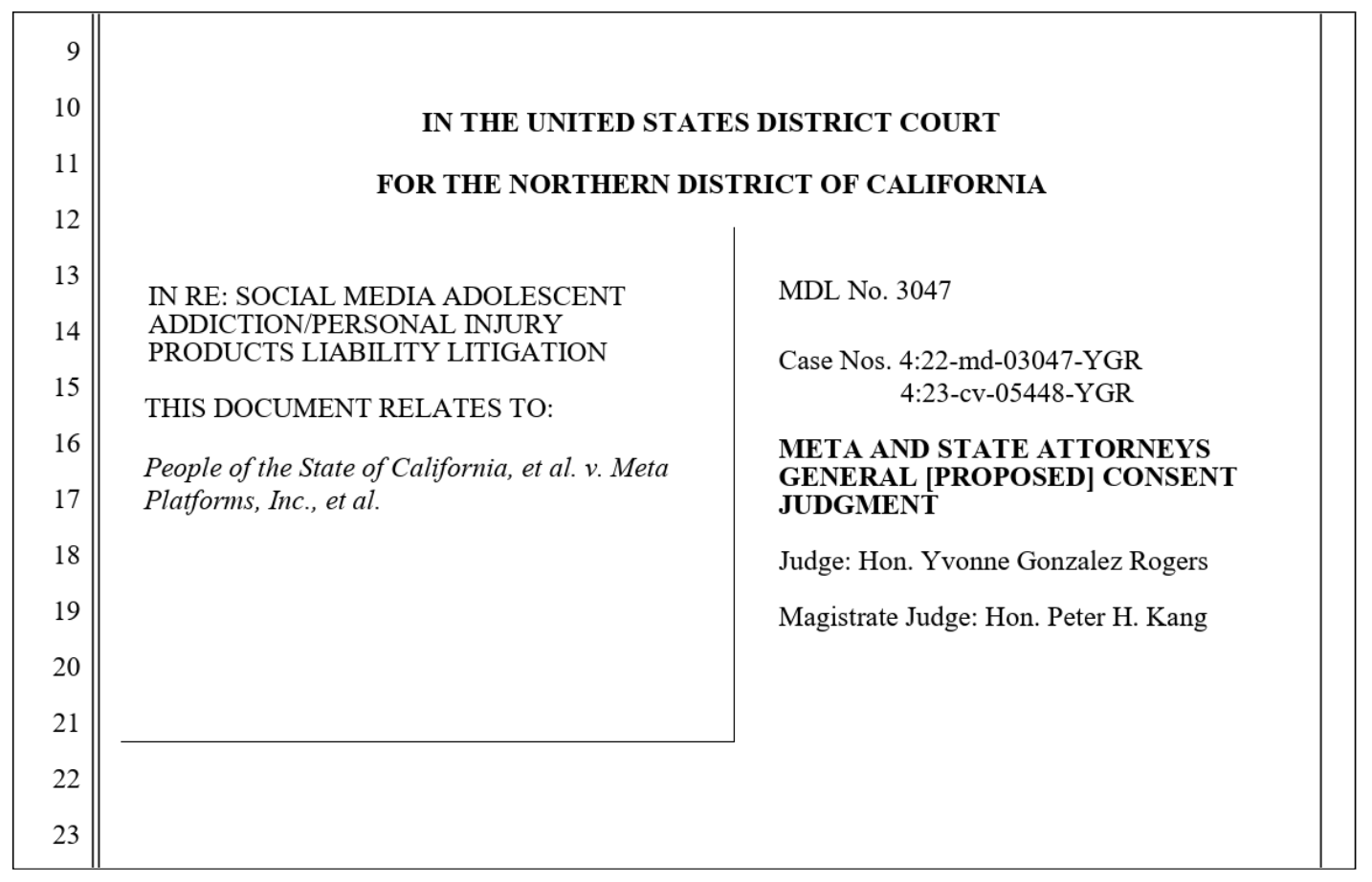
Click on image at left to download the full court settlement.
About the money
News outlets are quoting a variety of figures. It’s a bit confusing. Here’s how it works.
Meta is locked into a payment of $12.7 billion, to be distributed in annual installments over a 10-year period to the 50 states and District of Columbia.
Meta may pay an extra $5.3 billion if two specific conditions are met. Those are:
YouTube and TikTok implement one-hour Daily Limit, Night Mode, and age assurance measures (see below for details on these).
YouTube and TikTok each pay an amount matching the $5.3 billion figure, with half of Meta’s extra $5 billion payment tied to YouTube’s payment and half tied to TikTok’s.
It’s a bit like a sports contract that includes incentives. If YouTube and TikTok both implement the specified limitations, and each company pays $5.3 billion, Meta will be on the hook for a total payment of $18 billion. The states and D.C. would then split a total amount of $28.6 billion.
Agreement with 51 attorneys general
Although the case in question was led by state attorneys general in California, Colorado, Kentucky and New Jersey, the settlement agreement involves a bipartisan coalition of 51 attorneys general from every state and the District of Columbia.
The settlement only ends the jury trial in this particular case, which opened in federal court in Northern California earlier this month. It does not end the dozens of other social media addiction lawsuits brought against Meta, TikTok, and Alphabet (the owner of YouTube).
Agreement summary
The Tech Oversight Project, a nonprofit supporting plaintiffs in the social media trials, issued a statement heralding the settlement as a deal that forces Meta “to protect our kids.”
Meta agreed to enforce “ overnight shutoffs, daily limits our kids can't loosen without a parent, and an independent monitor watching Meta's books for a decade. Meta must now pay over $12 billion to states to fund things like after-school and summer programs, public health ads, a digital wellness public education fund, and youth mental health programs. Meta is also now banned from lying about the effectiveness of its youth safety tools.”
In settling the case Meta did not admit its guilt or acknowledge the validity of the lawsuit’s claims.
Actions to be overseen by the court for 10 years
In the agreement, Meta pledges to adopt a set of protections for teens and controls for parents, which it developed in collaboration with 52 state attorneys general. Those protections will remain for 10 years, with court oversight.
Time limits: Meta agrees to install a default two-hour daily time limit for minors, cumulative across both Facebook and Instagram. At 60 and 90 minutes, teens will be alerted about their daily usage. They will also see prompts at 15-minute intervals to “encourage intentional use,” per Meta’s description.
This two-hour limit will drop to one hour if YouTube and TikTok also agree to implement similar limits.
The time limit may be adjusted or lifted by a parent if a minor’s account is parent-linked.
Sleeping hours access: Meta will install a default block in all of its apps. This will prevent minors from accessing the apps between midnight and 6 a.m. (known as Night Mode).
Night Mode will expand to a period between 10 p.m. and 7 a.m. if other social media companies implement their own versions. As with time limits, parents may adjust this with a parent-linked account.
Notifications muted during school hours: The company will mute notifications for minors between 8 a.m. and 3 p.m. on weekdays (School Mode) between August 15 and June 15.
Likes and reactions gone: Minor users of Instagram, Facebook, and other Meta products will not be able to see the number of likes and/or reactions on both their own posts and others’ posts.
Makeup filters banned: Meta agreed to block “extreme makeup filters” for minors.
Enhanced harm reporting mechanisms: Meta agrees to offer an enhanced mechanism for teens to report potentially harmful content. The company must respond to 90% of those reports within six hours.
A non-addictive feed option: Meta agrees to offer minor users an option to have a non-personalized feed, meaning a feed that doesn’t use an algorithm to target them with content aimed to keep them endlessly scrolling.
Independent auditor: Meta agrees to bring on an independent auditor with expansive access to information and resources, regular reporting, and the right to communicate concerns to the state attorneys general.
Invest in improved age assurance: Meta agrees to invest in programs to improve age assurance technology to proactively identify accounts that might belong to users under 13 years old, or accounts that might belong to teens but were registered with an adult birthday. (Meta does not allow users younger than 13 to establish an Instagram or Facebook account.)
No more lying about safety features: Meta will be subject to an injunction prohibiting it from making further false, misleading, or deceptive statements around its safety features.
About the $12 billion settlement money
Meta’s $12 billion settlement will be distributed to states over a 10-year period.
Meta will pay an extra $5.3 billion if YouTube and TikTok implement their own one-hour daily time limit, Night Mode, and age assurance measures for minors. Those platforms must also agree to pay an amount matching the $5.3 billion figure.
Case background
The lawsuit, filed in 2023, alleged Meta illegally collected and used the data of children under the age of 13 who used its platforms, made decisions in designing its platforms that drove excessive use and put young users at risk, and that it lied to users, their families, and the public about the safety of Facebook and Instagram.
In doing so, the lawsuit claimed, Meta violated federal and state laws, including the Children’s Online Privacy Protection Act, California's False Advertising Law, and California’s Unfair Competition Law.
For more information on the full scope of the social media lawsuits and trials, read the Transparency Coalition’s full Guide to the Social Media Addiction Trials.
More about the social media trials