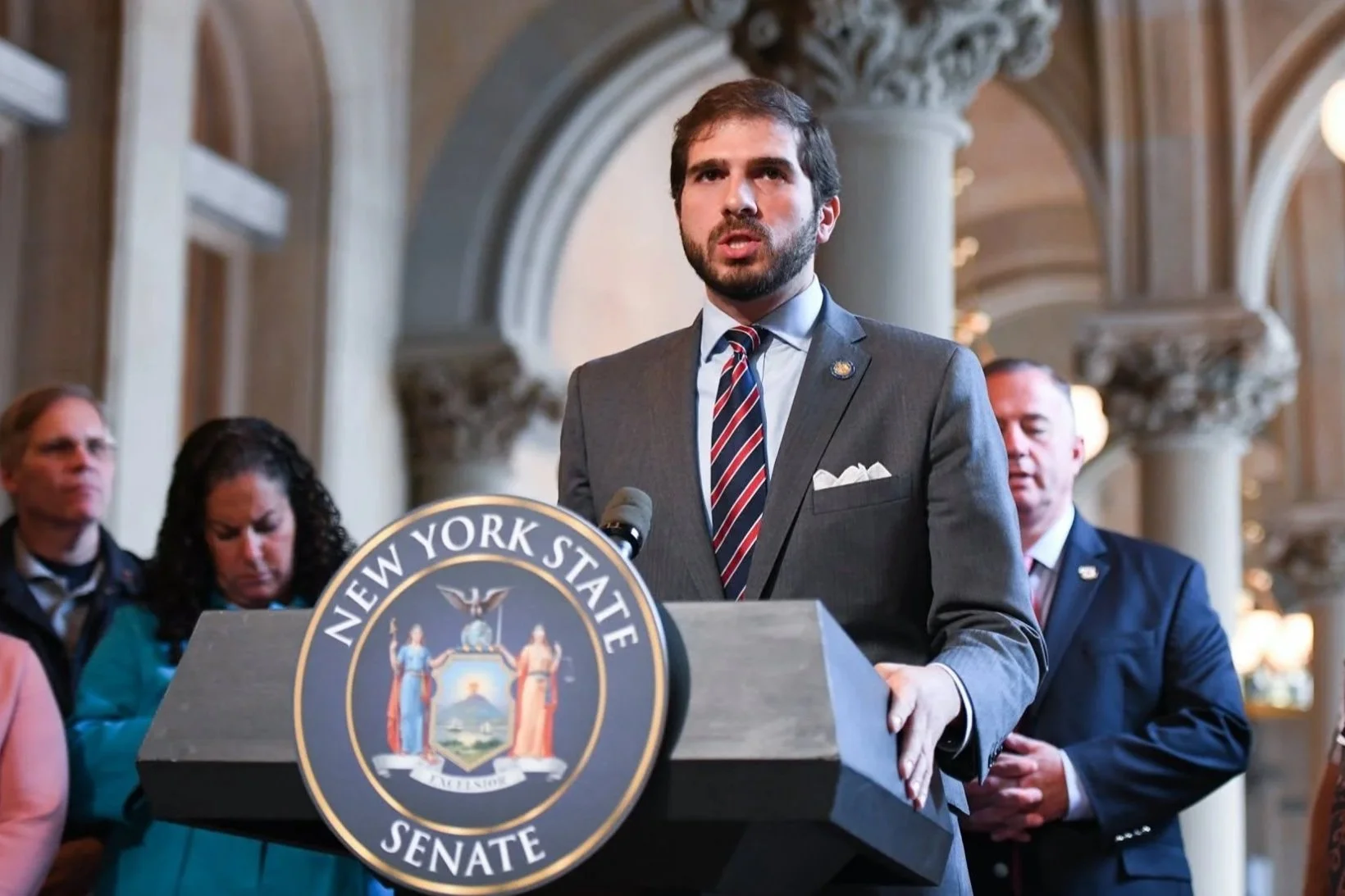
New York State Sen. Andrew Gounardes, above, introduced a newly strengthened version of the RAISE Act last week. The new measure, co-sponsored by Sen. Patricia Fahy, would require third-party audits and raise safeguards around powerful frontier AI models.
Nov. 2, 2026 — New York Sen. Andrew Gounardes, co-author of the state’s groundbreaking RAISE Act, last week filed a significant follow-up measure to be considered by lawmakers in the state’s 2027 legislative session.
The existing RAISE Act, passed in 2025, was a pioneering measure enacted to create some of the nation’s first frontier AI model safeguards.
S 10731, co-sponsored by Sen. Gounardes and Sen. Patricia Fahy, would revise the existing RAISE Act to widen its scope, add stronger state safety standards, require the use of licensed third-party AI auditors, gives the state the power to cap compute, and introduce whistleblower protections.
“AI models are already hacking companies' servers, lying to researchers and threatening to shut down crucial systems,” Gounardes said last week. “Big Tech can’t be trusted to police itself. RAISE 2.0 keeps AI corporations honest and keeps us safe.”
The revised act would add per-day monetary fines and give the Attorney General the power to issue an injunction to restrict an AI model’s deployment in New York.
Gounardes and Fahy are both up for re-election in tomorrow’s Nov. 3 election. Both are expected to win handily. Assemblymember Alex Bores, co-author of the original RAISE Act, did not run for re-election. His new nonprofit organization, Who Decides, is focused on uniting Democratic party leaders around a shared vision on AI regulation.
download and read the full bill:
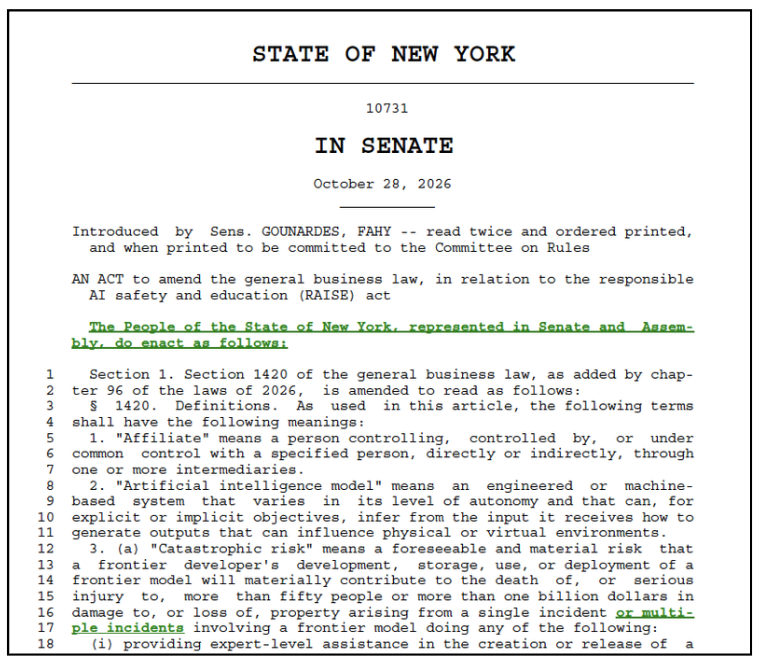
Click on image to download the full text of RAISE II, New York’s S 10731.
RAISE II: What the revised act would do
Under the proposed new bill, these changes would occur:
New state oversight office: A new AI regulatory office within the existing Dept. of Financial Services will be tasked with the implementation of RAISE and RAISE II.
The bill tasks the new office with adopting, by Jan. 1, 2029, binding minimum standards for safety frameworks and for mitigating each type of catastrophic risk, security risk, and AI R&D automation. The target is to come as close as practicable to preventing risks that are unreasonable given the benefits. The office must also weigh whether a topic is understood well enough to regulate, or is better handled through voluntary guidance or further study.
Widen the scope of coverage: The compute threshold for a frontier model, currently 10²⁶ operations, would drop to 10²⁵ operations. A proviso is added that ties frontier-model status to the regulatory office finding that a model is among the most capable, poses catastrophic risk, and is reasonably likely to automate AI research and development.
The “large frontier developer” test changes from revenue (over $500M in the prior year) to spending (over $1B on frontier-model R&D, training, security, evaluation and similar work over the prior 36 months).
Third-party audit requirements: Within 60 days of becoming covered, and every year after, a large frontier developer must hire an examiner to assess compliance with its framework and whether its public statements match the findings. Starting Jan. 1, 2028, an independent third-party examiner must be on continuous assignment, with reports every 90 days starting April 1, 2028. Each report assesses every catastrophic-risk type, security risk, AI R&D automation, and whether the next 90 days pose substantial risk without new mitigations, plus recommended mitigations. Audit rules:
Reports go unredacted to the state regulatory office within 7 days and are published, with redactions, 21 days later.
The state regulatory office decides disputed redactions on fixed deadlines.
Developers must give third-party examiners broad access to models, employees and documents. Developers may impose reasonable security protocols, but not ones that block the examiner’s work.
Records must be kept for five years.
Third-party auditor independence and licensing: Third-party auditors must have relevant technical expertise and no financial, operational or managerial dependence on any large developer. Fees are not allowed to be based on findings. The state regulatory agency must issue licensing regulations no later than Jan. 1, 2028. Only licensed examiners may serve from Jan. 1, 2029.
State regulatory powers and emergencies: The state regulatory office can impose an additional third-party auditor, for one year at a time, after an incident or when it finds the original auditor to be inadequate. Auditors must report a suspected covered emergency to the developer, the state regulatory office, and the Attorney General within 72 hours.
Authority to limit compute: The state regulatory office may require large developers to limit the compute used to train new models and/or the compute devoted to automated R&D. These restrictions would apply to all large developers at once, though the limits can differ by company. They may be issued only to reduce catastrophic risk, prevent a critical safety incident, or avert a covered emergency. A third-party auditor verifies compliance.
Definition of catastrophic risk: That term would expand to cover multiple incidents, not just a single one. The oversight standard loosens from “no meaningful” human oversight to “limited” oversight. A new category is added: a model attempting to overthrow or seize control of federal, state or New York local government.
Definition of critical safety incident: The terms of a “critical safety incident” would see these changes:
Theft or tampering with unreleased model weights no longer has to cause death or injury to be considered a critical safety incident.
“Loss of control causing death/injury” and the existing “deceptive techniques” phrasings are replaced by a model circumventing or evading its developer’s controls, access limits, shutdown or monitoring, outside a contained evaluation.
New language covers a model harming a third party’s computer systems without any user intending it, near-misses where a safeguard failed and only luck or intervention prevented an incident, and anything else the office designates by regulation. (This would encompass the well-known OpenAI / Hugging Face incident of a few months ago.)
Stronger transparency obligations: Under RAISE II, the frontier AI framework must now address security risk, the model’s ability to automate AI R&D, testing for deception or sandbagging, and whether the developer uses models to monitor other models. The state regulatory office may add further required elements by rule.
Transparency reports must now include the model’s specification and how far the safety assessments can be reproduced by outsiders.
New transparency obligations would include:
Senior officer certification: A designated accountable senior officer must certify, under penalty of perjury, that every publication and material submission to the state regulatory office is accurate.
False statements to the office are expressly prohibited.
Prevention and containment: Large developers must keep records of technical and administrative measures that can prevent an imminent critical safety incident and contain one. Open-source copies outside the developer’s possession are carved out.
State access to redactions: State regulatory office officials gets access to unredacted copies upon request.
Whistleblower protections: Under the new bill, large developers would become subject to Labor Law Section 740 (regarding retaliatory action by employers). Contracts or policies that block protected disclosures would be prohibited. Employees may use the Attorney General’s complaint website, and there are notice requirements: within 10 days of hire, for remote workers, and annually with acknowledgment.
Stronger enforcement provisions: Penalties would change from the existing $1 million for a first violation and up to $3 million per later violation (scaled to severity), to $1 million per day for a first violation and $3 million per day for later ones. The existing list of specific violations is replaced with any failure to comply with the act, its regulations, or a court order.
Under the new bill, the Attorney General would gain the power of injunctive relief, including the issuance of temporary restraining orders, for violations or covered emergencies, whether flagged by a third-party auditor or otherwise. Courts would be allowed to order corrective action, a halt to activity, or restrictions on deploying or using a model in New York. The state regulatory office would need to refer violations to the Attorney General. There is no private right of action under the current RAISE Act, and RAISE II would not create one.
report: All the new ai laws in 2026