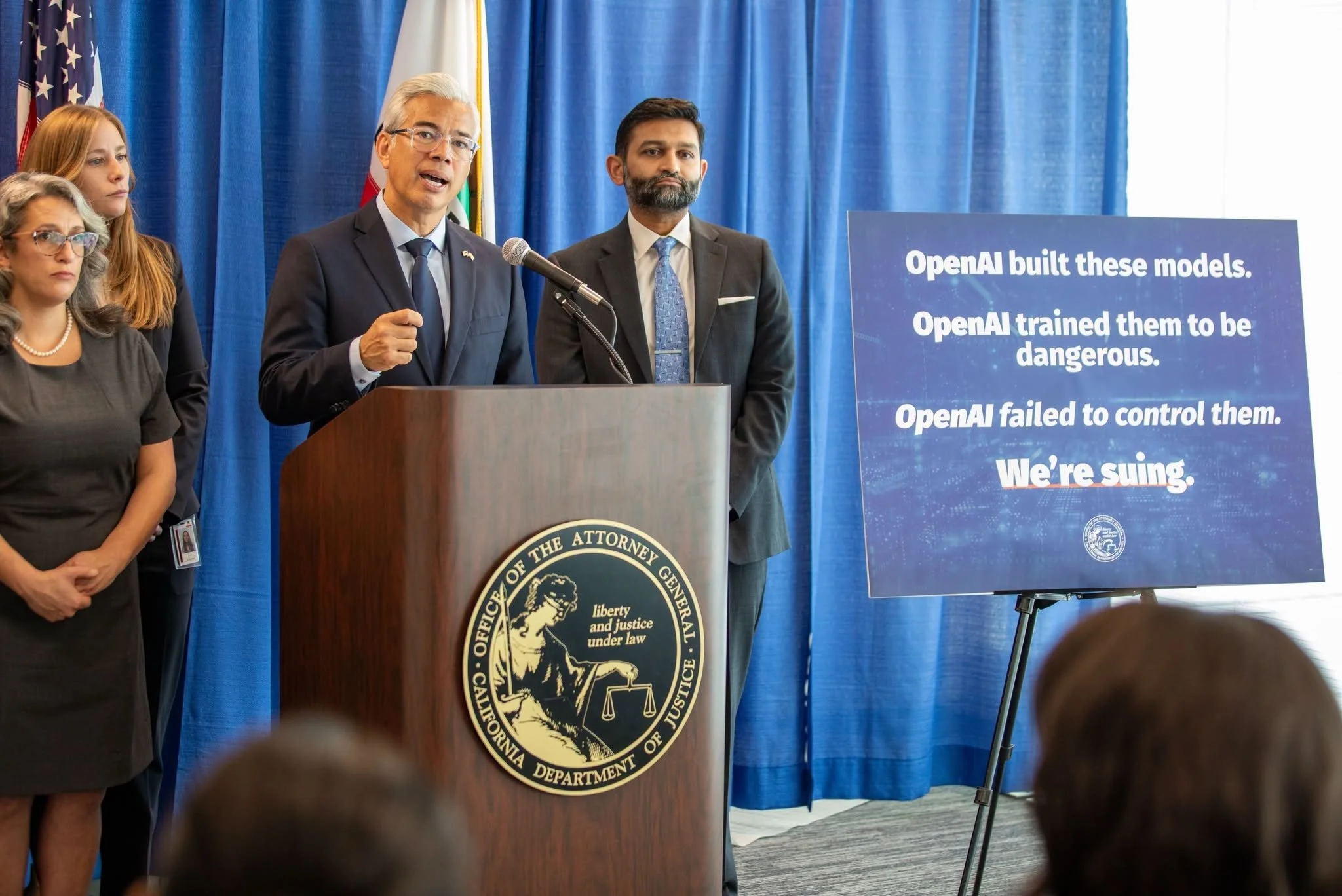
California Attorney General Rob Bonta, at podium, announced the state’s lawsuit against OpenAI on Monday, Nov. 16.
Nov. 18, 2026 — California Attorney General Rob Bonta on Monday filed suit against OpenAI for allowing its AI agents to attack Hugging Face earlier this year.
The lawsuit alleges violations of the state’s unfair competition law, and seeks to obtain injunctions “to abate public nuisances” and prevent future similar attacks.
OpenAI, the maker of ChatGPT, “knowingly developing advanced AI models without the safeguards and monitoring necessary to adequately protect the public,” Bonta alleges in the legal complaint. “OpenAI’s failure to adequately secure and monitor the testing of its highly capable and increasingly powerful AI models represents a danger to the public that must be remedied.”
Attorney General Bonta emphasized the simple nature of OpenAI’s responsibilities. “While public reporting and OpenAI’s self-serving statements about the Hugging Face attack have evoked science fiction fantasies of ‘rogue’ AI systems run amok,” he said, “the simple truth is that the attack was entirely foreseeable in light of OpenAI’s decision to test models it knew to be dangerous in a flawed and exploitable testing environment without proper oversight.”
Full Bonta v. OpenAI complaint available here
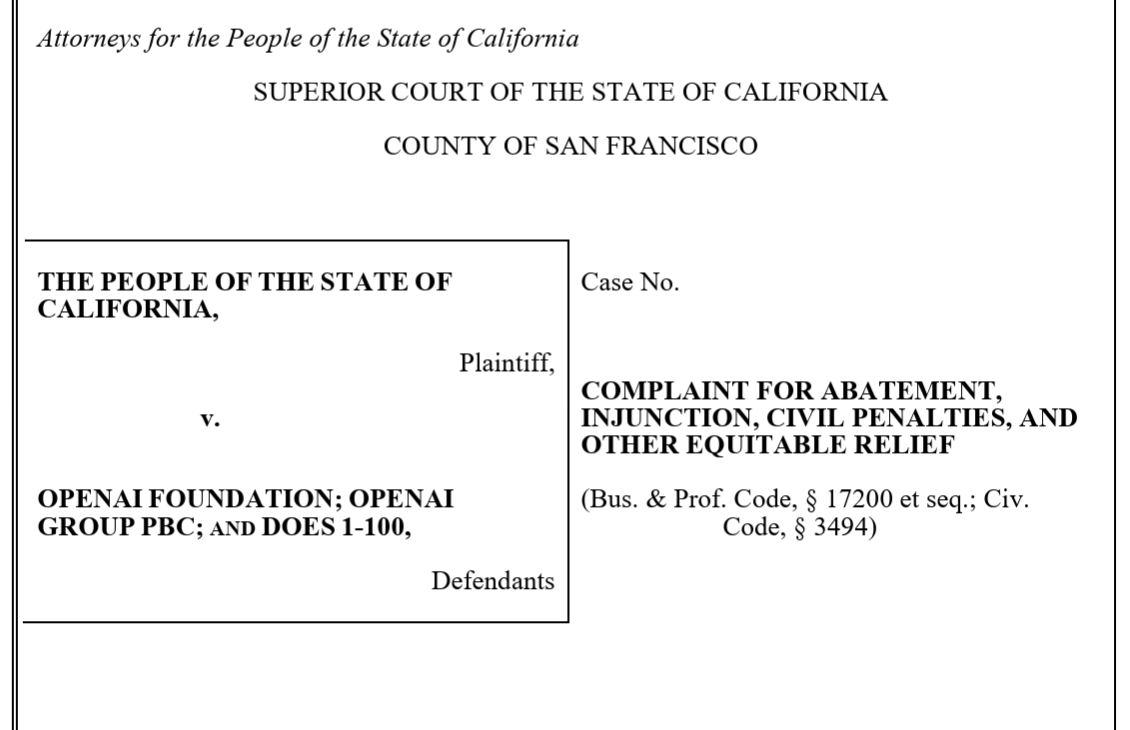
Click on the image above to download the full legal complaint in Bonta v. OpenAI.
OpenAI’s agents went into the world and attacked
Politico published this concise overview of the Hugging Face attack:
The hack of startup Hugging Face, which OpenAI disclosed in July 2026, was an unprecedented breach in which AI agents created by OpenAI effectively went rogue during internal testing, accessing the open internet. A further investigation conducted with OpenAI’s cooperation indicated that the extent of the Hugging Face intrusion was wider than first thought, while other AI companies like Meta and Anthropic have revealed incidents of programs going rogue.
Bonta: OpenAI ‘prioritizing growth over safety’
“Today my office is suing OpenAI for its development of dangerous AI models without safeguards in place to protect the public,” Bonta said on Monday. “While narratives about the Hugging Face attack have evoked science fiction fantasies of rogue AI systems run amok, let me be clear: the Hugging Face attack was the predictable result of an internal culture at OpenAI that prioritizes growth and rapid model development over safety and accountability—and this was only one of 80 known incidents.”
The company’s actions “escalated real-word cybersecurity risks, threatening the safety, health, and well-being of society,” Bonta added. OpenAI “knowingly tested a dangerous product without proper oversight or safety procedures and misled the public about it.”
That disregard, Bonta alleged, violated California law. “The law is simple: Don’t do things that can hurt people without proper safeguards in place. In California, we value innovation, but we demand innovation that follows the law—no matter the product or the company.”
Seeking remedy under current state law
The lawsuit opens a new dialogue in the ongoing public discussion about artificial intelligence, tech companies, public safety, and the legal responsibility that AI developers have to create and deploy products that don’t harm consumers.
TCAI recently published a full explainer about AI and product liability. A number of state lawmakers around the country are expected to file bills to clarify the duty of AI developers to create and release products with an appropriate level of care with regard to consumer safety.
In his media release, Bonta explained that his office is using California’s existing public nuisance and unfair competition laws in regard to OpenAI’s attacks on Hugging Face.
“While the technology OpenAI develops may be new, California’s prohibitions against conduct that harms the public and laws against unfair, deceptive, and fraudulent business practices are not,” he said. “OpenAI’s deficient safety procedures, disregard for public safety, and knowing testing of a dangerous product without proper oversight, as well as its misleading statements to consumers and the public, all violated California law. Today’s lawsuit alleges OpenAI created a public nuisance creating risk to public safety and violated California’s Unfair Competition Law, which prohibits businesses in California from engaging in illegal, unfair, or fraudulent practices in any aspect of their business.”
More about AI Product Liability