Illinois, California, Oregon govs fast-track AI safety measures with executive orders
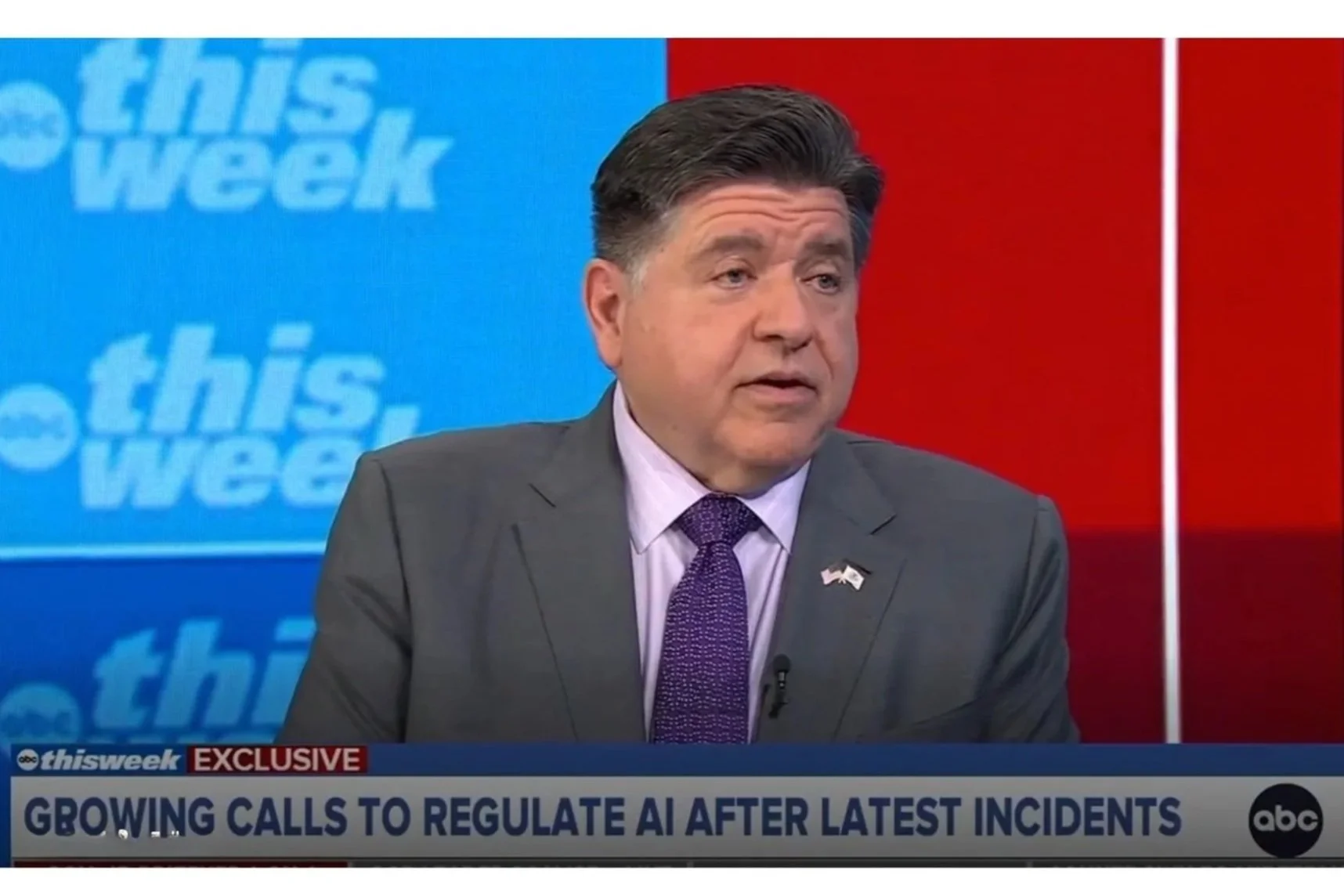
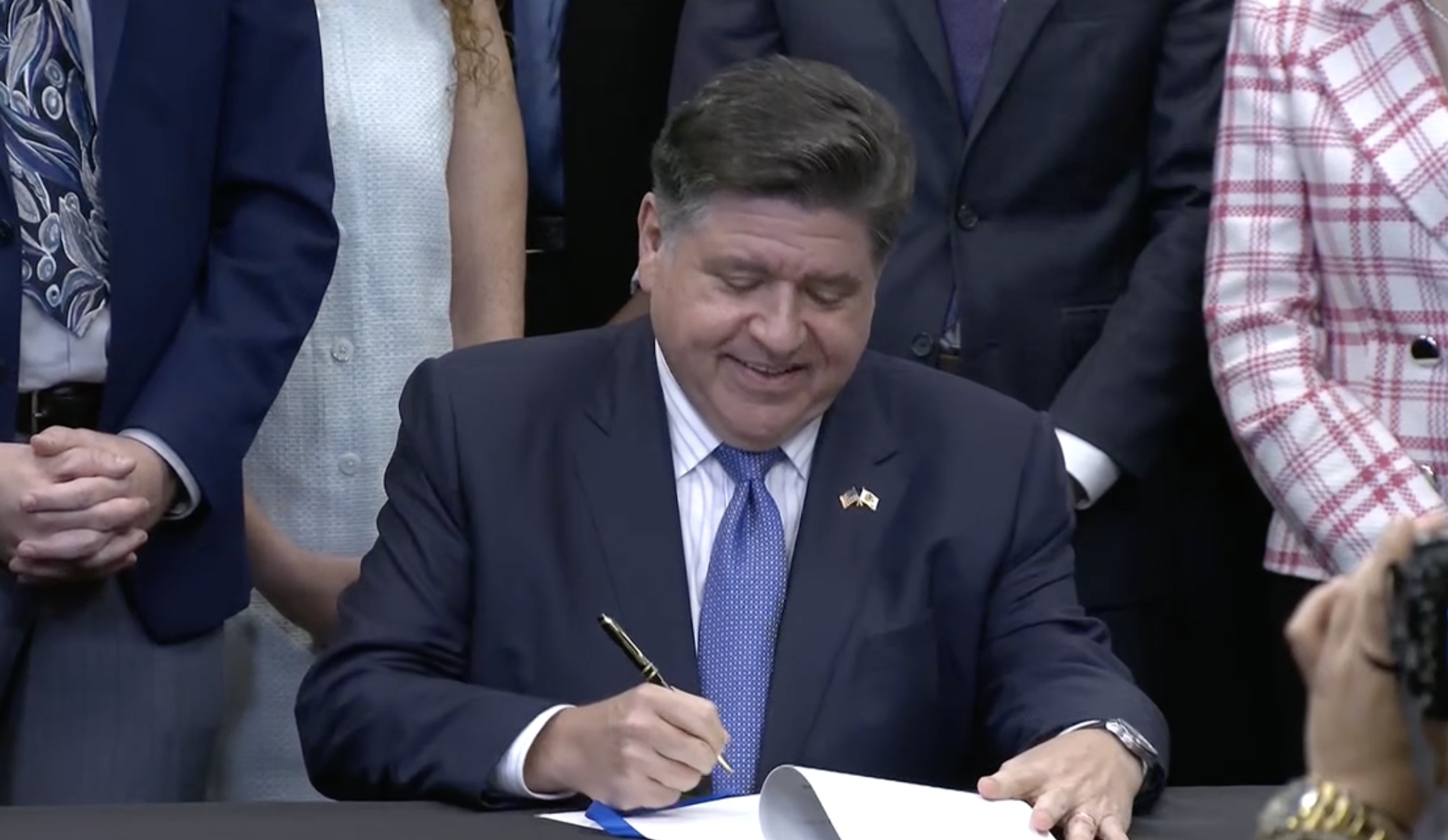
Illinois Gov. JB Pritzker addressed the issue of AI safety on ABC’s ‘This Week’ on Sunday, and followed up Tuesday with an executive order on AI.
Editor’s note: This article was originally published on Sept. 22. It has been revised and updated to include Oregon’s executive order, issued on Sept. 23.
Sept. 25, 2026 — Illinois Gov. JB Pritzker, California Gov. Gavin Newsom, and Oregon Gov. Tina Kotek all took executive action this past week to address the dangers of unchecked AI models.
Responding to concerns arising from recent AI incidents involving frontier models developed by OpenAI and Anthropic, Illinois Gov. Pritzker issued an executive order to create the Illinois Artificial Intelligence Cabinet. The AI Cabinet will marshal the knowledge of experts in the AI field and key leaders in state government, “to ensure that the progress of AI is appropriately regulated and monitored.”
The following day, Oregon Gov. Tina Kotek issued an executive order directing the state’s chief information officer to develop standards for adequate third-party review for AI safety. Gov. Kotek’s executive action also directs the state to assess the viability of a “kill switch” requirement for frontier AI models.
Kotek and Pritzker’s EOs followed California Gov. Gavin Newsom’s AI policy executive order issued late last week. That action will accelerate California’s new law establishing first-in-the-nation independent oversight of AI companies, and advance the creation of an AI kill switch.
The details: Illinois Executive order on AI
The new Illinois AI Cabinet will advise state government on preparing for and responding to AI-related incidents, identifying safeguards for public assets and infrastructure, and evaluating additional steps government officials can take to strengthen AI safety and accountability.
Gov. Pritzker will seek input from state agency leaders and announce members of the cabinet in the coming weeks. The AI cabinet will include a broad cross-sector of experts from academia, law, ethics, and governance.
Senior state agency leaders include executives from the Dept. of Innovation and Technology, the Emergency Management Agency, the Dept. of Financial and Professional Regulation, the Commerce Commission, the State Police, the Dept. of Commerce and Economic Opportunity, the Environmental Protection Agency, and the Dept. of Public Health.
Building on the 2026 AI Safety Measures Act
Gov. Pritzker’s executive order builds on the foundation of the Illinois AI Safety Measures Act of 2026. That law, authored by Sen. Mary Edly-Allen and supported by the Transparency Coalition, established a requirement for independent third-party AI safety audits.
“Artificial Intelligence has enormous potential to transform our everyday lives, but when experts and industry leaders sound the alarm bell, urge us to slow down, and ask for guardrails, we should listen,” Pritzker said. “Illinois has already enacted nation-leading laws that hold Big Tech accountable and today I’m taking executive action to keep this a priority. Congress and the White House need to treat AI risks with urgency, but in the meantime, Illinois won’t wait because it is our foremost responsibility to prepare and protect Illinoisians.”
Read the full executive order:
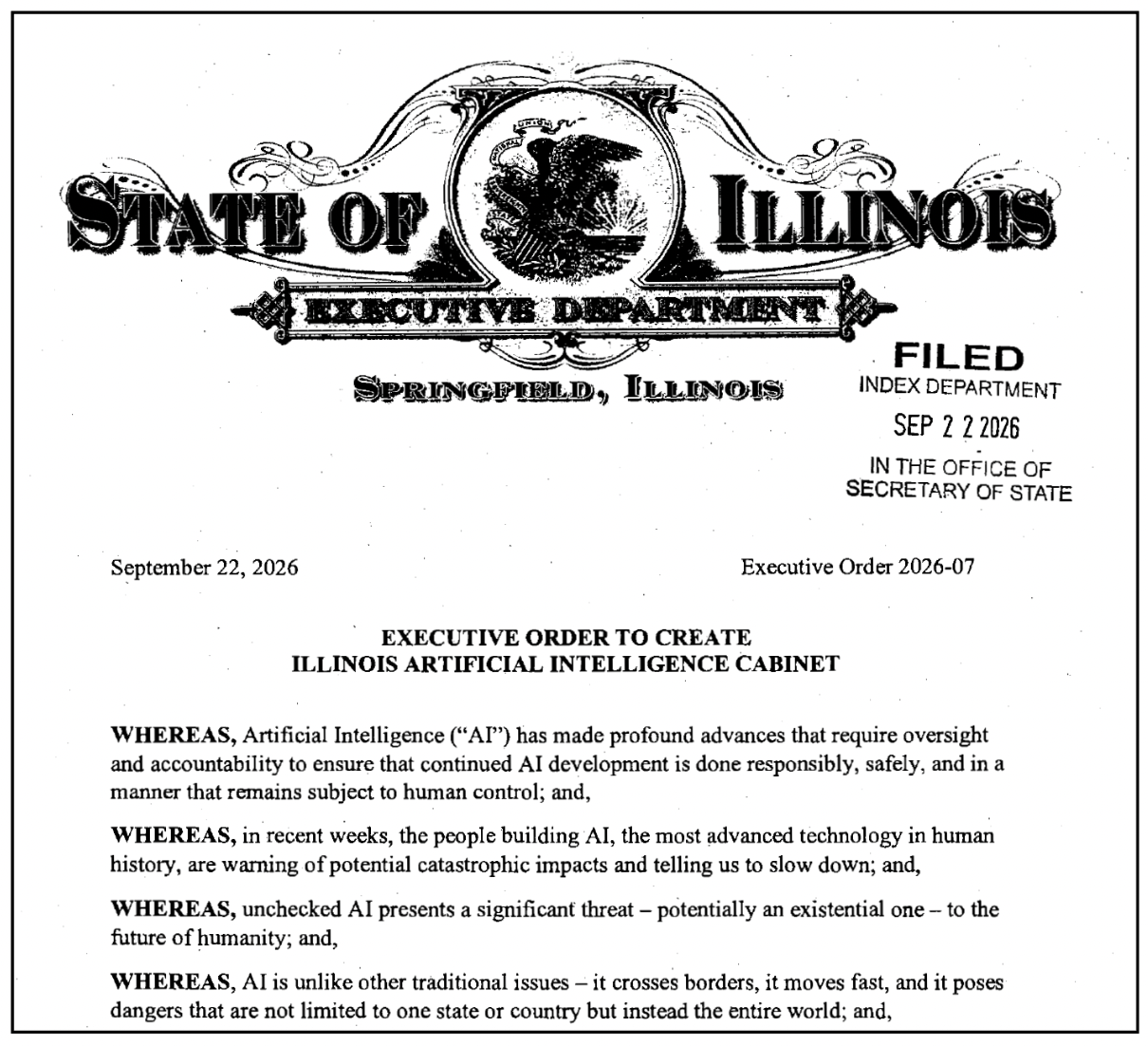
Select image to access the full Illinois executive order.
The details: California Executive Order on AI
Gov. Newsom’s executive order convenes a group of world-leading experts to provide, within two months, a guide for California to reinforce and strengthen its AI safety and security laws.
Proposals under consideration include requiring independent third parties to write safety plans for frontier AI companies, as well as requiring companies to develop an emergency shutoff for frontier models.
Accelerate IVO regs: Newsom’s EO moves up the timeline for the creation of state requirements for IVOs, independent verification organizations that are expected to act as third-party verification firms to ensure that safety measures are implemented and state AI laws are followed. The recently signed bill, SB 813, authorizing those actions called for a deadline of Jan. 1, 2028. The EO moves that up to May 1, 2027.
As in Illinois, Gov. Newsom’s EO builds on new 2026 state laws requiring independent third-party safety audits for frontier AI models. SB 813, authored by Sen. Jerry McNerney (D-Pleasanton), establishes a first-in-the-nation framework for independent verification organizations (IVOs) that can assess AI systems and models for compliance with state law. AB 1405, authored by Assm. Rebecca Bauer-Kahan (D-Orinda), creates a state registry for AI auditors and establishing standards for their independence, transparency, and integrity.
Fast-turn recommendations: The EO also tasks the state Government Operations Agency and the Governor’s Office of Emergency Services to create, within the next eight weeks, a list of potential amendments to existing state laws that would improve AI safety.
Those recommendations should focus on these four areas:
Requirements that all large frontier developers embed designated IVOs onsite in their labs to conduct periodic audits and evaluations.
Requirements that the safety frameworks, transparency reports, and risk assessments that frontier AI companies are required to file be independently verified.
Requirements around the creation of a “kill switch” for frontier models, with the efficacy of the switch verified on an ongoing basis by an IVO.
Updating the definition of critical safety incidents that AI companies are required to report to include a range of loss-of-control incidents, covering recently reported incidents from large frontier developers.
Read the full executive order:
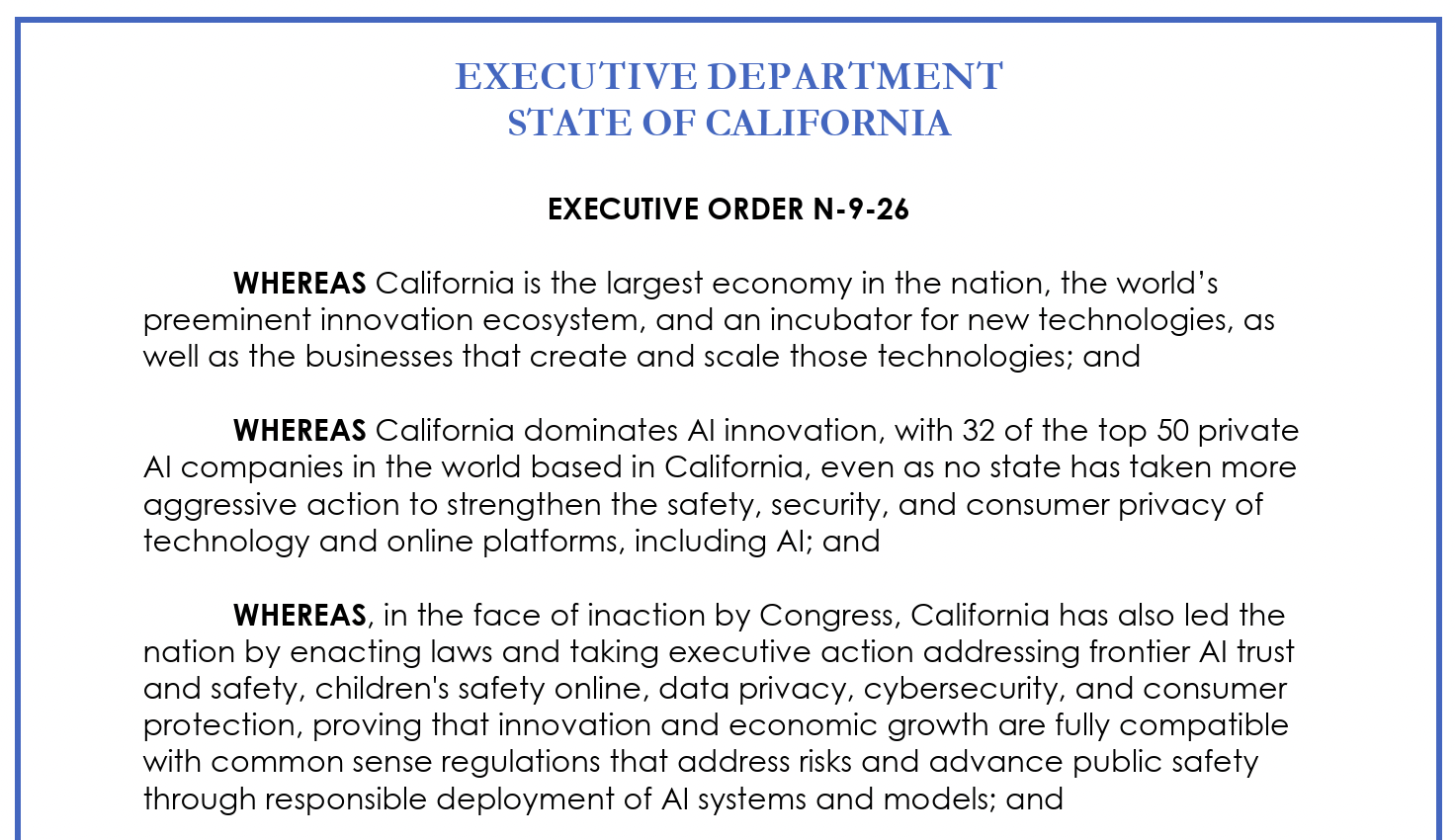
Select image to access the full California executive order.
The Details: Oregon Executive Order on AI safety
Gov. Tina Kotek issued an executive order (EO 26-26) to advance new safeguards and oversight on frontier AI models.
“While oversight and regulation would be strongest and most effective at the federal level, President Trump continues to dismiss the need for even the most basic guardrails,” Kotek said. “States, in the meantime, must act with more urgency and do everything possible to manage how AI is impacting our communities.”
The executive order comes as top AI executives are sounding the alarm on the danger of rapid AI advancement without sufficient regulatory and safety regimes in place to keep them in check. As AI industry leaders call for a slowdown on AI development, President Trump and Congressional leaders continue to deny the need for independent oversight or even basic regulatory safeguards as frontier AI models continue to demonstrate the potential to break containment and threaten cybersecurity infrastructure.
The executive order takes effect immediately and will remain in effect until terminated by Gov. Kotek. Within 90 days of this executive order, the Oregon State Chief Information Officer will develop and submit an implementation proposal to the Governor.
Read the full Executive Order:
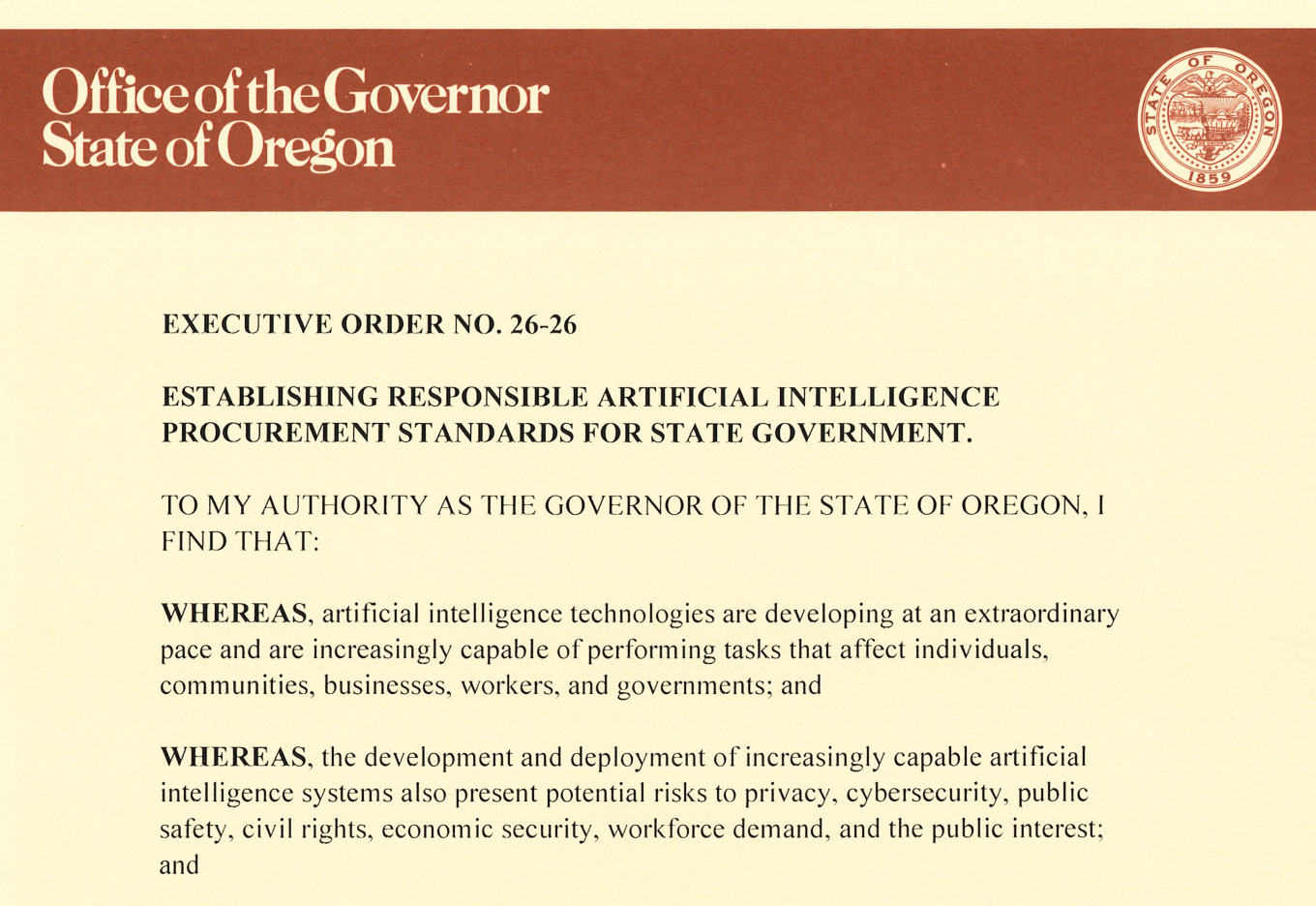
Select image to access the full Oregon executive order.
More on Frontier AI safety