Two months ago, Gov. Gavin Newsom fast-tracked the development of frontier AI safety rules in response to the OpenAI Hugging Face attack. This new report offers a detailed look at what those rules may look like. (Illustration: Getty Images for Unsplash+)
Nov. 20, 2026 — As the record-breaking Anthropic IPO grabbed global headlines last week, an obscure California state agency released a report that could set the roadmap for frontier AI safety regulation nationwide.
You may have missed it. We’re here to give you a nudge. It’s a big deal.
Legislators in many states are currently drafting bills that would create safety rules around the development and release of powerful frontier AI models. These measures come in the wake of the alarming OpenAI attack on Hugging Face this past summer.
California enacted one of the nation’s earliest and strongest frontier AI safety laws, the Transparency in Frontier Artificial Intelligence Act (SB 53), in Sept. 2025. It came into effect on Jan. 1, 2026. In Sept. 2026, Gov. Gavin Newsom issued an executive order—shortly after news of the Hugging Face attack broke—to fast-track California’s independent oversight of AI companies, and advance the creation of an AI kill switch, under SB 53.
Newsom’s order asked the California Government Operations Agency (GOA) to work with the California Office of Emergency Services and outside AI experts, and develop recommendations for legislative action in 2027. Specifically, Newsom asked for GOA to use SB 53 as the foundation for new rules around (1) standards, (2) independent verification organizations, (3) critical safety incident reporting, and (4) emergency shutdown requirements.
This report answers that assignment. Let’s dig in.
Download the full report here
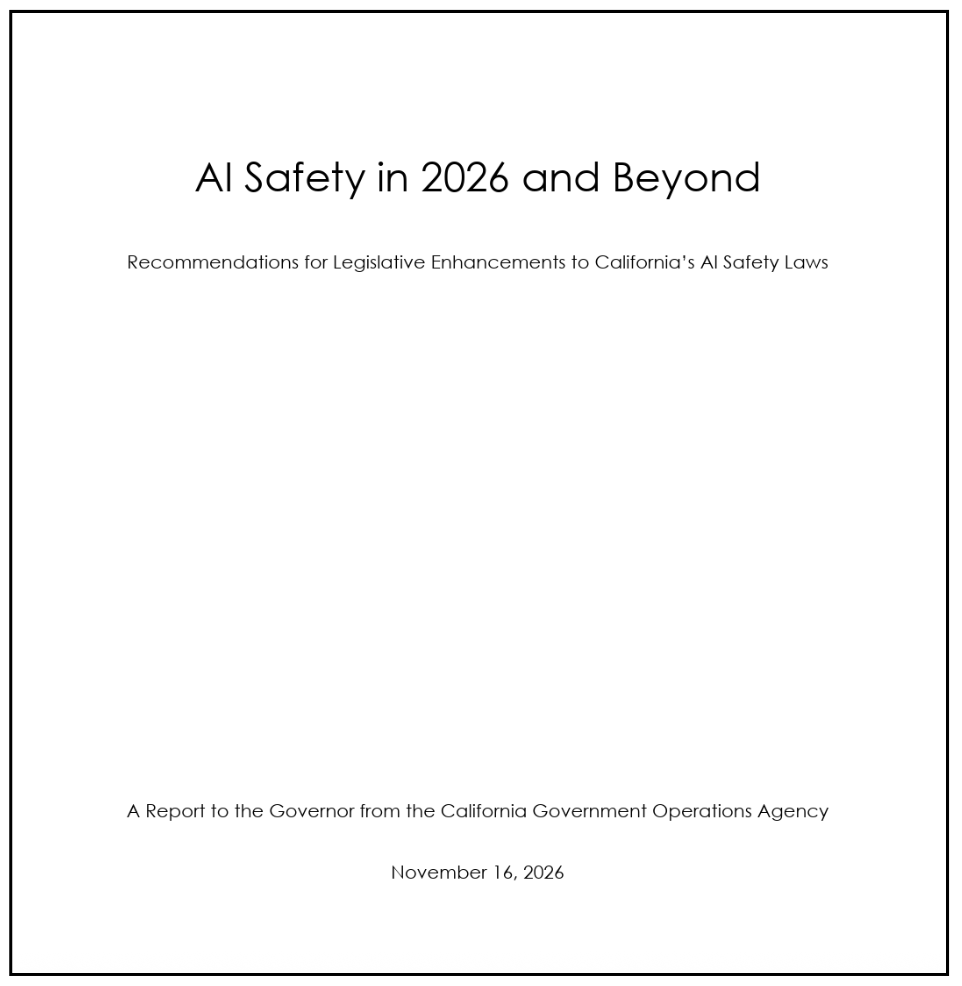
Click on the image to download the full California GOA report.
1. The state sets standards, ivos verify compliance
The GOA report recommends that the state establish baseline standards for safety, security, and transparency that all large frontier AI developers must follow.
Third-party audit firms, known as Independent Verification Organizations (IVOs), “should have the flexibility to determine and update technical specifications for meeting the standards as AI technology evolves,” the report says.
In other words, the state would set baseline standards while IVOs would turn those standards into specific tests and methods and keep them updated as the technology evolves. The state has the final say and can overrule an IVO's assessment, much as the FAA does with industry-written aviation standards.
Further: “The state should adopt clear standards that apply throughout the AI model development cycle, with reference to national and international standard-setting bodies wherever appropriate. IVOs would translate these standards into the technical methods and tests used to verify compliance, updating them as the science advances.”
Subsets of standards to be defined: Within the framework suggested by the COA report, a number of standards within specific areas must be defined. Those include:
Security standards, to protect against cyberattack and exfiltration of weights;
Compute allocation reporting standards, to track and report on the allocation of computing resources to R&D and other functions;
Accreditation standards, for an IVO to demonstrate its required level of expertise;
Outcome (performance) standards, which establish acceptable risk levels and mitigations for AI models and systems;
Contracting standards, to establish mandated and prohibited terms in the contracts governing IVO engagements;
Access standards, to establish the access a developer must provide for the IVO to carry out evaluations and assessments;
Practice standards, which require specific steps necessary to meet an outcome standard where IVO-written specifications don’t yet require it.
State oversight of recursive self-improvement (RSI): The report addresses the recent emergence of recursive self-improvement (RSI) as an issue of concern. RSI is the process by which an artificial intelligence model begins improving itself, or pursues a goal humans set for it in ways never intended.
GOA recommends: “Developers should have to report key metrics on their automation of AI R&D, including the share of compute they are devoting to this purpose. As the state stands up a system of IVOs, the very first responsibility of the IVOs should be to verify these metrics and assess the risks as they grow. If the state assesses that the automation of AI R&D above a certain level may result in catastrophic risk, the state should have authority to cap the development and use of RSI.”
2. a New Law must Require oversight by third-party auditors
Pass and enact legislation to require third-party audits: In Sept. 2026, Gov. Newsom and legislators enacted two laws (SB 813 and AB 1405) that work with SB 53 to establish independent safety and compliance audits conducted by state-licensed IVOs. Those audits are expected to function much like a KPMG or Deloitte financial audit of a Fortune 500 company. But few AI auditors exist, and industry standards have yet to be established.
Because SB 53 was enacted prior to the establishment of IVOs, however, the law currently does not require independent third-party audits—only an internal self-assessment. Similarly, SB 813 makes IVOs voluntary and relies on state "designation."
The GOA report recommends closing that gap with legislation requiring every large frontier developer to submit to ongoing oversight by state-licensed independent verification organizations. “IVOs must have full access to the people and information they need to run tests and make informed judgments on the risks of a developer’s frontier AI models. They must assess risks against the standards adopted by the state on an ongoing basis and share those unredacted assessments with the state.”
Create financial firewalls to maintain a strict level of IVO independence: The GOA report emphasizes the importance of IVO independence. Third-party auditors “cannot have payment contingent on audit outcomes, must manage financial and other conflicts, and should be independent of the developer being assessed.”
The state must have the authority to order corrective action: The GOA report recommends that IVOs should present assessments to the state, which, after engaging with the developer, should decide whether to order corrective action.
Per the report: “This is to ensure the developer is taking sufficient action to comply with baseline standards, reduce risk levels, and provide sufficient access to evaluators. Developers would be able to contest the state’s determination in court before it goes into effect. If a court finds in favor of the state, the court should be able to compel adherence to the state’s standards as a condition of further model development.”
3. Fund the publicly-owned CalCompute with AI developer fees
SB 53 set out a framework to create CalCompute, a publicly owned computing system of the size and scale needed to create artificial intelligence models. This would lower barriers to innovation, as compute costs for AI models currently run into the millions and billions of dollars.
Since the enactment of SB 53 in 2025, the report notes, “the need for publicly owned and operated compute has become more pressing as the demand for chips has risen, pricing out talented researchers who are working on vital safety and security issues.”
The GOA suggests funding CalCompute using a surcharge on IVO fees paid by the largest frontier developers. By doing this “the state can reserve capacity for independent safety and security research that serves the public and enhances the capacity for public oversight.”
4. Expand the threshold for incident reporting
Currently, SB 53 requires AI developers to report only the most catastrophic critical incidents—those that involve death or bodily injury.
The GOA report recommends expanding the threshold for critical incident reporting to capture “all serious incidents.”
This is where definitions really matter. Per the report: “Attempts to steal model weights should be reported even if death or bodily injury does not result, as should any situations of loss-of-control, whether from internal or external use of a model. The state should also establish a near-miss reporting channel and expand whistleblower protections to include former employees and contractors.”
Lower the training operation threshold: When SB 53 was adopted in 2025, the common standard used to demarcate the most powerful frontier AI models was the number of floating-point operations used to train them. At the time, 10²⁶ floating-point operations was the clear boundary line. Since then AI models have been built with greater efficiency, so that models trained with 10²⁵ or even 10²⁴ floating-point operations may be capable of triggering serious safety incidents.
The GOA recommends lowering the threshold so that “such models are subject to reporting requirements even if they have been trained with fewer than 10²⁶ floating-point operations. Relying solely on this numerical threshold has prevented the state from scoping in dangerous incidents, such as the OpenAI Hugging Face incident.”
Cut the timeline for reporting safety incidents, from 15 days to 48 hours: “Right now, the timeline for reporting most safety incidents is 15 days,” says the GOA. “The state should cut that timeline to 48 hours and retain the 24-hour requirement for imminent catastrophic risks, so both the state and the developer have timely notice of incidents and are ready to respond quickly if needed.”
5. mandate multi-level emergency Protocols, not just a single ‘kill switch’
The idea of a single shut-it-down kill switch seems like a basic commonsense mechanism. But the GOA report recommends that developers and state regulators demand more—because a powerful AI model may find ways to elude a kill switch shutdown.
Per the report: “Every large frontier developer must create a Risk Containment Protocol (RCP), tested and verified on an ongoing basis by an IVO, to show they are capable of shutting down models in case of emergency. The RCP must demonstrate not a single on-off switch but the ability to intervene on multiple levels (including compute, agents, internal access, and model deployment), identify the people responsible for intervening, coordinate with outside actors such as cloud providers and power suppliers, and determine when it is safe to restore the model.”
What’s in the Risk Containment Protocol (RCP): The RCP should specifically address potential failures of the shutdown procedure, and what’s being done to address them.
Per the report: “As an example, the developer should specifically test for whether the model will attempt to block implementation of the shutdown, such as by copying its weights (itself a form of loss-of-control) as well as whether an outside actor could access the shutdown controls.”
Codify the state’s authority to order an immediate shutdown: If the danger from a model is imminent and the developer refuses to take action, the state should have the authority to order a shutdown. Currently, SB 53 does not include that authority.
AI experts who consulted on the report
The California Government Operations Agency consulted with a number of AI experts as they crafted the report. Those experts included:
Jason Goldman, board member of the Center for Shared AI Prosperity, an early product leader at Google and Twitter, and the first White House Chief Digital Officer.
Gillian Hadfield, professor at Johns Hopkins University with a focus on AI alignment and innovative design for legal, regulatory, and technical systems for AI, and faculty member of the Vector Institute for Artificial Intelligence.
Alondra Nelson, professor at the Institute for Advanced Study and director of the Science, Technology, and Social Values Lab, and former acting director of the White House Office of Science & Technology Policy.
Rob Reich, professor at Stanford University with a focus on the governance of frontier science and technology, and former senior advisor to the United States AI Safety Institute.
Gov. Newsom’s message on the GOA report
More on frontier model safety